What Jobs Will Humanoid Robots Take? An Honest 2026 Answer
TL;DR
Morgan Stanley’s model puts 62.7 million US jobs within reach of a humanoid robot. The verified 2026 fleet in the Western world is a few hundred machines. The gap between them is measured in years, and it’s paced by the payback period, not the technology: physical work is exposed first, from around 2028; office work isn’t modelled to be touched until the 2040s.
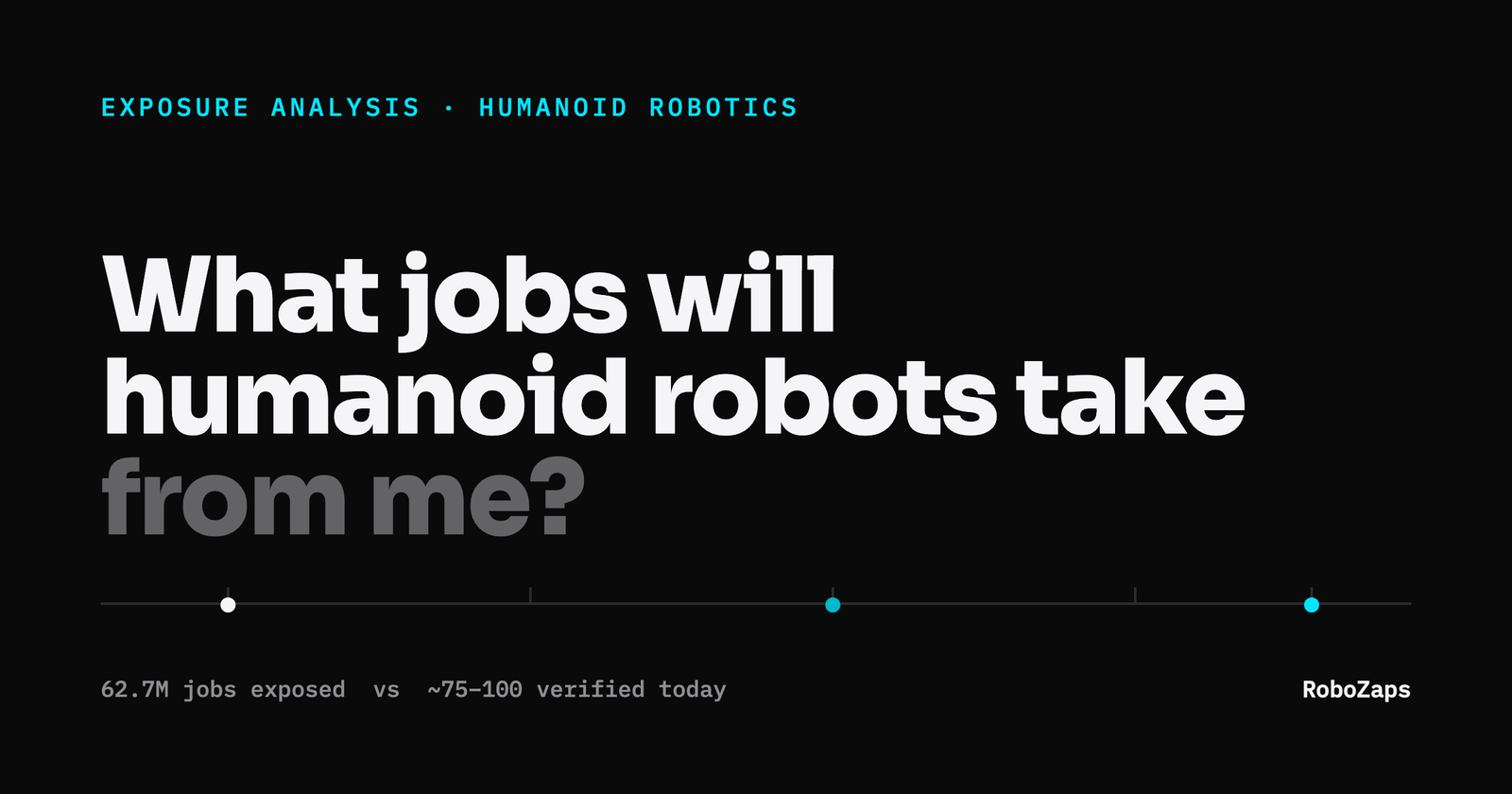
Two numbers frame an honest answer. Morgan Stanley’s model counts 62.7 million US jobs with some exposure to a humanoid robot. In mid-2026 the most commercially deployed humanoid in the Western world, Agility Robotics’ Digit, has an installed base estimated at roughly 75 to 100 units. Agility doesn’t publish an exact figure.
Both numbers are real. The distance between them is the story, and it is measured in years, not months.
Today and the forecast, on one axis
A linear scale can’t hold both ends of this subject. Placed side by side, today’s verified fleet would occupy less than one eight-hundred-thousandth of the bar. Here is the same range on a logarithmic axis, where every step to the right is a tenfold increase.
Verified deployment → modelled forecastEach gridline = 10×
Find your occupation
Morgan Stanley scored all 831 US civilian occupations for “humanoidability”: how much of the work is physical, repetitive, dangerous, or hard to staff. The scores roll up into the 22 standard occupation groups below. Bar length is the total workforce in a group; the filled portion is the share the model treats as substitutable. Select any row.
Tier 1 — modelled adoption from 2028Tier 2 — from 2036Tier 3 — from 2040Not substitutable
The order of arrival
The model doesn’t run everything at once. Physical, low-credential work is substituted first and takes about a decade to build momentum. Office and professional work isn’t touched until the 2040s.
Tier 1Tier 2Tier 3
The number that actually decides it
No job is automated because a robot can do it. It’s automated when the payback period clears a finance committee. That calculation is the real timer on every occupation above, and it rewards high wages, long shifts, and structured tasks. Move the inputs to see where your own workplace lands.
Cumulative human costCumulative robot cost
The model assumes 300 operating days a year, maintenance at 12% of purchase price annually, integration at 20% of purchase price, and a robot operating cost near $2 an hour (Roland Berger, April 2026). It’s the shape of the curve that matters, not the decimal.
The forecasters do not agree
Anyone quoting a single number for 2035 is quoting one bank. Published estimates for that year span more than an order of magnitude, because they count different things: units shipped in a year, units in service, or the total addressable market.
What is verified right now
Against those projections, this is the counted, company-reported state of play in mid-2026.
| Figure | What it is |
|---|---|
| ~75–100 | Estimated global installed base of Agility’s Digit, the most commercially deployed Western humanoid. Agility doesn’t disclose an exact count. |
| 65,000+ hrs | Operating hours Digit has logged across nine customer facilities, including GXO, Schaeffler and Toyota Canada. |
| up to ~40 | Figure 03 units reported at BMW Spartanburg in 2026. BMW and Figure haven’t confirmed a count; estimates run 10 to 40, following an 11-month Figure 02 pilot retired at the end of 2025. |
| 5,500 | Humanoid units Unitree shipped in 2025, an estimated more than every Western maker combined, at up to a tenth of the price of Western industrial humanoids. |
| 78% | Task-completion rate for AgiBot’s GO-1 after training on a million trajectories. Unsupervised industrial work generally needs 95% or more. |
| 1–4 hrs | Battery life under active use. A full unsupervised shift is not yet a solved problem. |
| Zero | Layoffs publicly attributed to humanoid robots as of mid-2026. Current deployments fill vacancies and offset turnover. |
| None | Published Optimus production count from Tesla. Widely circulated unit figures don’t originate with the companies they describe. |
Sources and method
Occupation scoring, tiering, the adoption curve and the payback analysis come from Morgan Stanley, Humanoids: Investment Implications of Embodied AI (June 2024), with the 2035 and 2050 fleet figures from its A $5 Trillion Global Market note (April 2025). The 2035 spread also draws on Goldman Sachs (about $38bn TAM and 1.4m shipments by 2035) and Bank of America Global Research (about 10m units shipping annually by 2035).
Deployment counts are company disclosures from Agility Robotics, Figure AI, Unitree and BMW, mid-2026, with a Technology.org deployment review from July 2026. The $2-an-hour operating cost is Roland Berger’s Humanoid Robots 2026 (April 2026); payback ranges are from IDTechEx’s Humanoid Robots 2026–2036 (May 2026). Task-level framing follows the ILO exposure index and the World Economic Forum’s Future of Jobs 2025. Exposure percentages are modelled estimates of technical substitutability, not forecasts of unemployment.