Why Bittensor’s latest upgrades could push TAO crypto above $220
Bittensor [TAO] is approaching a decisive moment as weeks of selling pressure begin to lose momentum. Since peaking near $292.2 in late June, the token has steadily retreated. However, each successive decline has become less aggressive.
That slowdown has formed a falling wedge, a pattern that often reflects weakening bearish conviction rather than fresh selling pressure. Consequently, at press time, TAO traded around $198.3, as it nears the pattern’s apex near the critical $182.5 support.
Buyers have defended that level several times since January, making it the foundation of the current structure. Meanwhile, the failure to reclaim $244.7 has kept the overall trend biased towards the sellers, as that previous support has turned into solid resistance.
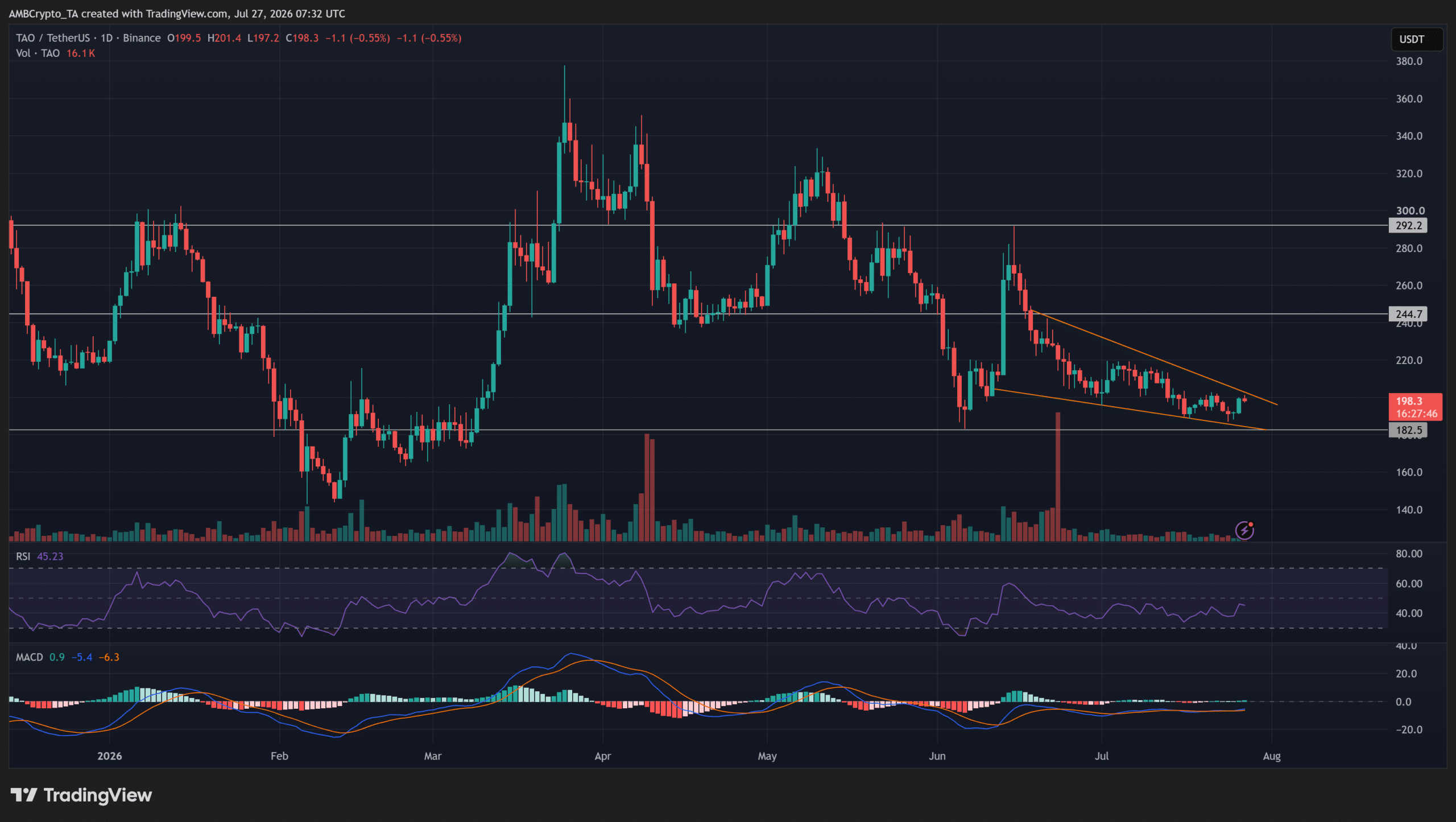
Additionally, momentum indicators show the bearish trend is waning. At the time of writing, the RSI has rebounded to 45.23 but still hasn’t reached the price’s recent lows. This shift indicates a reduction in selling momentum below the surface.
Notably, the MACD reinforces this view. While both lines of the MACD continued to converge on the zero line, the histogram has made a slight positive turn. Despite that, volume remains very light compared to what was seen during the sharp sell-off that occurred in mid-July.
That lack of follow-through suggests sellers are no longer entering with the same conviction. Therefore, a breakout above the wedge and a reclaim of $244.7 would likely confirm a bullish reversal and expose $292.2.
Yet, losing $182.5 would invalidate the setup and shift momentum back toward the February low near $150.
Do the latest upgrades support TAO’s recovery?
While the technical setup suggests selling pressure is fading, Bittensor’s latest upgrades strengthen the network’s long-term foundation. Previously, subnet owners could secure their position with a one-time commitment, making it harder for new participants to compete.
The new conviction mechanism changes that by rewarding users who keep their TAO locked over longer periods. It also allows committed challengers to replace inactive subnet owners after a year.
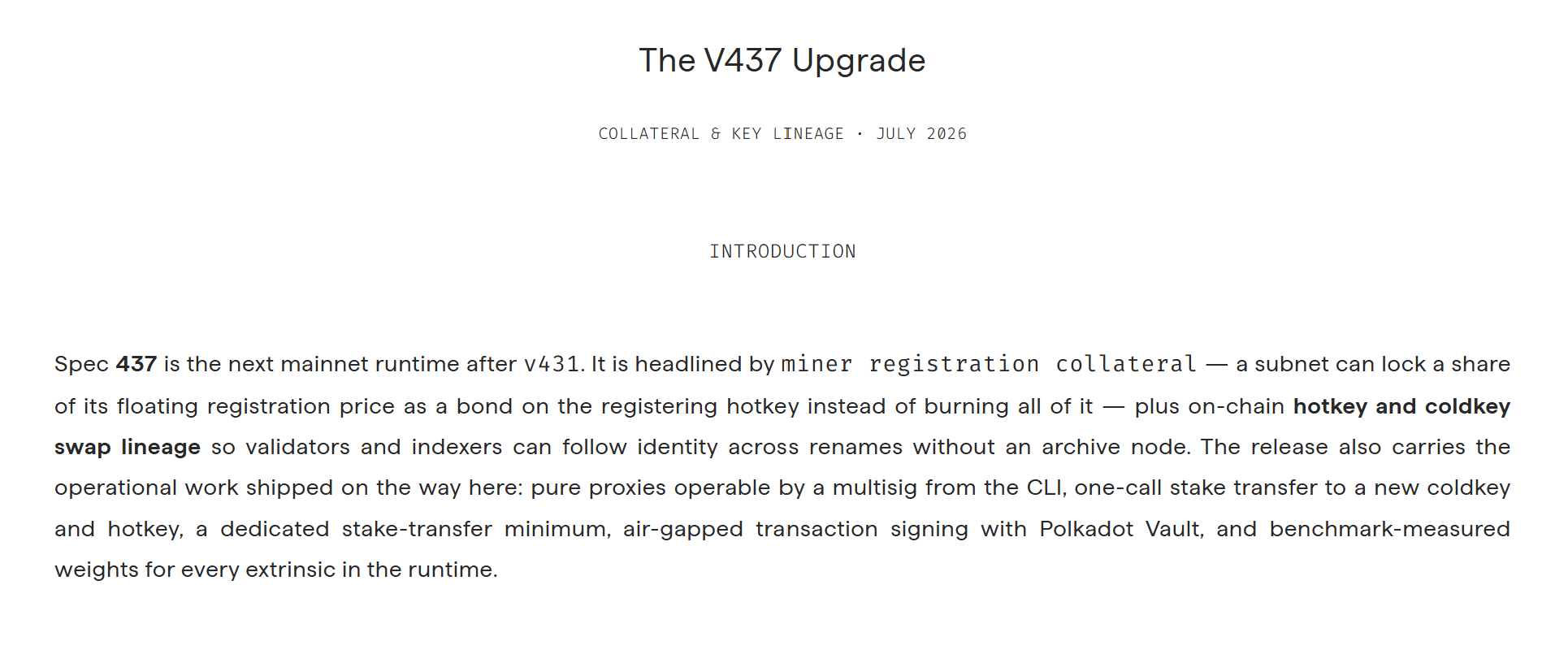
As a result, operators must continue contributing instead of relying on an early advantage. Meanwhile, Spec 437 reduces miners’ upfront costs by locking part of the registration fee instead of burning it completely.
Miners can recover those locked tokens only by remaining active and earning rewards. This approach encourages continuous participation but deters spam and short-term speculation.
All in all, if these upgrades increase demand, it could be enough to provide the demand needed to break above the resistance zone of $205-$220.