Why Don’t Most TVs Have Center Stands Anymore?
We may receive a commission on purchases made from links.
When shopping for a new television, the primary focus is usually on the display technology (OLED, LCD, QLED), resolution, high-dynamic range (HDR) quality, and sports or gaming support. Some of these things are even features you shouldn’t buy a smart TV without. However, one aspect of a new TV you might not have considered is its feet. Flat screens used to have beefy stands that sprouted from the center of the unit, and spread out to a wide base, offering ample stability. These days, you may have noticed that instead of a robust center foundation, you get these little feet that prop up the screen from either side.
There are several reasons for the change from a center base to the wide-set, smaller feet. For one thing, more people have been gravitating toward wall-mounting their TVs rather than placing them on furniture. In addition, modern TVs have become significantly lighter and thinner, perhaps not requiring the same level of support as earlier models.
However, while no manufacturers have confirmed it, some suspect cost-cutting measures are behind the change. Users across various forums speculate that making a solid center stand would cost more than producing a set of thin legs that attach at the ends. Without actual proof, it’s hard to say whether this is true or not.
Why does the change in TV stand even matter?
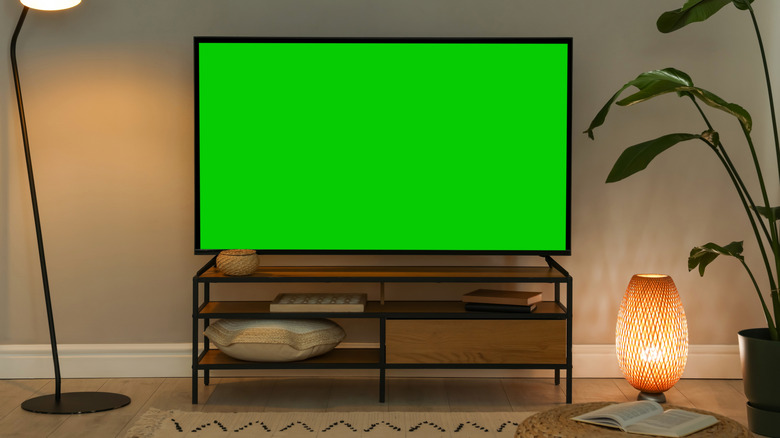
The change in TV stands is more meaningful than it might seem, simply because the average size of a television has steadily increased in recent years. When new units came with a center base, it was easy to place them on a variety of different-sized surfaces, but that is no longer the case. As center stands become a rarity, it’s more important than ever to ensure your furniture offers enough surface area. Those legs (which sit towards the outer edges of the unit) may exceed the width of your furniture, or just barely fit. That creates a risk of tipping over.
According to a U.S. Consumer Products Safety Commission (CPSC) report from 2019, an estimated 5,500 people were treated in emergency rooms each year between 2016 and 2018 for injuries caused by televisions tipping over, and TVs were involved in 348 of the 556 tip-over deaths reported to the agency between 2000 and 2018. The consequences remain serious when accidents do happen, particularly with children, who accounted for 83% of tip-over deaths reported to the agency, although that includes deaths caused by more than just TVs.
The CPSC advocates the use of anti-tip-over kits, which can help reduce the number of incidents. However, those with entertainment setups that place TV support legs precariously close to the edge of furniture may be in trouble.
You still have a few options for freestanding TV setups
For those who aren’t interested in wall mounting and don’t want to shell out for a wider console, there are aftermarket center stands available. One example of this is the Perlegear Universal Swivel TV Stand Base, which normally retails for $49.99 on Amazon (but can be found on sale for as little as $39.99). This stand can support units as large as 70 inches, weighing up to 88 pounds. It uses the built-in wall mounting holes (VESA patterns) on the back of the TV, which lets you secure a pedestal stand and ditch the small angled outer feet.
While not as common, some TVs still come equipped with a center stand, but they’re often not cheap. Sony’s 48-inch Bravia XR OLED features a center stand and OLED display technology, but it sells for $1,398 at the time of writing — a huge contrast from some of the best OLED TVs under $1,000.
Some manufacturers, such as Hisense, include additional leg attachment points closer to the center of the TV. This isn’t available on every model, however, so you’ll need to verify with the retailer or manufacturer before purchase. If you’re after a bigger picture and in the market for new furniture, here’s how to determine what size console you need to properly fit a larger display.