Why Some US Military Stealth Fighter Jets Don’t Have Internal Guns
Since aviation warfare began, people have strapped guns of various types onto planes, jets, and drones. Back during World War I and throughout most of WWII, the best way for one fighter or bomber to take out an enemy aircraft was to lead it with a burst of machine gun fire, strafing it as much as possible to take it out of the fight. Legendary aces like Manfred von Richthofen, better known as the “Red Baron,” achieved great success in aerial warfare using machine guns.
Long after the introduction of air-to-air missiles, military aircraft still feature guns. Granted, they’ve evolved considerably into multi-barrel options that fire thousands of rounds a minute, but for the most part, they’re not a significant aspect of modern combat. Modern fighters and attack aircraft typically use their guns only when they get close, but the goal is to achieve a strike from as great a distance as possible. That’s where weapon systems like the 70-year-old+ AIM-9 Sidewinder missile come into play, as they can strike a target from miles away, often beyond line of sight.
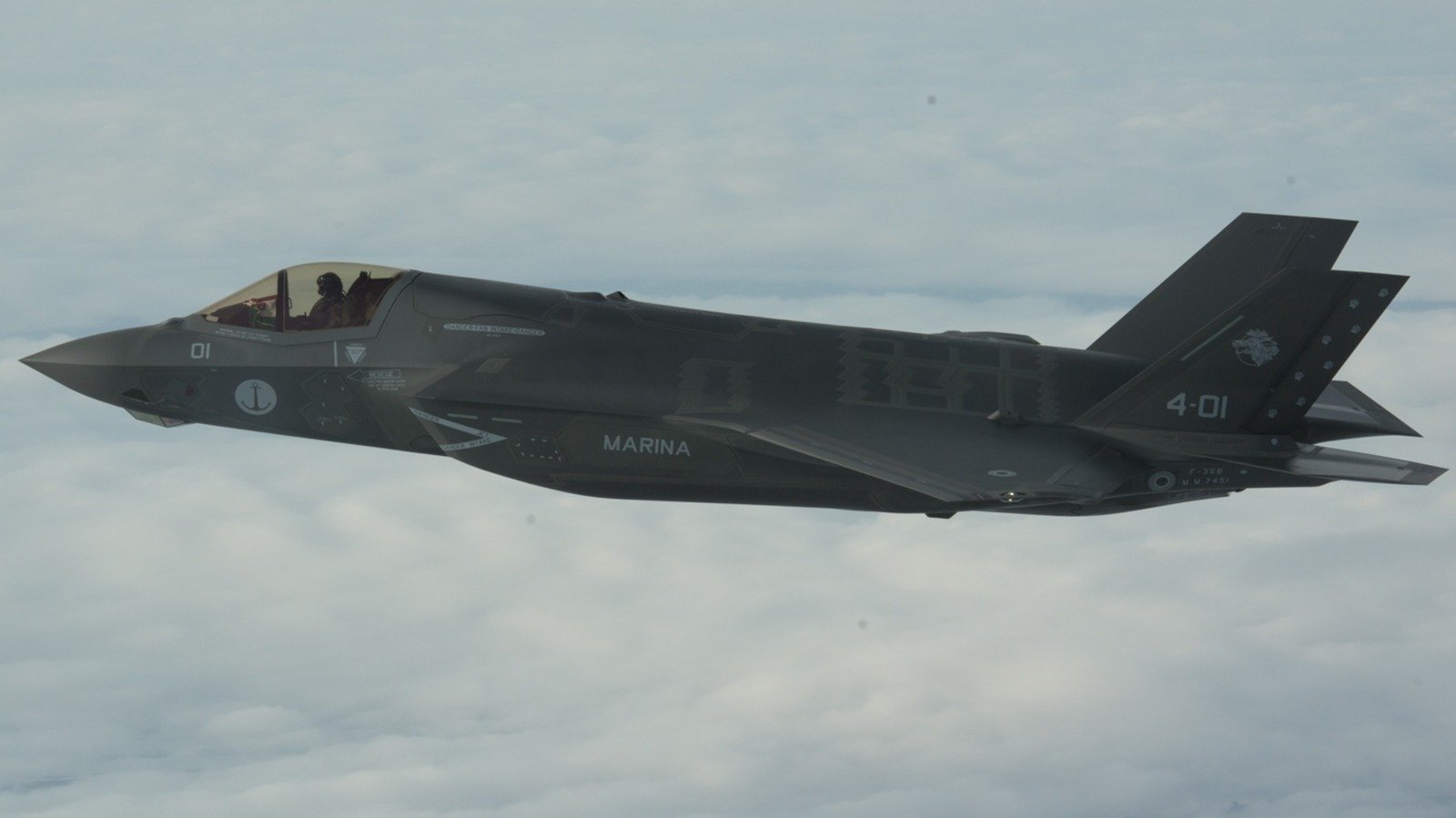
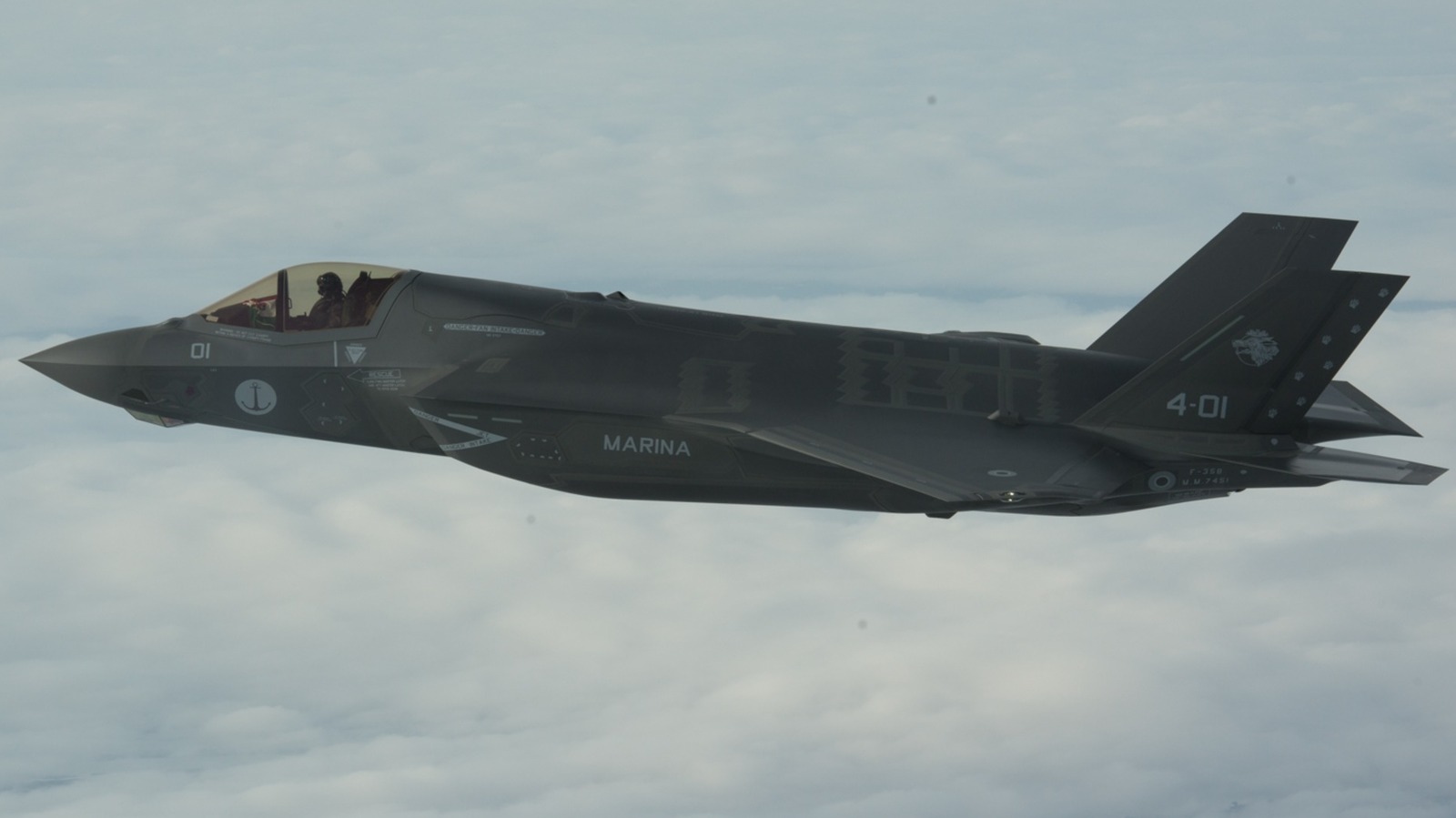
Regardless, most modern fighters have internal guns ready to go when they take off. Not all of them do, however, due to reduced internal capacity to install guns. This is true for only two operational models, the F-35B and the F-35C, both of which are different from the F-35A in that they’re Short Take-Off and Vertical Landing (STOVL) capable. The Bravo model is used by the U.S. Marine Corps and U.S. allies, while the Charlie jet is operated by the U.S. Navy and allies. Because they don’t have internal guns, it’s not uncommon for either model to fly missions without them.
STOVL limits the F-35B/C from carrying internal guns
The F-35A, operated by the U.S. Air Force and allies, has internal guns, while its variants don’t. The reason is STOVL. In order to direct thrust downward to achieve hovering and short takeoff and landing, the F-35B/C’s internal compartments had to be significantly adjusted. There’s simply no room to accommodate an internal gun system without sacrificing fuel capacity, stealth capabilities, and sensors. While there’s no internal gun, there is an option to install one along the bottom centerline of the fuselage, as seen in the picture above.
That pod between the two rear landing gear is known as the Gun Pod Unit (GPU) – 9/A. Inside that pod rests a 25 mm GAU-22/A four-barrel Gatling gun, which has only 220 rounds of ammunition before it’s spent. Modern fighter jets don’t eject shell casings, so the F-35B/C carries them home once its mission is complete. The GPU’s design is purposefully built to maintain the aircraft’s stealth, so it doesn’t cancel out the jet’s other stealth elements, putting it and the pilot at risk.
Because it’s an external pod, the GPU-9/A can be removed if the mission doesn’t call for it, which isn’t uncommon. The last time a fighter took down another with its guns was a long time ago. Back in 1992, during an attempted coup d’état in Venezuela, a Venezuelan Air Force F-16A shot down a rebel-controlled OV-10 Bronco and a T-27 Tucano, but it didn’t use missiles. Instead, it successfully shot down the enemy aircraft using its installed 20 mm M61 Vulcan cannon.



![[Laptop] Acer Predator Helios Neo 16S 16" OLED – Ultra 9 275HX – 16GB DDR5 – 1TB – RTX 5060 Win11 AI PC Refurb $1209](https://jobssz.com/wp-content/uploads/2026/07/1WoQPQEHx97AzMwgvoaV4qs1mZLYDyIfeVbSJRAX_hs.jpeg)