Wicker Trailer: Weta Workshop Built What Robotics Researchers Are Still Designing
Black Bear Pictures released the first official trailer for Wicker this morning, and within half an hour it had generated more than 500 searches on Google Trends. Most of the coverage has focused, understandably, on Alexander Skarsgård’s quote about “nipples made out of wicker.” TechTimes readers deserve the engineering story.
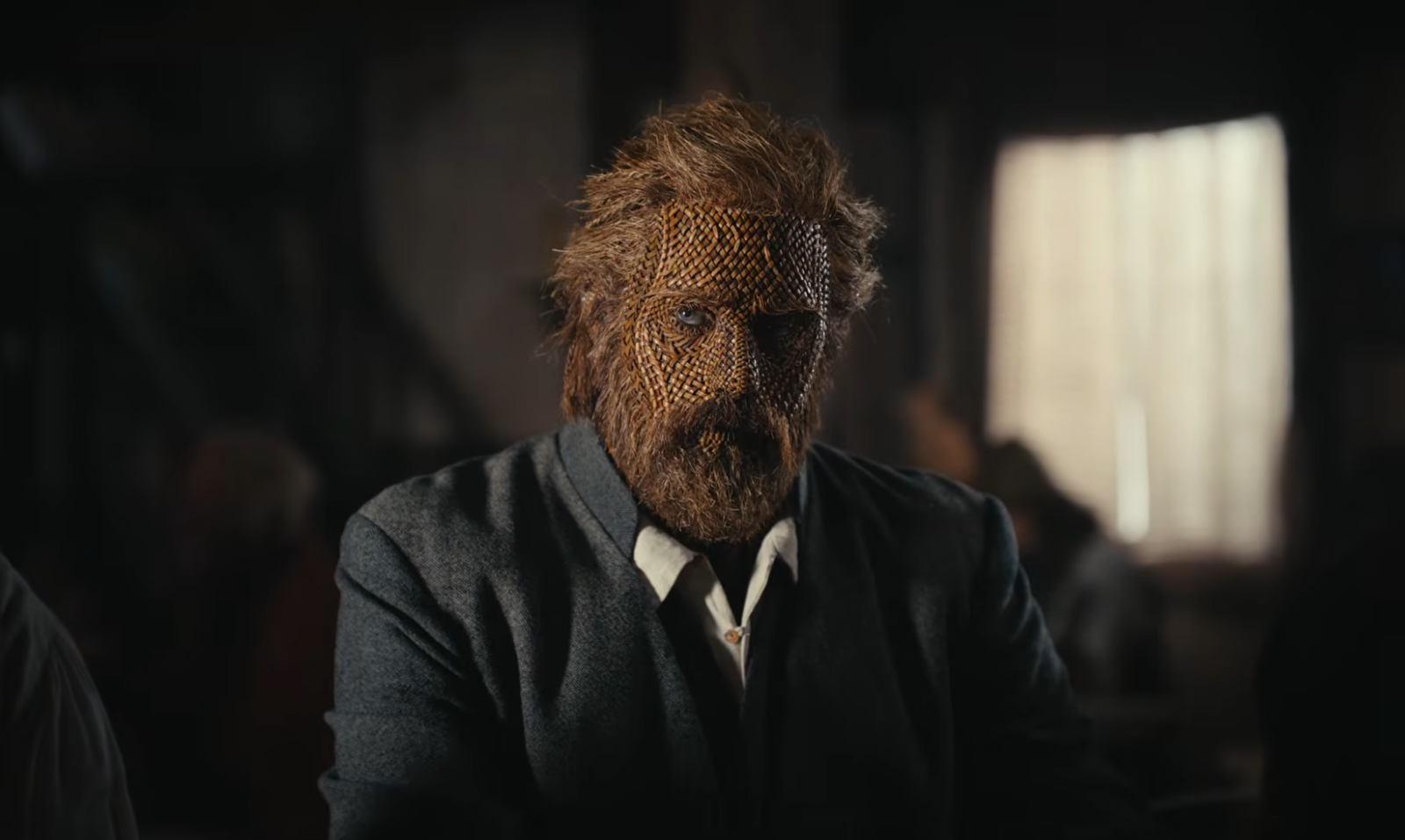
The suit Skarsgård wears in Wicker — a full-body wicker structure covering his entire frame, including custom facial prosthetics designed around his personal brow geometry — was built entirely without CGI by Wētā Workshop in Wellington, New Zealand. It had to satisfy a set of contradictory demands: rigid enough to look structural and non-biological; flexible enough at joints to allow a full range of athletic and intimate performance; lightweight enough for full shoot days; and durable enough to survive the physical demands of the role. Fifty people built it.
Those contradictions — stiff for load-bearing, resilient and mobile at articulation points — are precisely the engineering problem that a peer-reviewed study in Physical Review Research identified in August 2025 as the unsolved design challenge for the next generation of woven exoskeletons.
Baskets Have Been Solving This Problem for Thousands of Years
Guowei (Wayne) Tu, a doctoral student in civil and environmental engineering at the University of Michigan, published a study with his adviser Evgueni Filipov in August 2025 showing that ancient basket-weave geometry is mechanically optimal — providing both the stiffness needed for load-bearing and the resilience needed for repeated use.
The finding runs counter to the intuitive assumption that woven structures are inherently flexible. In reality, the researchers found, woven structures are 70% as stiff as continuous solid-sheet counterparts — but substantially outperform solid sheets when it comes to surviving large compressions.
The test was direct. A rectangular box standing 17 centimeters tall (6.7 inches) was crushed down to under 3.4 centimeters (1.3 inches) — less than 20% of its original height — and recovered its original shape without permanent damage. The equivalent solid-sheet structure was permanently deformed.
The key mechanism is stress redistribution. When compressive force is applied to a continuous solid sheet, stress concentrates at a single point until the material buckles irreversibly. In a woven structure, the interlocking ribbons transfer that stress across the entire lattice, preventing permanent damage at any single location. High-resolution 3D scans confirmed this behavior. A woven robot prototype with four legs — the research team called it a “dog” — held 25 times its own weight and resumed normal walking function after being crushed flat. A woven arm prototype held 80 times its own weight vertically while freely flexing at the joint, just as a human arm would.
The critical structural element is the 3D corner where woven planes meet — the spot where a basket’s walls come together at an edge. Different corner topologies (three-plane, four-plane, five-plane, and six-plane junctions) were all tested. All outperformed continuous structures on resilience.
Tu said: “While modern metamaterials are often designed for electromagnetic, optical or acoustic properties, people have been making mechanical metamaterials through weaving and other structural approaches for millennia.”
The study was funded by the U.S. Air Force Office of Scientific Research.
Weta Solved the Exoskeleton Co-Design Problem Without a Robotics Lab
At the end of their study, Filipov and Tu proposed a concept for what their research could produce: a woven exoskeleton that adapts its stiffness zone-by-zone across the human body, rigid over impact-vulnerable bones and flexible across joints.
Filipov said: “I’m very excited about harnessing the benefits of ancient basket weaving for modern 21st-century engineering applications. For instance, lightweight woven materials for robotics would also help humans stay safer in case of human-robot collisions.”
Wētā Workshop, working from the specific geometry of Skarsgård’s body, built exactly this — empirically and without synthetic composites. The designers led by Joe Dunckley and Sarah Rubano incorporated Skarsgård’s personal facial musculature into the prosthetic design so that his own expressions deform the wicker surface in a readable way. Directors Alex Huston Fischer and Eleanor Wilson describe clearing the set for a private ten-minute test when Skarsgård first wore the full costume.
This is the engineering principle that wearable-robotics researchers call co-design: deriving the structure’s geometry from the specific performer’s kinematic envelope, rather than fitting a pre-engineered structure onto a human body afterward. It is the difference between a tool and a prosthetic. Wētā didn’t have access to the 2025 Physical Review Research study — they arrived at the same solution through craft knowledge, which is the point. The geometry is correct because it has been correct for 7,500 years.
Natural rattan-like fiber, the material Wētā used, has anisotropic stiffness — it resists loads strongly along the fiber grain and flexes more readily across it. An expert weaver instinctively orients fibers to exploit this directionality: maximum-stiffness axes placed over load-bearing bones, maximum-flexibility axes placed across joint lines. This is the same principle that the Michigan team demonstrated mathematically, and it is why Skarsgård’s suit could pass as rigid while allowing the full range of motion required for performance — including, per the trailer, enthusiastic bed-breaking.
What Is Wicker?
Wicker is a 2026 romantic fantasy film directed by Alex Huston Fischer and Eleanor Wilson, adapted from Ursula Wills-Jones’ 2008 short story “The Wicker Husband.” Olivia Colman plays a fisherwoman on the margins of a seaside village who is perpetually ridiculed for being unmarried. She commissions the local basket-maker (Peter Dinklage) to weave her a husband. The result — the Wicker Husband, played by Skarsgård — proves devoted, capable, and unexpectedly extraordinary, triggering a wave of jealousy and upheaval throughout the village. Elizabeth Debicki and Richard E. Grant co-star.
The film premiered to a standing ovation at the 2026 Sundance Film Festival at the Eccles Theater in Park City, Utah, on January 24, 2026. It currently holds a 91% fresh rating from Sundance critics on Rotten Tomatoes and a score of 70 on Metacritic. Cinematography is by Academy Award winner Lol Crawley (The Brutalist); production design by Renátó Cseh (Poor Things); score by Anna Meredith (Eighth Grade).
Principal photography was completed by September 2025 in Budapest, Hungary. Black Bear Pictures acquired North American distribution rights in February 2026 at the European Film Market.
Where Is the Science Pointing Next?
For Filipov and Tu, the basket-weave study is a foundation. Their proposed next step is to integrate active electronic materials into woven structures — creating “smart” woven systems that can sense external conditions and change their stiffness in response, opening applications from soft robotics to adaptive architectural components.
For Wicker, the production already demonstrated that the empirical knowledge of master weavers contains structural insights that modern materials science is only beginning to quantify. Skarsgård called it the fulfillment of a lifelong dream. Filipov would call it 7,500 years of field testing.
Wicker opens in select theaters on October 23, 2026, with a nationwide expansion on October 30.
Frequently Asked Questions
Is Alexander Skarsgård’s wicker costume in Wicker CGI or practical effects?
The entire costume — full-body woven rattan-like material and custom facial prosthetics — was built practically by Wētā Workshop in Wellington, New Zealand. No computer-generated imagery was used. The suit was designed by Joe Dunckley and Sarah Rubano and required a team of approximately 50 people to build. The directors specifically incorporated Skarsgård’s own facial geometry into the prosthetic so his expressions visibly deform the wicker surface during performance.
What is the real science behind the woven exoskeleton idea from the Wicker trailer?
A 2025 study in Physical Review Research by engineers at the University of Michigan found that woven basket-corner geometry creates a class of mechanical metamaterial that is roughly 70% as stiff as a continuous solid sheet — but substantially more resilient. Woven structures recover from severe compressions that permanently deform solid-sheet counterparts, because the weave redistributes stress across the entire lattice rather than concentrating it at a single failure point. The researchers explicitly proposed a woven exoskeleton as an application: one that adapts stiffness zone-by-zone across the human body, rigid over bones, compliant at joints. Wētā Workshop’s Wicker suit solves exactly that engineering problem, in a wearable, performer-ready form.
When does Wicker come out in theaters?
Wicker opens in select theaters on October 23, 2026, with a nationwide expansion on October 30, 2026. UK and Irish cinemas also open October 30. The film is distributed in North America by Black Bear Pictures.
What is Wicker based on, and who is in the cast?
Wicker adapts “The Wicker Husband,” a 2008 short story by British author Ursula Wills-Jones. The film stars Olivia Colman as the Fisherwoman, Alexander Skarsgård as the Wicker Husband, Peter Dinklage as the Basket Weaver, and Elizabeth Debicki as the Tailor’s Wife. Richard E. Grant co-stars as the village doctor. The film is directed by Alex Huston Fischer and Eleanor Wilson, whose debut feature was the 2020 sci-fi comedy Save Yourselves!