Writing for Robots: Mapping Community for AI Agents
Note: This is Part Three in our series explaining how publishers need to adapt to a World Wide Web in which AI-powered “agents” outnumber us humans, and how California Local is preparing for this new era in digital publishing. To recap: Bots are software apps that roam the web. Agents are AI-powered bots that have been conferred a degree of agency and empowered to autonomously interact with websites in order to execute their missions.
Agents and People Read Differently
Much written content on the web is presented for human consumption as an article. Articles are generally composed of a title, a subhead or description, and the main content. They also usually include “tags” or categories that provide an at-a-glance understanding of what the article is about. Content produced for agent consumption is best presented as structured data that lays out the essentials: who, what, where, why and how, in stripped down, machine-readable format.
Further, the structured data needs to conform to a taxonomy—a set of rules that categorize and organize information to make it easily searchable and retrievable.
As a community information hub, California Local aggregates and accumulates news and information about local governments, nonprofits and other players. To successfully provide that information in machine-readable format, we’re developing a model and taxonomy that explains “community” to agents.
What is Community?
We define community as:
- People connected by geographic proximity
- People connected by demographic proximity
- People connected by temporal proximity
- People connected by shared interests
Four first-order attributes in this community model are location, jurisdiction, identification and time.
Our geographic area for this community model is scoped to the county level.
In a county, the local organized entities that influence and impact the members of the community are:
- Governments
- Community benefit groups (such as nonprofits)
- Institutions
- Businesses
Our taxonomy thus describes the different communities in a county as well as the entities with which they interact, and takes the form of data models and categories.
A data model is a list of attributes that stores values describing a specific instance of something, like a government.
In the case of a government-entity data model, the attributes would include the government name, website url, meeting calendar url, government type, jurisdiction area, and so on.
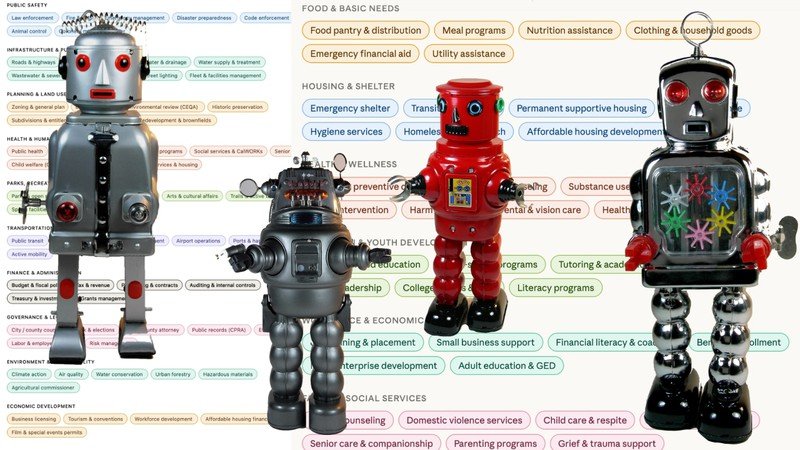
There are a large but finite number of categories that describe government operations and services. This long list is actually a significantly truncated version of ours:

Our overall taxonomy thus includes the data model and categories describing the various elements of “community.” These are applied to any content referencing a specific community or entity in our database.
So: When an agent connects to our community information hub, the taxonomy is made available as a reference. This describes the nature of the content to the agent and tells it how it’s stored in our database. The agent is able to then make a focused query for data. For instance, “what were the total number of housing units contemplated in planning commission meetings over the last year in this multi-county region?” Or a sitewide query such as “How many new state, county or municipal parks opened this year?”
Ultimately, we are doing this to save you time and money. As more and more local governments, nonprofits and other civic institutions embrace the agentic web, more and more citizens will deploy agents to find information. It’s expensive and time consuming for an AI-powered agent to read all the planning commission agendas in a multi-county area across a variety of government web servers to figure out how many units of housing are in the pipeline. Ditto reading all the local news outlets and government press releases to get a sense of how many new parks opened.
It’s cheap and efficient when that content is processed and stored side by side with the associated structured data conforming to a defined taxonomy that presents the information in a form more amenable to agent interrogation.
Publishers who have not already done so need to define their taxonomy for their future nonhuman visitors. Those in possession of aggregated and accumulated content can add significant value by developing data models and a taxonomy in-house to be applied retroactively to their archives.
Get Ready for the Robots
The rate of technological advances and user adoption of AI and now autonomous agents surpass almost any other technology in our lifetimes. Consumer-grade AI and agents will soon be moving from their current home in the cloud to be installed on your phone and computer like any other app.
Publishers need to be ready for robots in their workflow and in their readership, lest they be left behind like, well, yesterday’s newspaper.