Your reference image is doing more damage to your I2V output than your prompt
 |
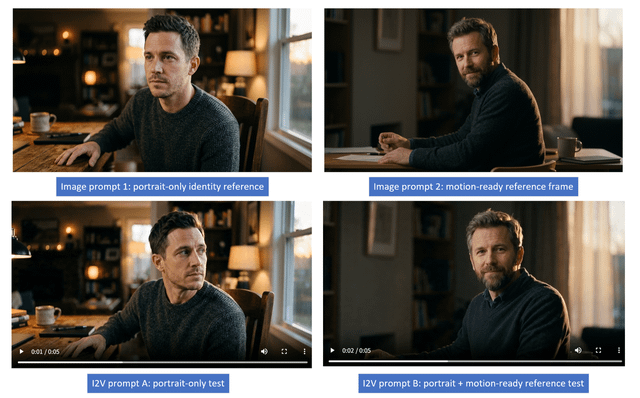
I always figured image-to-video was just objectively better than text-to-video for consistency. You give it a ref image, the model anchors to it, done. But running the exact same shot intent through both paths, the gap is weird and not where I thought it'd be. The shot was a slow push-in on a guy at a desk in evening light, turning toward the camera. wrote it as a structured prompt for t2v, then generated a ref image with the exact same framing and threw it into i2v. T2V actually gave more freedom for motion but the character drifted. Face changed between frames, desk warped a bit. I2V locked the subject down way harder (face stayed, desk stayed) but the motion was super stiff. The model fought the camera move because the ref image didnt imply any motion direction. That last part caught me off guard. A pretty ref image is NOT the same as a good motion ref. A portrait can still be useful for keeping the character consistent, but it is weak if you ask it to also define body motion, camera movement, and framing all by itself. What actually made the difference in my tests: subject boundary – clean silhouette, no clutter bleeding into the figure. messy edges smear during motion. implied motion – a mid-turn pose reads way better than a static front-facing portrait. the image should already hint at where the movement goes. background weight – if the bg competes with the subject visually, the model drags it along when the camera moves. framing room – tight crops leave no space to move into. you need negative space in the direction of motion. The mid-action pose and clean bg shots were usable. The tight portrait was not useless, but it worked better as an identity anchor than as the only I2V starting image. My fix rn is batch-generating two kinds of refs first: one clean portrait for identity consistency, and one motion-ready frame for pose, framing room, and direction. If the model supports multiple references, I use both. If it only takes one image, I use the portrait to help generate the motion-ready frame, then send that winner into the video model. I run it all through Atlas Cloud so I can call the image model and a few i2v models (Seedance, Kling, Veo) from one endpoint without swapping keys or SDKs between steps. Keeping the test loop in one place makes it easier to tell if a bad output came from the ref image, the prompt, or the video model itself. Still trying to figure out what matters most when the ref image and the motion intent pull in opposite directions. Right now motion implication wins over subject fidelity, but i dont trust that rule past the handful of shots I've tested. submitted by /u/Comi9689 |