10 Castlevania: Symphony of the Night Moments That Prove Why Alucard Is Still One of Gaming’s Coolest Heroes
Of the long list of classic games that have stood the test of time, Castlevania: Symphony of the Night is, by far, one of the most exciting and memorable thanks to its robust gameplay.
Whatever you analyze, the work directed by Tōru Hagihara and a young Kōji Igarashi is superb on all fronts, which allowed it to both spawn an entire genre alongside Metroid and not age a bit after 30 years.
The gameplay, the characters, the customization, the music, the level design, the bosses… There are numerous reasons to justify its exceptional quality, among which we must undeniably include its protagonist, Alucard.
As one of the most recognizable faces in the interactive industry, he plays a pivotal role in making this a must-have title, as I’ve compiled in this list of ten Castlevania: Symphony of the Night moments that prove why Alucard is still one of gaming’s coolest heroes.
10
A True Self Chiseled in Stone
What a Grieving Soul Hides

Symphony of the Night‘s narrative component is rather limited, as both the story and characters who bring it to life receive only slight and simple development, though this didn’t stop Konami from slipping in small explanatory details where you least expect them.
Among these, one of my favorites is that the Medusas that turn Alucard to stone have a small chance of transforming him into a giant gargoyle, whose imposing form is accompanied by the ability to take no damage.
While it may simply be a curious easter egg, I’ve always thought of this feature as a reminder of the inner demons Alucard constantly battles to remain true to his promise to his mother, despite it could prove helpful to simply succumb to the power of hate.
If you go through all the tragedies the dhampir endures, anyone would break and surrender to their most abject self, so the fact that you can see Alucard materializing how he contains it makes it all the more remarkable.
The Art of Screaming

Although it’s always been viewed with a sense of embarrassment when protagonists of any adventure, whether interactive or not, shout out the abilities they’re about to unleash, it’s genuinely refreshing to see a character who isn’t ashamed of being unapologetically cool.
If you’re like me and enjoy spamming your spells every other minute, expressions like “Dark Metamorphosis!” or “Soul Steal!” become ingrained in your psyche, almost like Goku’s Kamehameha or Naruto’s Rasengan.
These battle cries become an indelible part of the character’s identity, which is even more noticeable when, in the decades since, practically no fantasy game protagonist is so loud.
Many might think it’s a minor detail, but I dare say they’re profoundly wrong. Announcing your powers isn’t just dope; it’s a demonstration of how powerful your character is—that, even if they know what you’ll do, they’ll be powerless to stop you from destroying them.
8
Fighting Against Fake Allies
No Time for Sentimentality

Alucard is undeniably a Stoic individual, capable of combining serenity with an awareness of his emotions, and possessing the mental fortitude not to succumb to Shaft’s deceptions when he forces him to fight his former allies.
Fake versions of Trevor Belmont, Sypha Belnades, and Grant Danasty appear at Reverse Castle to prevent Alucard from carrying out his mission against his father, though he doesn’t hesitate for a second.
When you first encounter them, it’s surprising there isn’t a single second of dialogue, so common in these kinds of situations, but rather you jump straight into combat, practically motivated by disdain for the tarnished figures of your comrades.
In the grand scheme of things, it may just be a nod to the series’ previous installments, but it’s valid to interpret it as the resolve of an Alucard who won’t let even the dirtiest trick go unpunished.
7
Overpowered Early On
This Is What a Force of Nature Looks Like

When it comes to worldbuilding, Alucard has always been portrayed as an extremely powerful entity, and Symphony of the Night makes sure you understand this within the first few minutes of gameplay.
Even though Death arrives quickly to strip you of your abilities—this is an RPG, after all, so there needs to be a reason to explore and progress—the game cleverly gives you a glimpse of your true potential.
The fact that your first fights within the castle are one-hit kills, despite the size of the beasts you face, demonstrates the qualities of an Alucard who is far superior to everything they throw at him, even if he’s nerfed a couple of minutes later.
The trope of starting a game immortal and then having everything taken away is extremely common, yet it is precisely because works like this popularized it and revealed the brilliant idea behind its execution.
6
Facing Death
Transcending the Limit of Life

Speaking of Death, fighting it ranks among the coolest events in the history of human culture; there’s never a time when it feels boring or clichéd, and that’s certainly not the case in Symphony of the Night.
Considering what it does to you at the game’s beginning, having the chance for revenge many hours later, and being arguably more powerful than when you first met, is incredibly satisfying.
Seeing the antithesis of life pull out all the stops and still pale in comparison to Alucard, especially considering the boss fight isn’t particularly difficult, grants you a feeling of invincible power, more so than simply beating the campaign itself.
Would I appreciate a more demanding encounter? Perhaps, but not everything has to be a challenge, and the fact that it was a walk in the park for Alucard makes it all perfectly consistent with the notion that he’s a tough nut to crack.
5
A Wise Man Full of Great Phrases
Few and Iconic Lines of Dialogue

A video game character can’t just utter a line like “What you must remember is that the only thing necessary for evil to triumph is for good men to do nothing” and expect to be forgotten for eternity, and Alucard is brimming with dozens of these gems.
From his imperturbability in the face of Death to his condescension towards his father, every line he speaks makes you admire him even more, because he is both incredibly powerful and wise.
He can defeat ancient and seemingly immortal entities just as easily as he can win a philosophical argument about human nature in a couple of text boxes; that’s all he needs to impose his vision.
The next time a video game character says something along the lines of “You have been doomed ever since you lost the ability to love“, I’ll applaud just as much as I do with Alucard, but that hasn’t happened yet.
4
Recognizing the Succubus’ Trap
Perspicuity Incarnate

Modern generational characters like Geralt of Rivia, Kratos, and Arthur Morgan have shown their fortitude in the face of the ever-seductive power of desire, but we mustn’t forget that Alucard did it first.
His appearance before the Succubus is among the best moments because of how it reinforces Alucard’s will not to waver in his mission, no matter how many underhanded tactics are used to stop him.
Neither physically nor psychologically is he deterred from his ideals by the fabricated images of his crucified mother, a brutal image that would make any other character tremble on their knees in a similar situation.
There are many demonstrations like this, though Alucard manages to face even the most painful memory of his life with unwavering determination, which is truly admirable.
3
Dashing Backwards
Inside and Out in Style

From The Legend of Zelda: Ocarina of Time to Dark Souls and NieR: Automata, there are countless examples of how there’s no movement mechanic like jumping backwards, except for one: dashing backwards.
The look on your face when you discover your primary dodge button sends you flying in the opposite direction from where you’re facing is priceless, but it perfectly illustrates the absolute unity of combat Alucard truly is.
When you think about it in retrospect, it makes perfect sense that a hunter never takes their eyes off their prey, and in the food chain that is the world of Castlevania, Alucard has no need to turn his back on his enemies because he never retreats.
Unless you’re spamming the ability to move faster around the castle, the character always looks straight ahead, which perfectly matches his relentless determination to achieve his objective at all costs.
2
Design Between Dracula and Vampire Hunter D
Faithful to the Original Materials

Combining the abilities of Bram Stoker’s Dracula with the aesthetic of D, the Vampire Hunter, to create Alucard in Symphony of the Night is one of the most beautifully realized ideas in video game history.
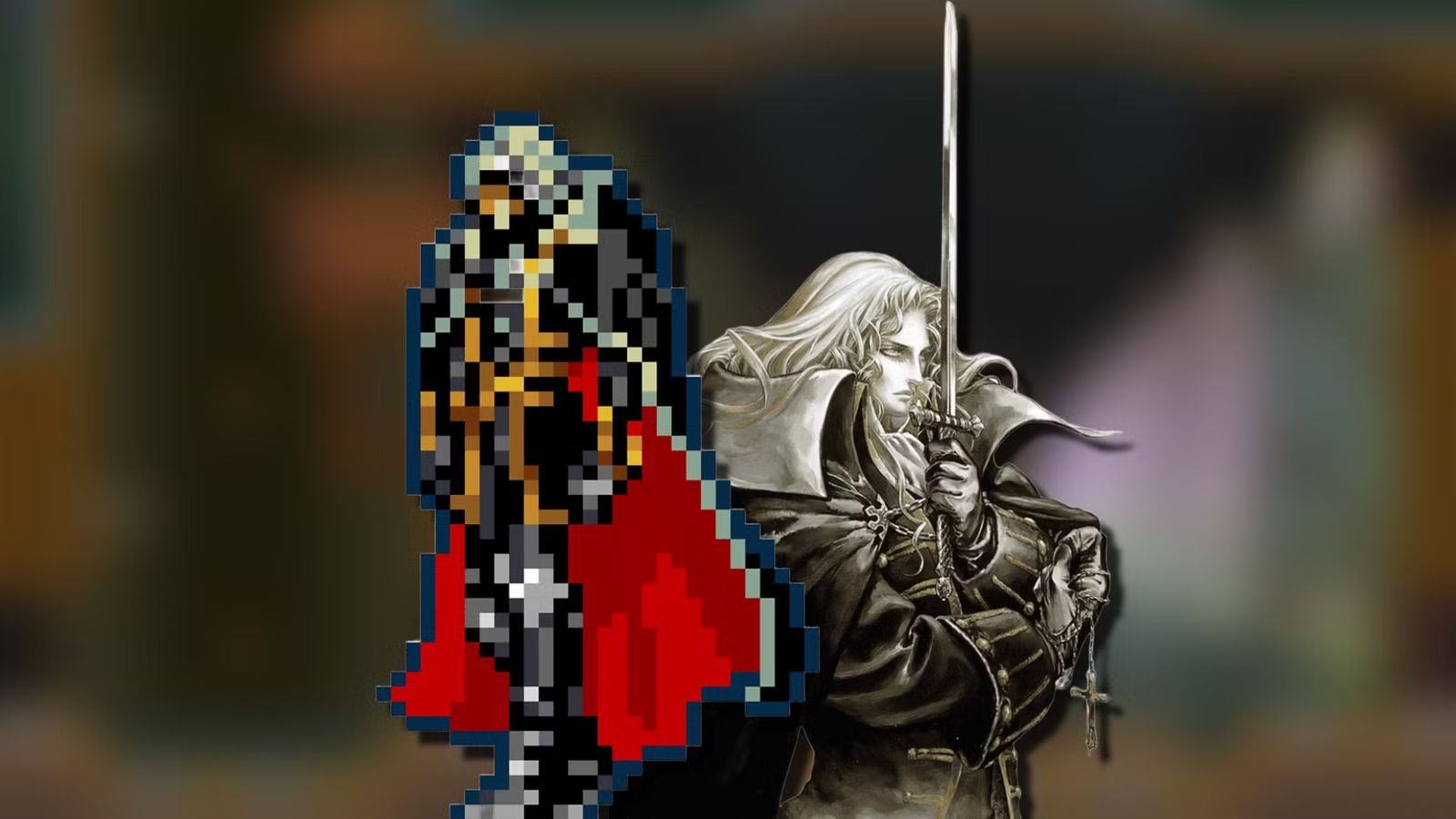
Discussing the game’s protagonist inevitably involves mentioning his divine design, both in pixel art and in official artworks, which remains among the most outstanding and recognizable in our history.
Between being able to transform into a bat, a wolf, or mist, and sporting a pale and elegant skin, divinely contrasted with his gothic attire, it’s easy to be captivated by everything about his aura, as it demonstrates great fidelity to the sources that gave rise to his existence.
The connection runs through the lore, his very name, and the aesthetic shift that defined his debut as a protagonist in relation to his prior appearance, making him a valuable outcome of the added history of vampire mythology.
1
Honoring His Mother’s Last Wishes
A Sorrowful but Resolute Son

When you learn Alucard’s backstory, the mission that brings him to Dracula’s Castle feels like a Via Crucis, as nothing about his campaign feels dignified or heroic; instead, it’s a responsibility born from problems that aren’t his fault but his inheritance.
Bearing the weight of a deceased mother, but also the unwavering motivation to fulfill her last wish, is a profound mark that truly reveals the complexity of Alucard’s character, who isn’t just great because of how he looks and what he does, but why he does it.
Between the difficulties of relating to others due to his nature, struggling with immortality, bearing the stigma of protecting the species that took his loved one, and fighting with a father devoid of conscience, he’s a tragic figure who, nevertheless, remains unshaken by his principles.
Alucard is cool in the most superficial sense of the word, but also in that deeper variation of the definition where it is understood as a synonym for a role model, someone to admire for their values, and that makes him the best of all.



- Released
-
October 2, 1997
- ESRB
-
T For Teen Due To Animated Blood and Gore, Animated Violence