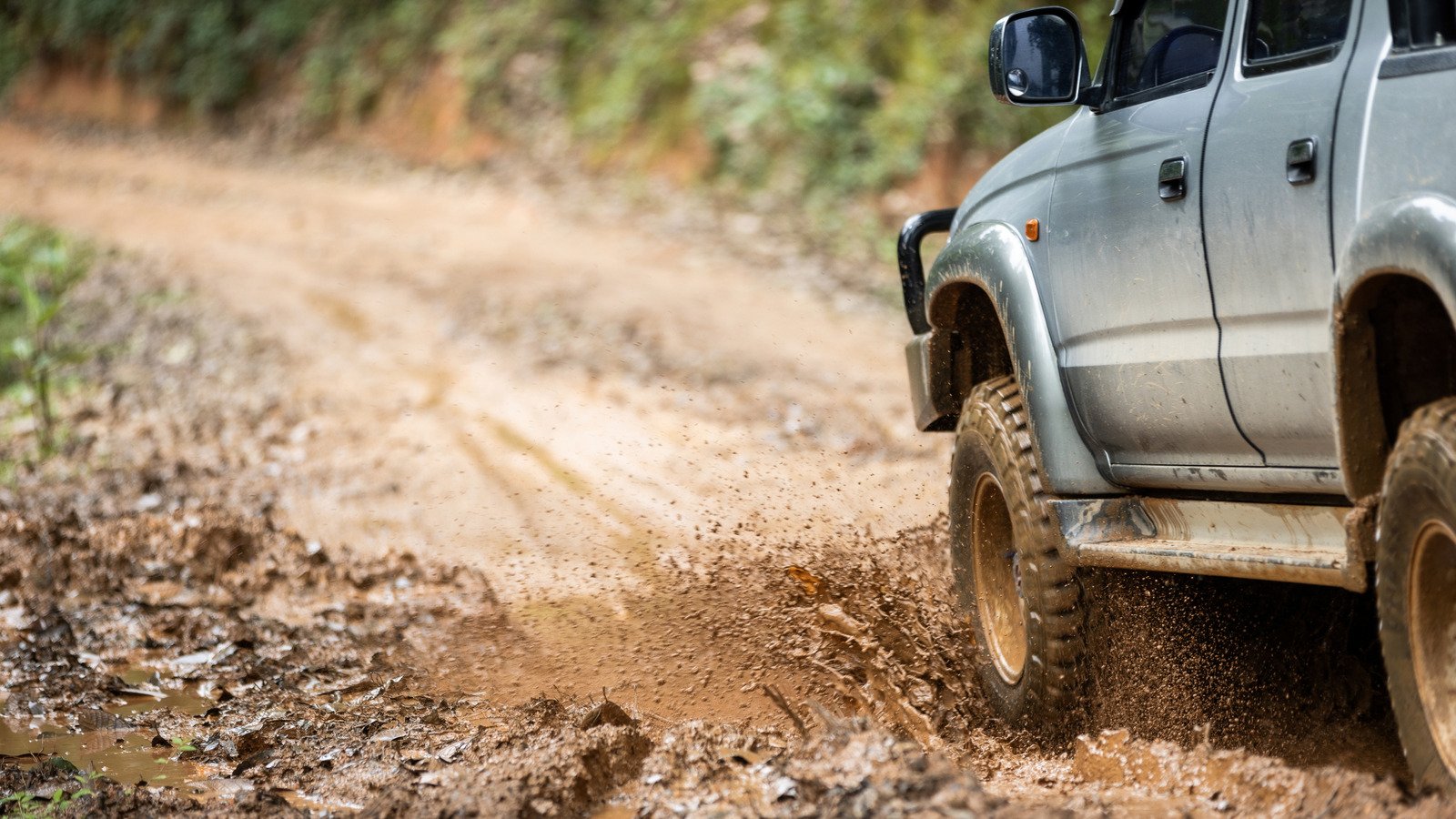
12 SUVs That Should Never Be Driven Off-Road
If you go for a drive on any road across America right now, you’re very likely to pass several SUVs along the way — maybe even more than sedans. That used to be unthinkable, but SUV popularity is at an all-time high in the United States. More than half of all new cars sold in the last year were SUVs. It’s the most popular vehicle type in 48 of 50 American states, and multiple reasons could explain why: higher seating positions, more interior space, and horsepower considerations. After all, some SUVs pack a serious punch in the pony metric, with a few even exceeding 1,000 hp.
Whatever the original reason for buying one, most people still expect an SUV to handle rough terrain when necessary. Chief among these is the ability to get its wheels dirty when it needs to — however infrequently that may be. According to data from Capital One, 98% of SUV and crossover buyers only go off-road once a year at most. Inferentially, the majority of SUV owners don’t consistently go off-roading, but you never know when those extra few inches of ground clearance could come in handy.
That said, one would be forgiven for assuming that every SUV can traverse rocky roads and ascend steep terrain when it needs to. The reality is very different; not every model in that class was actually engineered for such needs. In fact, the ones on this list should never be driven off-road at all if you can avoid it, albeit for different reasons.
Land Rover Range Rover
The first SUV on the list, the Range Rover, isn’t here for a lack of ability as one might think. In fact, it’s actually one of the more capable SUVs out there in terms of towing capacity, and you’d be hard-pressed to find a smoother ride over rough terrain. That ability comes courtesy of the air suspension that has been a staple of Range Rovers since 1994, which provides the foundation for the 2026 model’s 8.6-inch ground clearance.
Towing-wise, the 2026 P530, for example, can pull up to 8,200 lbs with its 523-hp twin-turbo V8 powertrain. Both of these attributes point to a vehicle that’s actually perfect for off-roading; you could hitch a travel trailer and go for a trip in the woods with the Range Rover’s specs. So what’s the problem? In simple words, value retention. You see, while the Range Rover is built to handle strain, it’s a luxury vehicle first and foremost.
That means maintenance is already on the higher end of the spectrum — according to CarEdge, you can expect to spend upwards of $6,500 over the first five years of ownership, and there’s still a roughly 24% chance you’ll need major repairs. By adding off-roading or towing to the mix, you’re increasing your chances of spending time in the repair shop for rocker panel scrapes and suspension wear, to name a few. Already, the Range Rover’s depreciation figures aren’t the best (74% after five years). Wear from consistent off-roading could further crater your Range Rover’s resale value, so staying away from the trail is an economically prudent decision.
Rolls-Royce Cullinan
The Cullinan is in a similar boat to the Land Rover Range Rover, but it resides in an upper echelon of its own in the luxury SUV niche. While the Range Rover already has a well-documented depreciation curve that off-roading can accelerate, especially given its high maintenance costs, the Cullinan brings a slightly different perspective. It loses between 40 and 45% of its value over five years under normal circumstances, which is a better deal than the roughly three-quarter drop seen in the Range Rover.
However, as one of the absolute peak expressions of driving comfort and luxury, off-roading could have catastrophic consequences for a Rolls-Royce Cullinan. Although it’s built for such strains, as evidenced by its adaptive suspension that sits at nine inches with the off-road setting enabled, you’d be risking hundreds of thousands of dollars in resale value if a single scratch from a loose rock damaged the paint.
Considering that these types of vehicles are built and bought for the image they portray, a body that isn’t cared for like an egg isn’t going to fetch anywhere near market value if you decide to part with it in the future. For the value you’d be risking, you’d be better off getting a different vehicle entirely for your off-roading needs.
Maserati Levante
A tier or two below the Rolls-Royce Cullinan in terms of sheer reputation for opulence and style, the Maserati Levante is another expensive SUV that you’ll want to avoid taking up a rocky trail. Discontinued in 2024, chances are you’re looking through the used market for a Levante model, so the worst of the frightening depreciation curve is behind you already — some 2024 units are on the used market for less than $30,000. With that in mind, a Maserati Levante might look like a bargain, but you’d be best to steer clear if you have off-roading plans.
The main reason for this recommendation isn’t price (although paint jobs and panel repair can cost upwards of $3,500). It’s mechanical; you’d get about eight inches of ground clearance on a standard trim, which means the unibody rides rather low. To make matters worse, the Maserati Levante uses low-profile tires. That means bumps in the road can be very pronounced, and due to the shorter sidewalls, they’re more prone to damage. Considering the topsy-turvy topography of some trails, it’s not far-fetched to imagine a ride rudely punctuated by a suddenly flat tire, not to mention the scrapes that might ruin the undercarriage.
Beyond these limitations, the Maserati Levante uses an AWD system. That engineering choice is fine for light trails and adverse weather conditions, but when it comes to crawling over rocks, it lacks a dedicated low-range transfer case. Simply put, it won’t reliably climb over obstacles in a controlled manner, which is far from ideal for serious off-roading.
Honda CR-V
The CR-V is an SUV model you’re likely to run into every day; it’s the best-selling SUV in America for the first half of 2026. It’s far from the flashiest or the most powerful, but it’s reliable. It’s one of the models out there with a fighting chance of making it to 200,000 miles. With these distinctions, you might be thinking of taking the family up a trail behind the wheel of a CR-V in the near future.
While the CR-V is one of the sturdier SUVs out there, it has specific limitations that hold it back when it comes to going off-road. For starters, the 2026 model only has two drivetrains: FWD and AWD. The ground clearance in both of these configurations isn’t the most impressive (7.8 inches for FWD and 8.2 inches for AWD), which means the undercarriage is just as vulnerable as the Maserati Levante’s to scrapes from rocks and loose debris. Couple that vulnerability with the fact that the underbody shield is actually plastic, and chances are you’d be shopping for vendors that sell metal or aluminum underbody skid plates after a run or two on the trail.
Even the newly introduced TrailSport, which is the CR-V’s toughest trim for off-roading, only uses what Honda calls a “skid garnish” — a silver trim piece on the lower bumper that’s more aesthetic than practical. While the TrailSport does feature 18-inch wheels wrapped in all-terrain tires for more grip, the low unibody and the drivetrain’s limitations don’t suit off-roading needs.
Mazda CX-5
The Mazda CX-5 has a similar profile to the CR-V but with a slightly different perspective. Despite its commercial success for the Mazda brand — it’s the automaker’s best-selling model globally — sales have dipped in recent years. Nonetheless, there are things you should know before buying the CX-5, like its struggles when it comes to off-roading. That’s primarily because of its low ground clearance. Its trims measure between 7.6 and 7.9 inches, so it’s slightly shorter than the Honda CR-V, depending on the trim and drivetrain. At that height, driving smoothly becomes an issue once you’re no longer traveling on pavement.
From a drivetrain standpoint, the CX-5’s problem has a different complexion from the CR-V. Where the Honda uses a real-time AWD system that is fundamentally reactive, the CX-5’s i-ACTIV AWD uses 27 sensors to shift torque before any slippage occurs. While that’s useful for providing traction in situations like climbing a highway on-ramp or driving on a wet road, the same lack of a low-range transfer case that the CR-V suffers from becomes a limitation when the vehicle slows considerably — which is what would happen on a rocky trail.
Now, that’s not to say the CX-5 would struggle in every off-road scenario; its traction system can sustain performance on light trails and snowy paths. However, by Mazda’s own admission, in particularly tough terrain where diagonally opposite wheels can lose contact with the ground, even its ability to lock the torque coupling may not be enough, things can get dicey.
Tesla Model X
Electric vehicles bring a different level of complexity to the off-roading paradigm. Some of the most powerful SUVs in the world today, in terms of sheer horsepower, are electric; the Tesla Model X has a Plaid trim that delivers 1,020 hp from its tri-motor powertrain. That doesn’t always translate to flawless performance on a rocky trail, though.
That’s a considerable number of ponies by any metric, so what’s the issue with the Model X? On paper, its adaptive suspension allows the driver to change the vehicle’s height, with the allowable ground clearance pegged at 5.7, 6.6, and 8.1 inches. Besides the obvious reasons outlined earlier, like scratches and scrapes being possible (if not frequent) at such heights, the battery is integrated under the floor of the Model X’s chassis.
That’s a design choice that serves two functions: maximizing range and improving stability by lowering the center of gravity. The downside of the battery’s position is that off-roading is risky business. The last thing you want is for your battery to suffer a hit from an errant rock on the trail. Although the battery pack is protected by a reinforced enclosure, a significant impact to the underbody could still damage it. While rare, electric vehicles can catch fire from impacts to the battery, so best to err on the side of caution.
BMW X6
Consider the X6’s history; it’s essentially a coupe version of the X5. It adopts a sleeker design, if you will, that cuts into the headroom and cargo space that the X5 would typically enjoy.
Unfortunately, as a result of that sporting aesthetic direction, the X6 is less capable of hitting the trails than its sibling. They may share the same platform and powertrains, but there’s a key difference for off-roading: ground clearance. The 2026 versions of the X5 and X6 measure 8.3 and 8.1 inches off the ground, respectively. That 0.2-inch gap may not seem like much, but it has real ramifications for approach angles, which could be problematic on rocky paths.
The X6 has an approach angle of 21.7 degrees compared to the X5’s 25.2 degrees. Although the X6 outperforms its sibling in departure angle (25.1 degrees vs. 22.3 degrees), the combination of a marginally lower body frame and a shallower approach angle makes the X6 worse for climbing steep inclines or rocks nose-first. Considering that off-roading often calls for precise navigation with the fender, there’s a good chance you could end up scratching the bodywork if your approach isn’t immaculate.
Chevrolet Equinox
It’s a recurring theme for SUVs with low ground clearance to dominate this list. At 8.05 inches for the 2026 model, the Chevrolet Equinox is among the taller SUVs here. That ground clearance isn’t necessarily enough for off-roading if you have any intentions of going beyond light trails, though.
For starters, the Equinox hasn’t had the best history with handling. Online chatter and Consumer Reports point to the issue, particularly when driving along bends, high peaks, and low troughs. If you’re going to travel on an especially rough trail, that’s important to note — you always want to be behind the wheel of a vehicle you’re fully confident in.
Second, the maximum towing capacity of just 800 lbs on FWD models (with AWD versions rated at 1,500 lbs) is a subtle indicator that the Chevrolet Equinox wasn’t designed with off-roading stresses in mind. Most compact SUVs can safely tow anywhere between 5,000 and 7,000 lbs, so the deficiency in terms of sheer capability is clear.
Volkswagen Tiguan
One of the shortest models on this entire list in terms of ground clearance, the Volkswagen Tiguan’s underbody sits just seven inches above the ground for the 2026 model. Even for a compact crossover, that mark is several tenths of an inch shy of the Mazda CX-5’s 7.6-inch in its lowest trim. Naturally, with such a low figure, it’s logical to assume Volkswagen didn’t have off-roading high on its priority list during the design phase.
That inference is supported by the AWD tuning when you take a closer look. We tested the 2025 Volkswagen Tiguan; it uses a 4Motion system that dynamically distributes torque based on throttle input, terrain type, and other factors. While this engineering blueprint comes with a drive mode selector that lets drivers switch between snow, on-road, off-road, and even custom off-road settings, it distinctly lacks low-range gearing.
Now, on moderate off-road paths, the Tiguan’s configuration might be sufficient. However, once you veer away from gravel paths and light trails, you’re going to struggle. The low ground clearance will become too much of a hindrance to get past unless you get a lift kit. Even then, it’d still lack locking capability, so while off-roading is possible in theory, you should really look into getting a model that suits your needs if you’ll be doing it frequently.
Kia Sportage
Like the Volkswagen Tiguan, the Kia Sportage runs small; its lowest trim measures 7.1 inches of ground clearance, although that height jumps to 8.3 inches for the SX-Prestige trim. The 7.1-inch figure rivals that of the Tiguan for the smallest mark on this list, and as you can infer by now, that little ground clearance isn’t great for the maneuvers your vehicle is going to be performing on rough terrain.
Secondly, the underbody of the Kia Sportage’s non-X-Pro trims isn’t the most protected. You could get your hands on front and rear skid plates, but they are plastic, which means they are essentially light-duty in nature compared to the steel or aluminum skid plates you’d be accustomed to seeing on vehicles actually built to handle off-roading. Those materials are chosen to protect essential parts such as the oil pan or steering gear by absorbing impacts from loose rocks.
The absence of robust underbody protection on the Sportage is doubly alarming when you consider that it uses MacPherson struts for its front suspension and a multi-link system for the rear. The lack of protective armor means the lower control and multi-link arms, as well as the sway bar links connecting them, are exposed to impact damage. The X-Pro trims should perform better with their 8.3-inch clearance, but, as a review from TheCarConnection shows, the lack of solid underbody protection should discourage drivers from any serious rock-climbing ambitions.
Lamborghini Urus
The Urus is only the second-ever SUV from the conveyor belts of Lamborghini and was an instant hit for the Italian automaker; it accounted for 60% of Lamborghini’s sales in 2023. When it comes to off-roading, it won’t be as out of place as seeing a Rolls-Royce Cullinan climbing rocks in the middle of nowhere. However, it still sits in an echelon of luxury and prestige that, economically speaking, would make it hard to justify any potential damage to the paint or parts.
Value retention aside, there are real limitations that place a logical boundary on where you can travel with an Urus. The most obvious of these is the low-profile performance tires — while they help with grip and performance on smooth pavement, they have inflexible sidewalls and a stiff tread pattern that make them prone to damage. Ground clearance isn’t as much of an issue as it is for other models; its 6.2-inch minimum can reach 9.8 inches thanks to the air suspension.
Despite that adaptive ability, any damage suffered on an off-road trip could easily run into the tens of thousands of dollars to fix. So, like the Cullinan and Range Rover, you’d be better off keeping the Lamborghini Urus on the pavement if you plan to retain its value.
Ford Escape
Rounding out this list is the Ford Escape. With 2026-model ground clearance that ranges from 7.5 to 8.2 inches, it’s not the shortest SUV on this list — although its hybrid trim goes as low as 6.9 inches. Unfortunately, that range and off-roading don’t mix well.
The Ford Escape uses an AWD system that acts only when it detects wheel slip — presumably to preserve fuel economy. By now, we know that AWD drivetrains are engineered to handle typical driving needs. They provide extra traction in slippery conditions like snow, rain, and even when driving over gravel. However, that ability does not extend to the demands of off-roading.
It’s not as robust since it lacks a locking rear differential or a two-speed transfer case, so it won’t bail you out when you need power directed to specific tires in environments that call for careful navigation over loose terrain. Like many of the other options on this list, you’d probably be fine on the odd untarred, bumpy path headed to a campsite, but for serious off-roading purposes, you’d likely damage something underneath the vehicle.