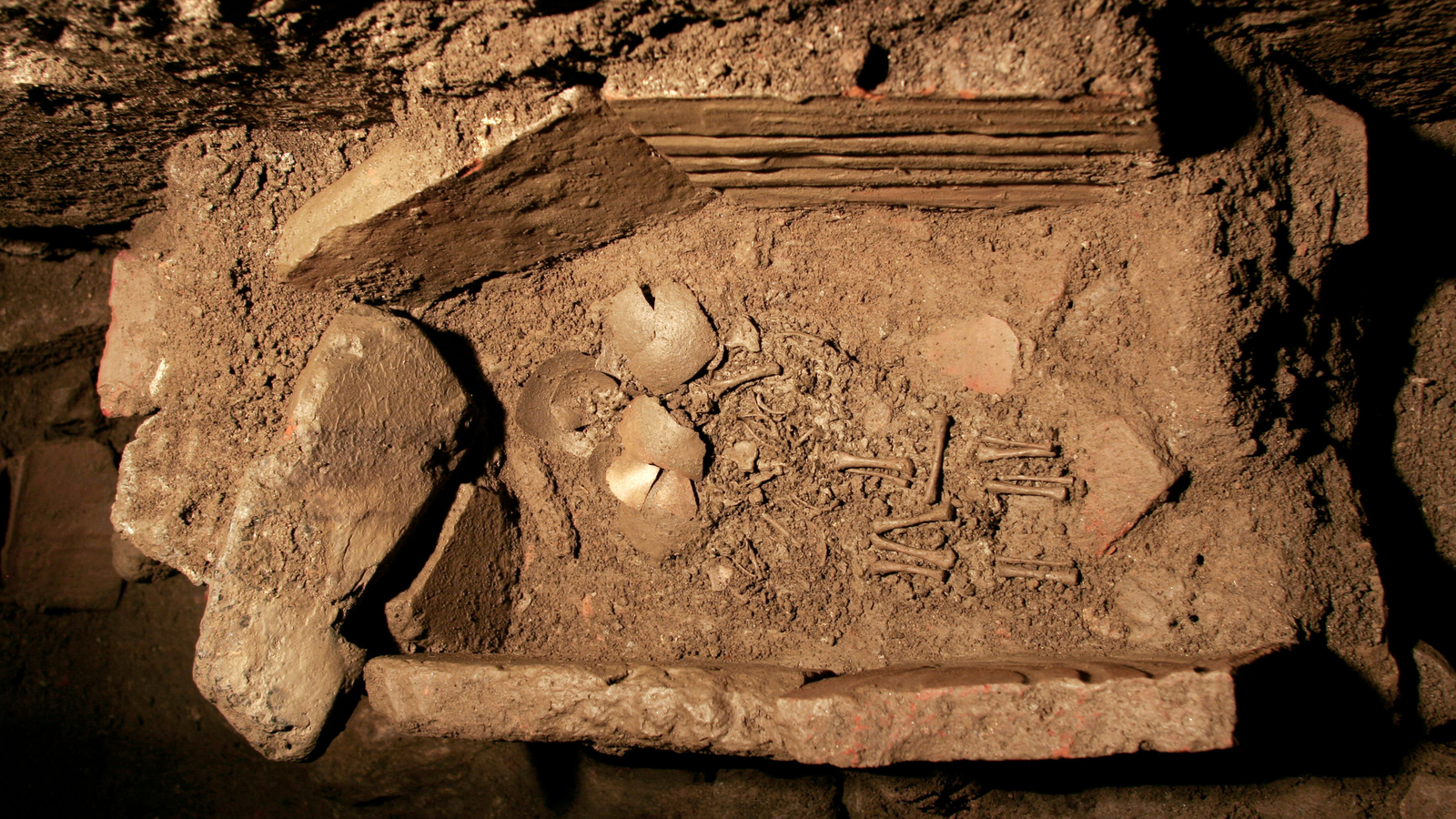
Archaeologists have uncovered a rare and unusual burial of premature twins in a 1,200-year-old tomb near the Temple of Artemis at Ephesus in Turkey. Although the burial was found in an abandoned latrine, researchers think the intention was to protect the babies in the afterlife.
“This interment was made in an unexpected and exceptional setting,” Lilli Zabrana, an archaeologist at the Austrian Academy of Sciences who co-authored a new study detailing the discovery, told Live Science in an email. Burials previously discovered at Ephesus were made in a dedicated cemetery outside the boundaries of the ancient temple.
“What is even more unusual is that the burial contains two premature infants, who were probably twins, which is a rather rare occurrence,” study co-author Caroline Partiot, a bioarchaeologist at the Austrian Academy of Sciences, told Live Science in an email. Evidence of a rare genetic condition found in one of the infants makes the finding even more unique, the researchers noted.
Latest Videos FromLive Science
In the study, published online July 13 in the journal Childhood in the Past, Partiot and Zabrana analyzed bones found in a tomb that was likely built in the eighth to ninth century, during the middle Byzantine era. The grave was placed within an abandoned latrine channel, originally built during the second or third century, Zabrana said, but the latrine was a later addition to a Roman odeum — a building used for musical performances — that was built in the first century within the sacred area of the famous Temple of Artemis at Ephesus (one of the Seven Wonders of the Ancient World), which was originally built around 550 B.C.
The Romans built a music hall called an odeum at the Temple of Artemis. The infants were found in a tomb in the odeum’s latrine.
When excavators opened the cist, or stone-lined grave, they saw two tiny skeletons buried side by side. Based primarily on the size of the bones, Partiot and Zabrana estimated the skeletons were from infants who were likely born prematurely at around 33 to 34 gestational weeks, or 7.5 months in utero. (A full-term pregnancy typically lasts between 39 and 40 weeks.)
“The hypothesis that they were twins is based on the fact that they have very similar ages at death and were buried in direct contact with one another,” Partiot said. “However, it will only be possible to confirm whether they were indeed twins through future DNA analyses.”
Although the researchers did not find any evidence of trauma or disease on the babies’ skeletons, they did notice a rare bone called a supernumerary cervical rib. This hereditary trait involves the growth of an extra rib bone that forms at the back of the neck in about 1% of people and usually doesn’t cause any problems. However, Partiot has found that, in babies, there is an association between cervical ribs and anomalies in Hox genes — a group of genes that code for specific body parts during embryonic development — that can lead to stillbirth, prematurity or sudden infant death.
Get the world’s most fascinating discoveries delivered straight to your inbox.
“To the best of our knowledge, no cases of twins with cervical ribs have been documented in an archaeological context” before this one, the researchers wrote.
The twins may have been buried in an odd location outside the known burial grounds at Ephesus because they died as premature infants who probably hadn’t been baptized yet, the researchers proposed. The infants’ final resting place was likely a kind of “practical compromise” between Christian burial practices and local customs, the researchers wrote in the study.
The team found no evidence of the twins’ mother nearby or in the Ephesus cemetery. “It is possible she died at the same time, but it is also possible that she did not; it is difficult to say,” Partiot said. “Both infant mortality and maternal mortality were very high at the time.”
But the twins’ protective cist grave preserved their skeletons for more than a millennium, which “clearly indicates that this was a respectful burial rather than the disposal of human remains,” Zabrana said. Ultimately, the tomb reveals a family’s “intention to care for the two deceased infants in death, and to acknowledge their fleeting place within the community,” the researchers wrote.
Partiot, C., Zabrana, L. (2026). Peace in unexpected places: The Middle Byzantine burial of two perinates, possibly twins, in a latrine canal of the Odeion in the Artemision of Ephesos. Childhood in the Past. https://doi.org/10.1080/17585716.2026.2682804
What do you know about the bones in your body? Test your knowledge with our human skeleton quiz.
Researchers at King’s College London have identified a promising new strategy for tackling Alzheimer’s disease by targeting several of the disease’s earliest biological changes at the same time. Their study found that KCL-286, an experimental drug originally developed for spinal cord injury that has already passed Phase 1 safety trials, reduced multiple hallmarks of Alzheimer’s…
On July 16, 2026, NASA announced it will install two SpaceX Starlink mini laser terminals on the exterior of the Orion spacecraft ahead of the Artemis III mission, targeting late 2027. The terminals will relay 4K imagery and live video from Orion directly to Mission Control at Johnson Space Center in Houston — the first…
Kroger states the technology aims to free up employees to better assist customers. Kroger is testing inventory-monitoring robots in its central Ohio stores. The robots, named "Tally" and "Barney," scan shelves to identify out-of-stock items. The robots do not take photos of customers or collect their personal information. submitted by /u/Gari_305 [comments]
We all know that humans have five senses. But a growing body of research shows we have a sixth one that almost nobody talks about – and it may be just as important for our wellbeing as any of the others. It’s called interoception: the body’s ability to sense and interpret its own internal signals….
Get the Popular Science daily newsletter💡 Breakthroughs, discoveries, and DIY tips sent six days a week. By signing up, you confirm you are 16+, will receive newsletters and promotional content and agree to our Terms of Use and acknowledge the data practices in our Privacy Policy. You may unsubscribe at any time. The day has…
Scientists have proposed a new way to describe black holes that could overcome a major limitation in one of Stephen Hawking’s most influential ideas. The research introduces an updated approach to black hole thermodynamics that works even when black holes are changing over time, potentially offering new insights into how they form, merge, and slowly…