Blockchain-based IoT integration for VAT photopolymerization additive manufacturing process security and transparency
This section provides a description of how blockchain can be applied to the IoT-VPP AM System to enhance data security, trust, and traceability. The methodology is designed based on an independent research study with pilot studies that correlates the blockchain technology with the IoT sensors in the regulation of VOC emissions in the VPP process. The methodology consists of several important elements: the key activities of the project will consist of the experimental setup, blockchain architecture design, data collection, cleanup, integrating blockchain into the system, and data analysis.
Experimental setup
The experimental setup has been made to provide an approach towards a VPP-AM setup in which a significant focus is being given to monitoring the VOC emissions, along with other paramount process parameters, during the experiments. The components of the setup included the following.
VPP-AM machine
The VPP-AM machine, which is a high-resolution Anycubic Photon Mono X 6 K with a 9.25-inch monochrome exposure screen, was used to conduct experiments. The light source has a 40-LED parallel array, and the highest printing speed is 80 mm/h. The light intensity (5,000 to 6,500 uW/cm²) was adjusted, and the spatial resolution in the machine (34 u²) gave the freedom to systematically investigate the effects of process parameters on VOC emissions.
Sensor array
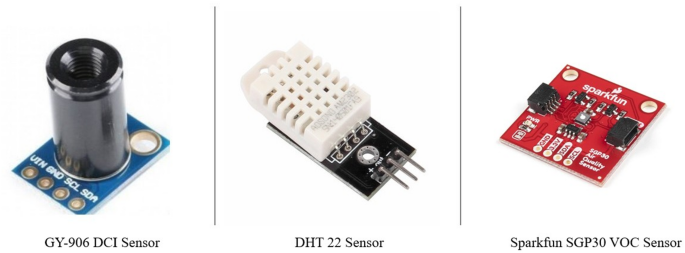
A set of IoT sensors was connected to the experimental device to measure VOC emissions, resin temperature, and environmental conditions. The sensors included (Figs. 1 and 2):
-
I.
VOC Sensor: A Sparkfun SGP30 Air Quality Sensor Breakout (Qwiic) was used to measure and determine VOC emissions throughout printing. The sensor gives out an index value of the concentration of VOCs in the air surrounding it. The sensor reports the readings of total VOCs (TVOC) in parts per billion (ppb), carbon dioxide (CO₂) equivalent in parts per million (ppm), and H₂.
-
II.
Temperature Sensor: The GY-906 MLX90614ESF-DCI Sensor Modules were used to measure the temperature of the resin vat. The temperature of resin is one of the most important factors influencing VOC emissions, as it influences the viscosity of the resin and its efficiency to cure.
-
III.
Environmental Sensor: A DHT22 temperature-humidity sensor received the temperature and humidity of the surroundings within the printing case. These are the levels that affect the rates of resin evaporation and the dynamics of VOC emission.

Sensor setup used in the experiments.

The setup used includes the VPP-AM machine (Anycubic Mono X 6 K) and sensor.
All the fabrication tests were undertaken in closed chambers at 23 ± 1 °C and 50 ± 2% RH. Randomization of print orders and resin-exposure combinations between experimental runs was used to eliminate systematic bias. Each trial was preceded by a 2-hour baseline, which was used to establish VOC balance and ambient stability. The sensor values have been recorded at a rate of 1 Hz, and they have been averaged with a three-sample moving average filter to reduce short-term filter changes.
Control unit
The minicomputer used as a central data acquisition and processing control unit was Raspberry Pi 4. The sensors communicated both through their PCI connector and I2C communication to the board, where they provided real-time data at set times. The data obtained was recorded and put aside to be analyzed later.
The accuracy of each sensor was ensured by calibrating it with laboratory reference instruments before data were collected. The photoionization detector to calibrate the SGP30 VOC sensor was also pre-calibrated, and a thermally calibrated thermocouple (at least 0.2 °C) was used to verify the temperature module in the GY-906 DCI sensor. The preprocessing script in Raspberry Pi 4 used calibration coefficients automatically.
Resin material
We used a commercially produced grey photopolymer resin in all our experiments to ensure that we have similarity in the material properties. The reason why we selected it is that it is compatible with the Anycubic Photon Mono X 6 K and is commonly applied in industries.
Safety and privacy protocols
All procedures conducted during the experiments adhered to institutional safety regulations and OSHA allowable exposures to VOC. The experimental condition was to be under inspection of forced ventilation (12 ACH air exchange rate), and personnel must be equipped with proper equilibrium personal protection.
Regarding the data privacy aspect, the blockchain-IoT system can store process-related sensor data only. None of the personal identifiable information (PII) or data of workers is collected, logged, and transferred. The private Hyperledger Fabric network uses membership service providers to control access based on roles, allowing only certain authorized organizational nodes (like machine operators, quality control personnel, and compliance officers) to view ledger data based on what they need for their jobs.
Blockchain architecture design
The blockchain architecture was developed to ensure secure and transparent data management in the VPP system that is enabled for IoT. It consists of three main layers (Fig. 3): the data acquisition, blockchain, and application layers.

Blockchain-based IoT architecture for VOC monitoring in VPP-AM. The diagram illustrates the three main layers: data acquisition, blockchain, and application. The arrows describe the transmission of encrypted data.
The diagram depicts the entire data lifecycle within our integrated system. Data is generated by the IoT sensor array observing the VPP process, ultimately acquired and pre-processed by the Raspberry Pi 4 edge device, encrypted using AES-256, and created as a transaction to the Hyperledger Fabric network. A Chaincode smart contract verifies the data against pre-set thresholds prior to the information being committed to the immutable distributed ledger. Lastly, the application layer provides stakeholders with real-time monitoring and automated alerts through a web dashboard.
Data acquisition layer
The data acquisition layer consists of IoT sensors collecting real-time data on VOC emissions, resin temperature, and environmental conditions. The gathered data is preprocessed and then recorded on the Raspberry Pi 4’s blockchain.
Blockchain layer
The purpose of this layer of the blockchain is to store and use the information obtained with the help of the IoT sensors in a safe way. The Hyperledger Fabric framework was recently adopted to create a private blockchain network due to its scalability and modular optimization, which allows it to support smart contracts30. The blockchain network will include the following:
-
I.
Nodes: Each node within the network may represent a stakeholder in an AM process, e.g., a machine operator, a quality control team, or a regulatory authority. The distributed ledger is stored in each node.
-
II.
Smart Contracts: Smart contracts were created on the framework of Chaincode (Hyperledger Fabric (Fig. 4)). These contracts are automated and used in data validation, storage, and retrieval. Importantly, the contracts also impose preconditions, such as sensor calibration and data integrity checks, prior to significantly committing any records to the immutable ledger.
-
III.
Consensus Mechanism: This involved the employment of the Practical Byzantine Fault Tolerance consensus algorithm to make sure that the nodes would be compliant with the state of the ledge31. PBFT has been selected since it is suitable in a private blockchain setting in cases where the trust of parties is comparatively low32.
The Hyperledger Fabric architecture was set up with Practical Byzantine Fault Tolerance (PBFT) consensus among three validating peers (one ordering node and two endorsing peers). Each block was formed after every 500 ms with a maximum of 50 transactions in each block. Although the full IoT load (4 sensor nodes transmitting 1 Hz) was applied to this network, the network was able to sustain an average throughput of 487.2 tps with an average block finalization latency of 1.18 s. The early-stage throughput value, which ranged from 430 to 450 tps, was associated with the pre-optimization tests conducted prior to changes in the batch timeout and endorsement policy.
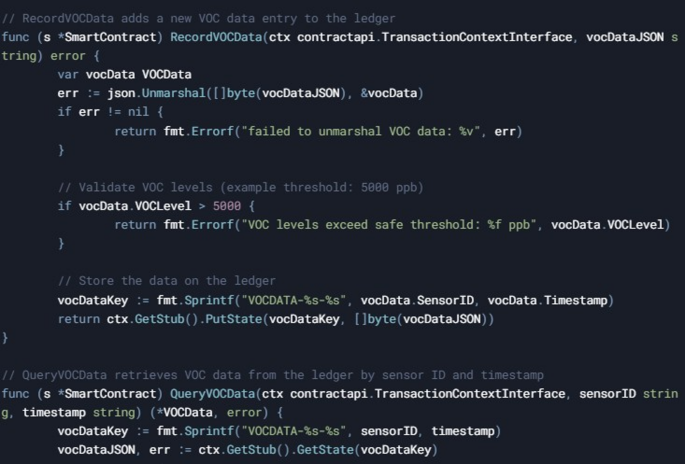
Snapshot of the chaincode implementation for VOC data validation and secure ledger storage in Hyperledger Fabric. The code segment illustrates the automated smart contract functions that verify sensor calibration, check for outlier readings, and validate permissible VOC (ppb) thresholds before data commitment. Each validated record is cryptographically hashed and appended to the distributed ledger under PBFT consensus, ensuring immutability and auditability.
Moreover, the blockchain was evaluated for network performance using Hyperledger Caliper (v0.5.0), which provided performance indicators for throughput, latency, and consensus performance based on a sustained ingestion of IoT readouts from Raspberry Pi 4. Each performance measurement is the mean of three experimental replications, given a constant device sample rate of 5 Hz.
Application layer
The application layer provides a user interface for accessing and interacting with data stored on the blockchain. A dashboard has been developed using React.js, enabling users to view emissions, temperature, and humidity in real time. Alerts are shown on the dashboard when VOC levels are above a permissible limit so that operators can act in time.
Data acquisition and preprocessing
Data is preprocessed before inserting into the blockchain to ensure both correctness and uniformity. The Raspberry Pi 4 aggregates sensor data and performs preliminary validation, including calibration verification and outlier detection. This preprocessed data is subsequently formatted into a JSON structure standardized for storage in the blockchain.
Data encryption
All data were encrypted with AES-256 encryption and were sent to the blockchain network to enhance the protection of data. Encryption ensures that the user cannot access the transmitted information without the proper decryption code.
To guarantee safe passage of information, AES-256 encryption was utilized with a dynamically selected session key that was generated in a key-generation procedure using SHA-256. The code of the encryption key was stored in the local secure storage of Raspberry Pi to be refreshed every now and then to eliminate replay/compromise. The sensor payloads were encrypted and hashed with SHA-256. To help limit access to schedules and timestamps of the ledger, Hyperledger Fabric Chaincode added access control through vaults. The sensor data streams were forwarded to off-chain storage, and the blockchain provided immutable reference to the information in the form of hash-based data on the ledger. This solution ensured the integrity of data through blockchain technology and ledger control.
Blockchain integration
The integration of blockchain technology with the IoT-enabled VPP system involved several key steps:
Blockchain data storage
The encrypted data are transferred into the blockchain network, after which the blockchain records them in the distributed ledger. The records are matched with a time stamp, and each one connects to the previous record, creating an indestructible chain of records. The blockchain aspect implies that once the data is stored, the process of altering or modifying it is impossible; as a result, the data integrity level is high.
The introduction of latency and energy overhead caused by the encryption pipeline and blockchain storage pipeline was parameterized and systematically quantified as to their practical feasibility of operation in real time. Also, the Raspberry Pi 4 control unit was profiled with the Keysight N6705C DC Power Analyzer at constant power during continuous operation and measured the data overhead due to metadata in the blockchain by comparing the size of the analog sensor payload with the final payment size.
Smart contract execution
Smart contracts play a critical role in automating data validation and storage. For example, our VOC validation contract verifies that sensor readings fall within predefined safety thresholds before blockchain commitment. If validation fails, the contract generates an alert and suspends data recording until the issue is resolved. Upon validation failure, the smart contract triggers an alert and suspends data recording until the anomaly is resolved (Fig. 5).

Smart contract workflow. The diagram illustrates the process of data validation, storage, and alert generation.
Experimental design
The experimental design aimed to study the effect of significant process parameters on VOC emissions during the VPP process. The following Table 1 parameters were looked at:
We used three replicate prints to guarantee the statistical reliability of each parameter combination. The dataset obtained from the blockchain-enabled IoT system, including VOC emissions, resin temperature, and environmental conditions for each print, was analyzed further.
Data analysis
The implementation of blockchain technology has enabled a secure and transparent record of all experimental data, increasing the efficiency of the data analysis process. The analytical techniques used are listed below:
Correlation analysis
The relationship between VOC emissions and the printing parameters was found to have strength and direction, which was assessed by the Pearson correlation coefficient between the variables VOC emissions and printing parameters: layer thickness, exposure time, and light intensity. The blockchain’s storage of information may guarantee the presentation of the analysis on valid and indisputable records. We also conducted regression analysis to examine the quantitative relationship between VOC emissions and individual process parameters, as well as to analyze how variations in each independent variable affected VOC emissions. Furthermore, analysis of variance (ANOVA Type-II) was used to determine whether each of the parameters had any significant effect on the variance in VOC. These two approaches provide us with the measure of how big the effect is (with the help of regression coefficients) and whether it is significant (with the help of p-values). This makes the explanation of the impact on VOC emissions more stringent.
Time-series analysis
Time series analysis revealed trends and patterns in VOC emissions during the printing process. The blockchain immutable ledger has provided a reliable historical record, allowing for accurate analysis and prediction of trends in VOC levels.
Smart contract-based alerts
Smart contracts automated the detection of VOCs. If categories of VOC emissions exceeded predefined thresholds, the smart contract would trigger an alert on a web-based dashboard to prompt operators to take corrective actions.
Comparative baseline testing
To validate blockchain’s quantifiable impact, we established comparative baselines using MySQL 8.0 for data integrity testing (20 simulated tampering attempts) and manual operator monitoring for alert response time measurements (10 threshold violation events).
Mitigation strategies
Integrating the blockchain system into the VPP-IoT system allowed for the development of advanced mitigation strategies for VOC emissions. These include:
-
I.
Real-Time Monitoring: The blockchain-based system shall monitor the levels of VOC emissions in real time, enabling operators to take quick action to avoid any possible hazards.
-
II.
Predictive Maintenance: With the help of the analysis of historical data available on the blockchain, the system can predict the time when VOC emissions will cross the safe limits, thereby enabling proactive maintenance and alterations of the operations process.
-
III.
Regulatory Compliance: The immutability of blockchain records ensures that all data is auditable, facilitating compliance with environmental and safety regulations33.