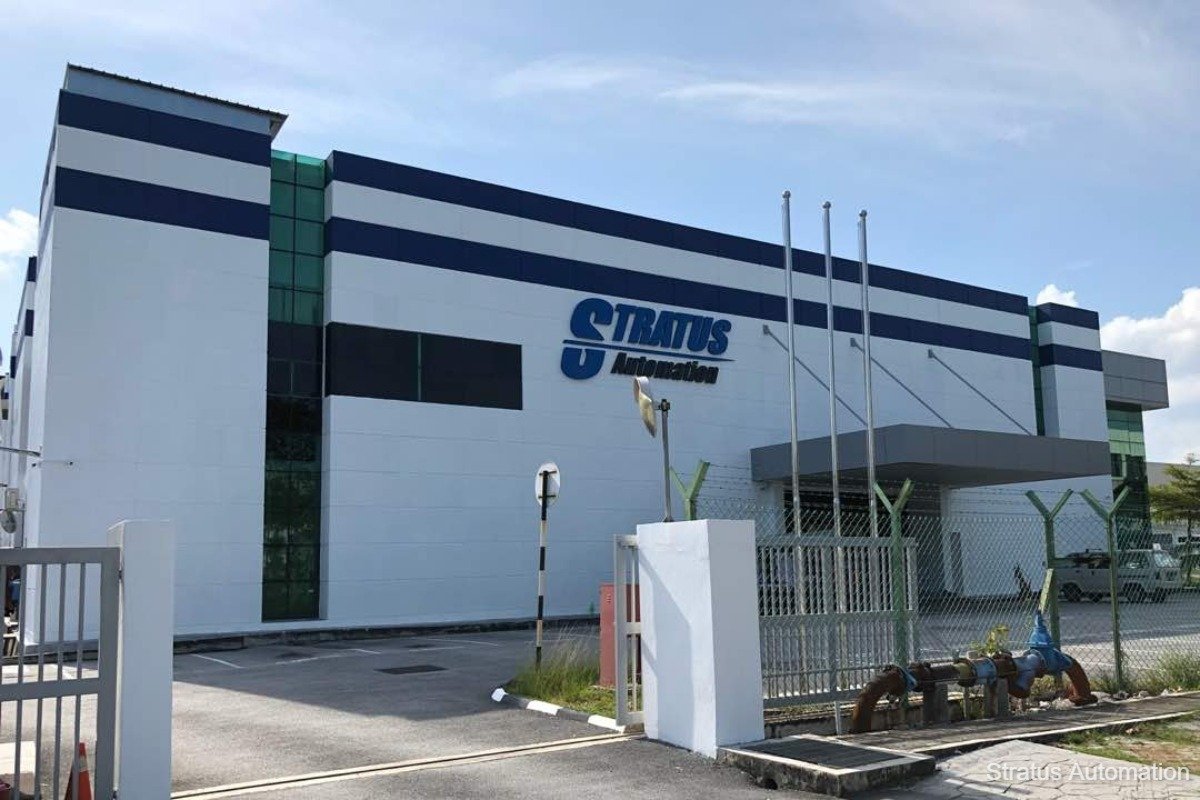
IPO Watch: Stratus’ Main Market debut to ride on chip automation boom
This article first appeared in Capital, The Edge Malaysia Weekly on July 20, 2026 – July 26, 2026
PENANG-based semiconductor factory automation specialist Stratus Global Holdings Bhd (KL:STRATUS), whose listing on July 21 will be the sixth initial public offering (IPO) on Bursa Malaysia’s Main Market this year, is poised to benefit from the ongoing expansion in the global chip manufacturing sector.
While the company may not enjoy the same profile as chipmakers or semiconductor equipment manufacturers, analysts say it occupies a niche segment that stands to benefit directly from semiconductor manufacturers’ continued investments in new production capacity.
Stratus designs and builds automated material handling systems (AMHS) that transport silicon wafers and other sensitive materials in semiconductor fabrication plants.

The company is raising RM285 million in gross proceeds (RM270 million net of RM15 million for estimated listing expenses) through the issuance of 356.3 million new shares at an IPO price of 80 sen. This gives it a valuation of RM1 billion upon listing.
The proceeds will primarily fund its manufacturing capacity expansion (RM122.6 million or 43.02%), overseas business development (RM20 million or 7.02%) and research and development (RM45 million or 15.79%). These three initiatives account for nearly two-thirds of the allocation, which leaves RM82.4 million or 28.91% for working capital.
Unlike the many automation companies that serve multiple industries, Stratus focuses almost exclusively on semiconductor cleanroom automation. It provides services for both front-end wafer fabrication facilities and, increasingly, back-end semiconductor assembly and testing.

The company’s product portfolio includes conveyor-based AMHS, hybrid AMHS incorporating overhead hoist transport (OHT), automated storage and retrieval systems (ASRS) and proprietary transport control software known as IntelliMove. These systems automate the movement and storage of silicon wafers in fabrication plants, reducing the risk of contamination while improving production efficiency and traceability.
The investment case for Stratus is closely tied to the semiconductor industry’s ongoing capital expenditure (capex) cycle.
Both PublicInvest Research and RHB Research expect the demand for semiconductor automation to remain robust as artificial intelligence (AI) continues to drive investments in data centres, advanced chips and next-generation electronics.
PublicInvest says Stratus is well positioned to benefit from the continued growth in semiconductor manufacturing, supported by rapid technological advancements, increasing AI adoption and the need for greater factory automation. It adds that the expanding fabrication capacity globally is creating sustained demand for AMHS, a critical component in the highly automated semiconductor manufacturing plants.
RHB Research shares a similar view, highlighting industry forecasts that point to continued expansion in 300mm wafer fabrication capacity until 2030. It notes that Stratus already has an established presence in these advanced fabrication facilities, putting it in a favourable position to ride future capacity growth.
The research house believes that the country’s National Semiconductor Strategy and 13th Malaysia Plan should provide additional long-term support for domestic semiconductor investments.
Engineering strength meets expansion ambition
Founded in 1998 by its Japanese CEO Ryo Narisawa, Stratus has spent nearly three decades building its engineering expertise in cleanroom automation.
One of the company’s key competitive advantages is its extensive in-house engineering capabilities. Rather than outsourcing most of the fabrication work, the group designs, fabricates, assembles and tests many of its key AMHS components internally, including conveyor frames, stocker frames and overhead hoist transport structures.
Stratus has also developed its own proprietary transport control software, allowing customers to optimise material flow, routing and production efficiency across semiconductor manufacturing facilities.
Analysts believe its engineering capabilities create meaningful barriers to entry, particularly given the stringent quality requirements associated with transporting semiconductor wafers inside contamination-controlled cleanrooms.
PublicInvest highlights Stratus’ continuous investments in R&D, supported by more than 50 engineers dedicated to developing modular, scalable and customised automation solutions for customers.
About RM187.6 million, or nearly two-thirds of the IPO proceeds, has been earmarked for the group’s next phase of expansion.
Stratus plans to acquire and redevelop two industrial properties opposite its existing Bayan Lepas facility, creating a new manufacturing complex that will significantly increase fabrication, assembly and testing capacity while housing a dedicated R&D and demonstration centre. The operations are expected to commence in phases from the third quarter of 2028.
RHB estimates the expansion could increase production floor space by between 150% and 200%, raising annual revenue capacity from about US$50 million to US$100 million currently to between US$200 million and US$400 million after full completion.
Beyond manufacturing expansion, the company intends to establish sales and engineering support offices in Japan, Taiwan, Germany and the US, allowing it to strengthen customer relationships in major semiconductor manufacturing hubs while expanding its presence across both front-end wafer fabrication and back-end semiconductor production.
Financials, valuation and investor considerations
Stratus’ financial performance reflects the project-based nature of its business. Its revenue grew to RM220.3 million in the financial year ended March 31, 2025 (FY2025), from RM145.9 million in FY2023, before easing 10.5% to RM197.1 million in FY2026 following the completion of several major projects and the appreciation of the ringgit against the US dollar, as its revenue is entirely denominated in the greenback.
Although the company’s earnings moderated, its profitability remained healthy.
Its gross margin stood at 51.8% in FY2026 while its net profit margin was 25.9%, reflecting the high-value-added nature of its engineering work. Its net profit came in at RM51.1 million for the year.
The company’s revenue mix has also evolved. Hybrid AMHS became the largest contributor in FY2026, accounting for 65.7% of its revenue after the group secured new projects from two major customers.
Geographically, the revenue contribution has shifted significantly towards North America and Europe, which together accounted for more than 80% of its revenue for the financial year, compared with a business previously concentrated in Asia.
Stratus had an unbilled order book of RM108.4 million as at June 3, 2026, of which RM75.4 million is expected to be recognised in FY2027 and the remaining RM33 million in FY2028.
Looking ahead, PublicInvest forecasts its net profit to grow at a three-year compound annual growth rate (CAGR) of about 15%, reaching RM77 million by FY2029. The growth is expected to be driven by continued foundry expansion, deeper penetration into the back-end semiconductor segment, wider adoption of hybrid AMHS solutions and additional production capacity from its new manufacturing facility.
RHB is more optimistic, forecasting an earnings CAGR of 24% over the same period, with net profit rising to RM96.8 million by FY2029 as semiconductor capex remains robust and new capacity comes onstream.
Stratus has no bank borrowings and intends to maintain a dividend payout ratio of at least 25% of its annual consolidated profit.
Analysts are broadly positive on the company’s prospects. The five research houses that initiated coverage assigned fair values ranging from RM1.36 to RM2 per share, implying an upside of roughly 70% to 150% over its IPO price of 80 sen. TA Securities has the lowest target price at RM1.36, while M+ Research is the most bullish with a fair value of RM2.
PublicInvest assigned a fair value of RM1.72 by applying an FY2028 price-earnings ratio (PER) of 30 times, representing about a 30% discount to the weighted average valuation of its regional peers. The research house believes the discount appropriately reflects Stratus’ relatively smaller size, customer concentration and cyclical exposure, while recognising its niche position in semiconductor automation.
RHB Research arrived at a slightly more conservative fair value of RM1.55, based on 24 times the company’s FY2028F earnings, broadly in line with Bursa Malaysia Technology Index’s historical valuation. At an IPO price of 80 sen, the shares will trade at 12.4 times FY2028F earnings, which RHB considers attractive relative to its local automation peer Pentamaster Corp Bhd (KL:PENTA) and selected regional peers.
Despite the differing methodologies, both research houses agree that Stratus deserves to trade at a premium to its IPO valuation given its specialised engineering capabilities, high-margin business model and exposure to the structural growth in global semiconductor investments.
Nevertheless, the bullish outlook comes with several risks.
The company’s earnings remain highly concentrated in the semiconductor industry, with more than 89% of its revenue derived from semiconductor customers. Its top three customers accounted for between 70% and 82% of its annual revenue in FY2023 to FY2026. Any slowdown in semiconductor capex or the loss of a major customer could materially affect earnings.
In addition, the projects’ revenue recognition model could result in earnings volatility, depending on the timing of the projects’ completion, while its US-dollar-denominated revenue leaves earnings exposed to foreign exchange fluctuations. Increasing competition from global automation companies is also a key consideration.
Investor appetite for the IPO has been strong. The public portion of Stratus’ IPO was oversubscribed by 128.82 times, surpassing even that of high-profile chip designer SkyeChip Bhd (KL:SKYECHIP), whose offering was oversubscribed by 95 times when it was listed in May this year.
Save by subscribing to us for
your print and/or
digital copy.
P/S: The Edge is also available on
Apple’s App Store and
Android’s Google Play.