North Review – Xbox One
Reviewer’s Note: Given that it’s impossible to avoid SPOILERS for this short story-based game, read on at your own risk.
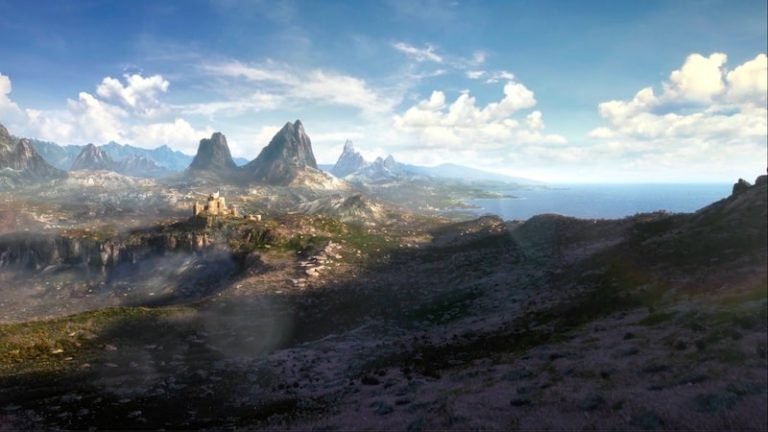
There’s something remarkably effective about freshman developer Outlands’ first shot: a slow camera pan of a stark landscape encircled by billowy clouds, blended with bright yellows, oranges, and pinks, and complimented by a pleasant synth track until briskly segueing to a muted, grey metropolis. The hike North wasn’t easy for the unnamed protagonist and his ultimate reward doesn’t seem worth the trouble. Obvious parallels to the 2015 refugee crises – and immigration more broadly – abound as he tries acquiring asylum status. The sojourn was arduous and life-threatening, but nothing could’ve prepared him for this Kafkaesque bureaucracy.
The game’s design reflects that illogic in a few ways. Nearly everything within its three walkable levels (connected via elevator) is accessible from the start, but progress is gated behind sequentially completing tasks with peculiar demands. There aren’t any objective markers nor glowing spots on the ground; it expects players to heuristically discover the golden path. This is accomplished by interacting with special people, places, or things in order to get a mail notification. Each one represents another written letter to be sent to his sister at a mailbox. Since she remained South, he’s both describing his unfortunate situation and guiding players on the next objective.

The result is serviceable writing weighed down by dreadful objective design. Sidling around generic assist systems like yellow paint or floating exclamation points doesn’t deserve applause if said replacement is worse. Its stupidity is seen immediately: the one mechanically-demanding mini-game here requires taking a… special beverage beforehand. The way to discover this – unless on accident – requires leaving the industrial warehouse and traipsing over to a mailbox to learn about it in his newest letter. That’s the whole gimmick: explore, likely hit a brick wall, find nearest mailbox, acquire hint for another odd micro-puzzle, rinse and repeat. A mailbox might only be a loading screen away, but it’s about the principle.
It’s also obvious this setup is needed to pad out such an ephemeral runtime. A standard $4.99 price tag when a completionist playthrough takes less than a half-hour is rather insulting. Past the consumerist angle, such a fugacious experience also means North fails at its thematic goals. Where’s the time to genuinely feel like a destitute sojourner? While not a quality walking sim in its own right, Dear Esther’s fleeting runtime made sense for playing the ‘ghost’ of a guilt-ridden character wrestling with tragedy; plus, its randomised circumlocution meant fans could piece together different theories after several replays. Here, being this compact leaves whatever intended messages with no bite. Players can enter the protagonist’s apartment and examine Polaroids scattered about, but they can’t subsist with his alien roommates nor share in their existential anguish within this corporatist hellscape.

The “alien” roommates referenced are literally that. North’s allegories vacillate between blatantly obvious and utterly confused; imagine mixing a few harsh immigration stories into a vat with a couple of cheap costumes from Spirit Halloween, a heap of tawdry symbolism, and Bob’s your uncle. Perhaps that strikes as overly harsh, but this game’s idea of emphasising capitalism’s destructive ends is littering gravestone crosses inside the protagonist’s workplace. About as subtle as David Cage. Other times, Outlands wants to have its cake and eat it: tie real-world class conflicts in ‘northern’ territories while squeezing other social/cultural issues that don’t apply. A drug-induced sequence has the protagonist revealing his closeted homosexuality, as though that potentially hurts his chances at asylum? There could be a different interpretation there, but, again, it’s on the narrative to properly explore these topics instead of hastily inserting them like Zyn packets.
At least it occasionally finds footing with its presentation. The tonal whiplash of the aforementioned opening sells these concrete skyscrapers looming overhead while state cameras monitor every important pathway. Colour is mostly limited to examinable pictures, the factory’s sulfuric-orange interior design, and the rare hallucination. There are brief spots that capture the awe and trepidation of being a stranger in a strange land (so to speak). There’s no cohesiveness though. Even granting Outlands’ shoestring budget can’t disregard their fast ‘n loose approach to environmental design and atmosphere; relying on Unity shop assets and random surrealist imagery can only go so far without measured direction.
Those rare visual highs are also tougher to appreciate when it’s unpolished. This comes with important qualifiers: the “almost Early Access” state around its initial console release – even on Xbox One X – and an updated version that’s still underwhelming on Xbox Series X. One cross-console nitpick is the camera lens smeared with a thin layer of Vaseline and seeing weird colour effects when looking near certain light sources. Though the degree varies between hardware, not maintaining a consistent framerate is utterly insane. That’s not to dismiss honest work put in to improving its originally dreadful state, but one’s patience can only go so far.

An obvious retort could be “adjust the settings.” There aren’t any. A preamble before playing overtly states this game has no save system nor menus of any kind. Want to invert the Y-axis? Well, that must be toggled from the console’s side. Whatever field-of-view, stick sensitivity, and more that Outlands decided on is all that’s here. One immediate example is the aforementioned workplace portion that briefly turns into a collect-a-thon artificially ramps up horizontal and vertical sensitivity to 11 without prior warning – and also blows up the default music volume level alongside. It’s impossible to see this as anything but player antagonism.
What’s frustrating is underneath its ostentatious navel-gazing there is a thematic throughline about these limitations reflecting tougher immigration experiences. Not having expected comforts like checkpoint saves nor a pause menu marries neatly with absent objective markers and indiscernible dialogue. Problem is: crediting that kind of artistic intent flies out the window when a brief power outage reset this critic’s playthrough. Even if only fifteen minutes were lost, trudging through this shit again was unjust punishment all the same. There’s a reason these functionalities are an industry standard.
No matter how potent a motif might be, message alone can’t suffice when making a game. A relevant topic should serve as fuel to meaningfully explore it through the medium, not pretend as though broaching it immediately deserves adulation; hell, in North’s case, even basic functionality was too much to ask for. Aside from occasionally evocative – albeit ham-fisted – images or spurts of serviceable prose, what’s left is an agonising and hollow experience. Ironic that a game arguing for greater empathy could be so indifferent towards player connection.