NASA Langley unveils first new wind tunnel in more than 40 years, opening new chapter for aviation and space research
NASA Langley opened its first new wind tunnel in more than 40 years, a state-of-the-art facility that will help test future aircraft and spacecraft.
NASA Langley Research Center officially opened its new Flight Dynamics Research Facility on Friday, marking the agency’s first new wind tunnel in more than four decades.
The state-of-the-art facility is designed to help engineers test the next generation of aircraft and spacecraft before they ever take flight. NASA leaders say the investment will support everything from future aviation technologies to deep-space missions while helping researchers identify problems earlier, reduce risk and save development costs.

According to NASA, the Flight Dynamics Research Facility is one of only three such facilities in the world. It features nearly twice the wind speed and five times the horsepower of its predecessors, expanding NASA’s ability to study vehicle performance in flight.
“The Flight Dynamics Research Facility, the first NASA wind tunnel in over 40 years, makes a revolutionary step forward in how we test everything from aircraft to spacecraft,” said Dr. Trina Dyal, director of NASA Langley Research Center. “The researchers right here at NASA Langley Research Center will use this tool to ensure that we can have safer flight and continue to push the boundaries of exploration into the next century.”
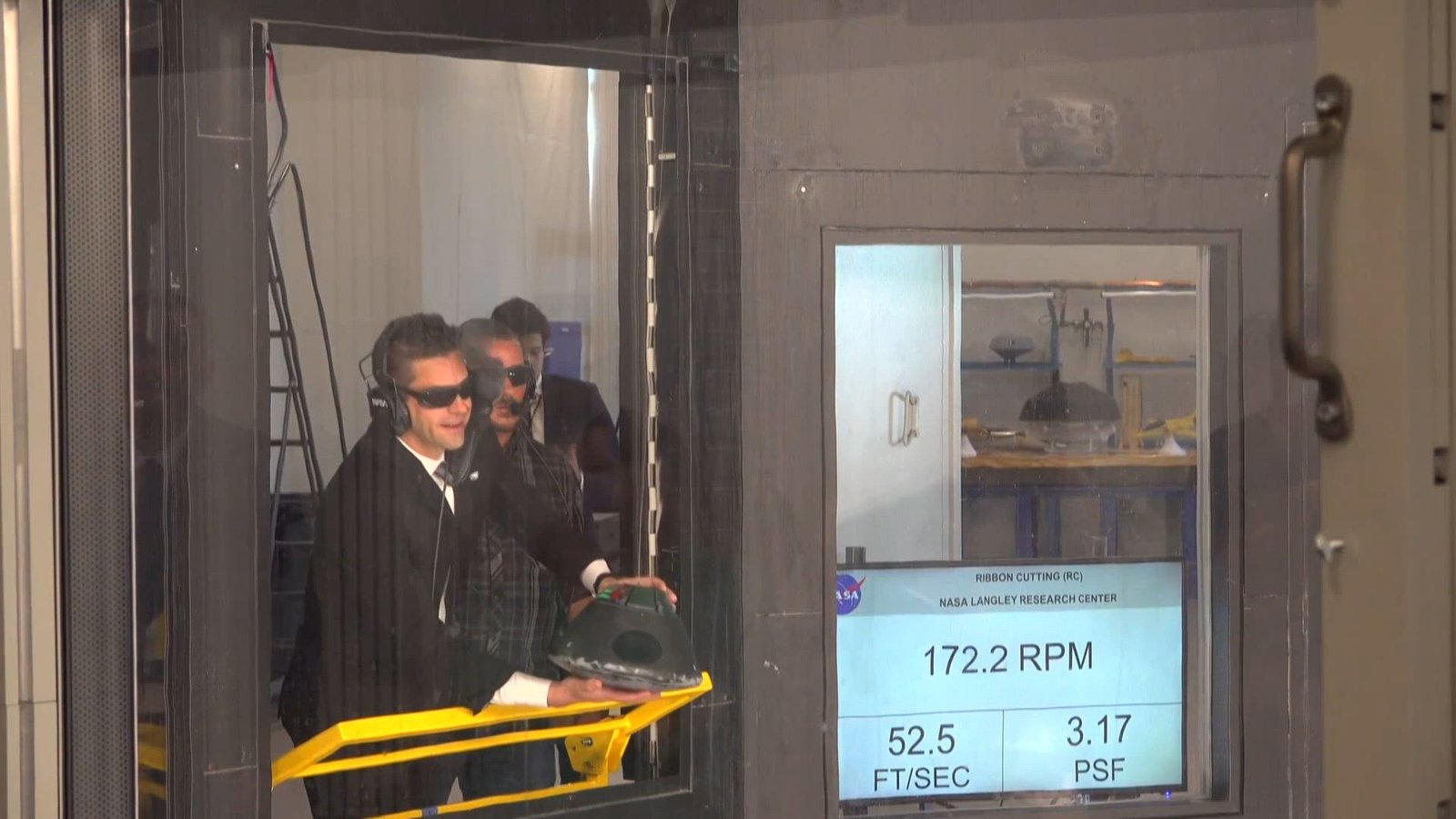
The facility was officially dedicated during a ribbon-cutting ceremony attended by Dyal, NASA Administrator Jared Isaacman and U.S. General Services Administration Administrator Edward Forst, whose agency partnered with NASA to build the project.
Isaacman said facilities like the new wind tunnel allow engineers to learn more about a vehicle’s performance before expensive hardware is built or missions begin.
“You would rather learn as much as you can about the vehicles that we’re designing, in a test environment like this,” Isaacman said. “It’s a great way that we can continue to learn very quickly, advance the next generation of aircraft and, obviously, spacecraft.”
Isaacman said the facility will help NASA move faster while making smarter investments in future missions.
“When you talk about reducing risk, saving cost and being good stewards of taxpayer dollars, facilities like this enable us to accelerate the pace in which we discover,” he said.
NASA leaders also said the new facility replaces two older wind tunnels, allowing the agency to consolidate testing capabilities into one modern research center while focusing resources on future technologies.
One mission already expected to benefit is DAVINCI, NASA’s planned mission to Venus.
Dr. Hayden Dean, a senior aerospace engineer at NASA Langley and the aerodynamics lead for the mission, said the facility will help researchers better understand how the uniquely shaped spacecraft will travel through Venus’ dense atmosphere.
“Facilities, especially low-speed facilities like the FDRF, help us study that characteristic to make sure that we are properly modeling how this vehicle moves to ensure all the scientists are going to get the exact science they want when we finally land on Venus,” Dean said.
The DAVINCI mission, expected to launch sometime in the 2030s, would be NASA’s first mission to Venus in nearly 50 years. Scientists hope it will provide new insight into how the planet evolved and whether it may have once been habitable.
NASA says the Flight Dynamics Research Facility will also be available to support research conducted with industry and academic partners, ensuring the center continues its role as a leader in aeronautics and space research for decades to come.