If You Call These Cars JDM, You’ve Been Getting It Wrong
Japanese Domestic Market, better known as JDM — it’s a title which carries weight in the United States, without any doubt. People take pride in having something otherwise unobtainable here, myself included — I imported my JDM R34 Skyline last year, so I’m as guilty as anyone else. And even well before then, I always found myself fascinated by the fact that the same car can have two completely different configurations depending on the region, and that extends well beyond which side the steering wheel is on.
Take the Honda Accord Euro-R, for example, with its distinctive “Red-Top” H22A engine — despite the name, it’s actually only sold in Japanese markets. There’s a mystique behind cars like that; we want what we can’t have, put simply. It’s likely why you see a lot of rebadges as well. Think of the Acura to Honda Integra or NSX, for example, or front-end swapping a 240 to make it a Silvia lookalike. Frankly, as a girl who’s been actively involved in the automotive culture for around three decades now, I’ve seen a lot of this. But just because you have a JDM front end doesn’t make it a JDM car.
That’s not always a bad thing, though. It took me two months to get a water pump because Nissan never sold the RB engine stateside, so I have to buy my parts directly from Nissan’s warehouse in Japan. It’s a huge pain, especially if you’re dailying the car like I do. A good way to circumvent that is to get a USDM car that looks like a JDM car — but that also causes some confusion (sometimes by design). Let’s take a look at a few examples of this.
Nissan Skyline / Infiniti G-Series
Okay, as an R34 Skyline owner — not the one worth stupid-money, mind you — I’m obliged to talk about this car as a matter of principle. As many JDM fans know, there was no U.S. equivalent of the R-platform Skyline — R30 through to R34, specifically, or any Skyline prior to that. But Nissan consolidated a number of models in the early-2000s as part of a widespread revamping. Models like the Silvia were dropped while the Skyline and Fairlady Z underwent radical restyling, becoming what we know today as the G-platform for the former. In other words, the Infiniti G35 is, for all intents and purposes, the first USDM-issued Skyline. Is it JDM, though? No. Still an excellent car in its own right, I hasten to add — I can’t stand the holier-than-thou attitude of, “It’s not a REAL Skyline.” It is.
Nevertheless, there were some key differences between the two markets, primarily in the drivetrain. The base-model Skyline, namely the 250GT, featured a VQ25DD powerplant, a direct-injection 2.5L V6. Then you have the VQ30DD in the 300GT, both RWD platforms. Or you could opt for the 250GT Four, which followed the previous R34 Skyline’s nomenclature — the “Four” meant it was four-wheel drive. None of those were options on the USDM model, which initially featured exclusively RWD coupled to the larger VQ35 engine.
The Skyline nameplate is actually still ongoing — you might know it today as the Infiniti Q50. Various models were created exclusively for Japan as well, including the 2023 Skyline NISMO, which includes a more powerful engine, improved body rigidity, tuned suspension, and grippier tires (along with the distinctive body kit).
Toyota Soarer / Lexus SC
Fun fact: I actually did a piece many moons ago about undercover Toyota Soarers, digging up old police records to see exactly what they were equipped with. And guess what — they boasted a twin-turbocharged 2.5L 1JZ-GTE under the hood, an engine which was infamously never offered in the United States. So right away, if it’s a factory turbo, it’s not a Lexus.
The JDM Soarer featured three engine options, in fact: the 2JZ-GE (yes, it’s one of several 2JZ-equipped vehicles), the 1UZ V8 out of the Lexus LS, and the 1JZ-GTE exclusive to Japanese markets. Conversely, the USDM Soarer, known as the Lexus SC, was available as either an SC300 (2JZ) or SC400 (1UZ).
While the faster factory twin-turbo JZZ30 Soarer was indeed a JDM exclusive, it’s by no means the only difference between these two markets. Toyota has a habit of doing this — for example, the Toyota Celsior (a Lexus LS400 here) has two windshield washer buttons, with the second spraying a special hydrophobic fluid for quickly melting snow. JDM Toyota Soarers were likewise packed with weirdly specific technology not seen in USDM cars, such as active suspension systems and four-wheel steering.
While the Toyota Soarer is well-known as an important JDM car, that doesn’t mean the USDM SC300 is any less desirable or special. It’s been called the Diet Toyota Supra for a reason; at the end of the day, it’s still a desirable, luxury grand tourer available with a 2JZ and manual transmission. The JDM model just takes all that quintessentially Japanese weirdness and cranks it up to 11, so in addition to the different powertrains, you’re likely to run into many other differences between the two.
Nissan 240SX / Nissan Silvia
This is probably one of the most egregious examples I’ve seen at car meets and such — a left-hand drive Nissan 240SX with a Silvia front end and badging. They actually came in two variants, namely the S13 and S14 — there was never an S15 equivalent for the United States market. I’ll address them both in one lump because they’re both equally guilty for the same thing.
Now, S-platforms are probably one of the most frequently-modified cars of all time. Front-end swaps onto 180SXs (and vice versa) are so common that they have nicknames — Sileighty and Onevia, respectively. Let’s talk about the Onevia for a second; what is that, exactly? Put simply, it’s a Silvia with a 180SX front end, distinguished by that shark-nose and pop-up headlights. Why’s that so important, though? Because the coupe variant of the USDM 240SX is literally just a Onevia with a different engine. So you can easily just put a Silvia front-end on a 240SX, and it’ll pass the smell test, as long as you don’t notice the left-hand drive steering.
The Silvia and 180SX alike used the CA18 and its turbo variant in the K’s model. It’s a DOHC 1.8L engine that’s substantially different to the KA24E, originally a SOHC 2.4L naturally-aspirated engine producing less power. Then along came the S14 generation, introducing the newer 240SX with the KA24DE DOHC, producing a modest 155 horsepower. That’s a full quarter less than the 202-hp SR20DET the turbocharged JDM Silvia K’s produced by comparison — sadly we never got that engine stateside. But we did get pop-up headlights, so that’s nice. Pop-up headlights are cool, and it’s a crying shame that we never see them on new cars.
Acura NSX / Honda NSX
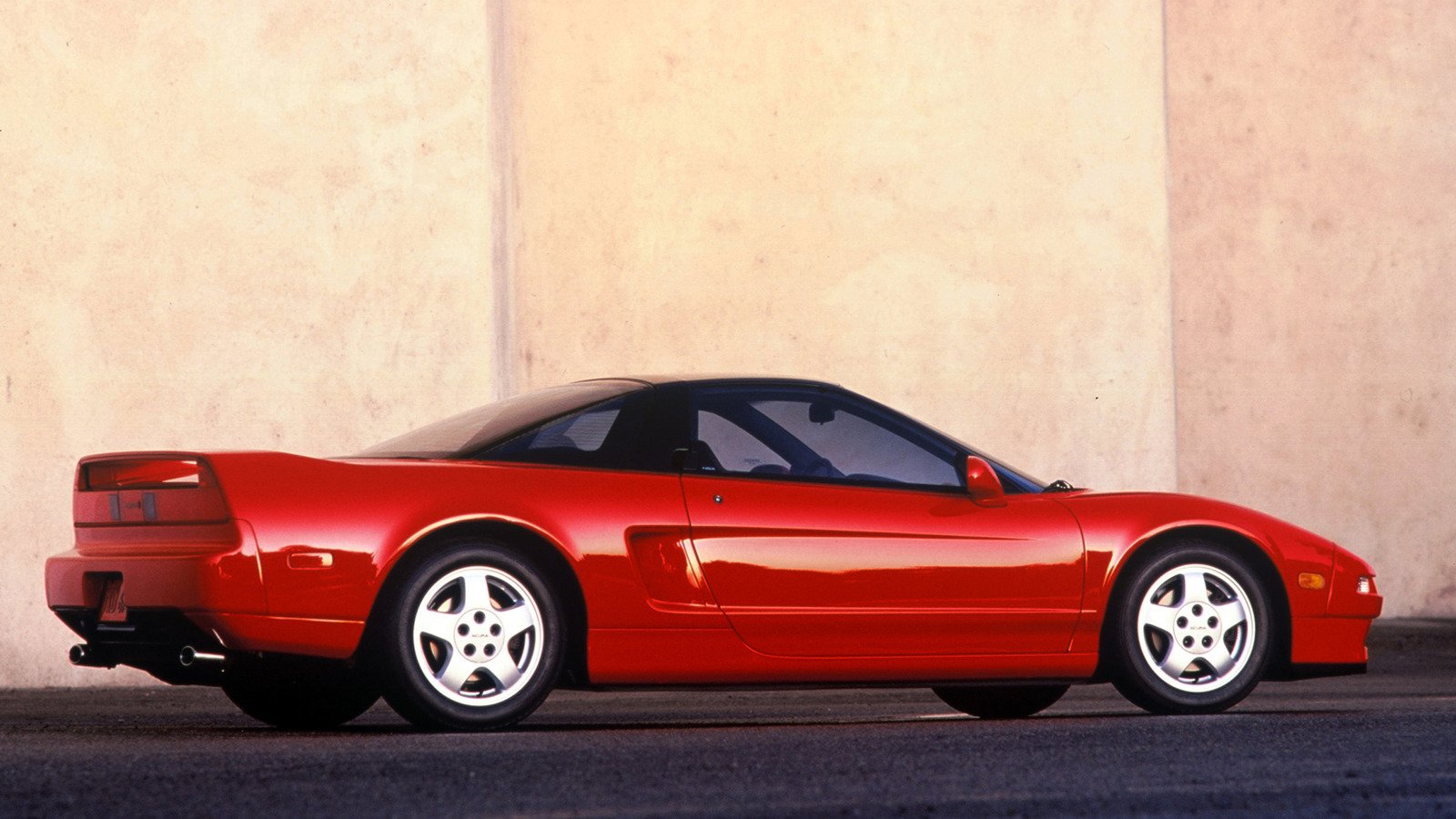
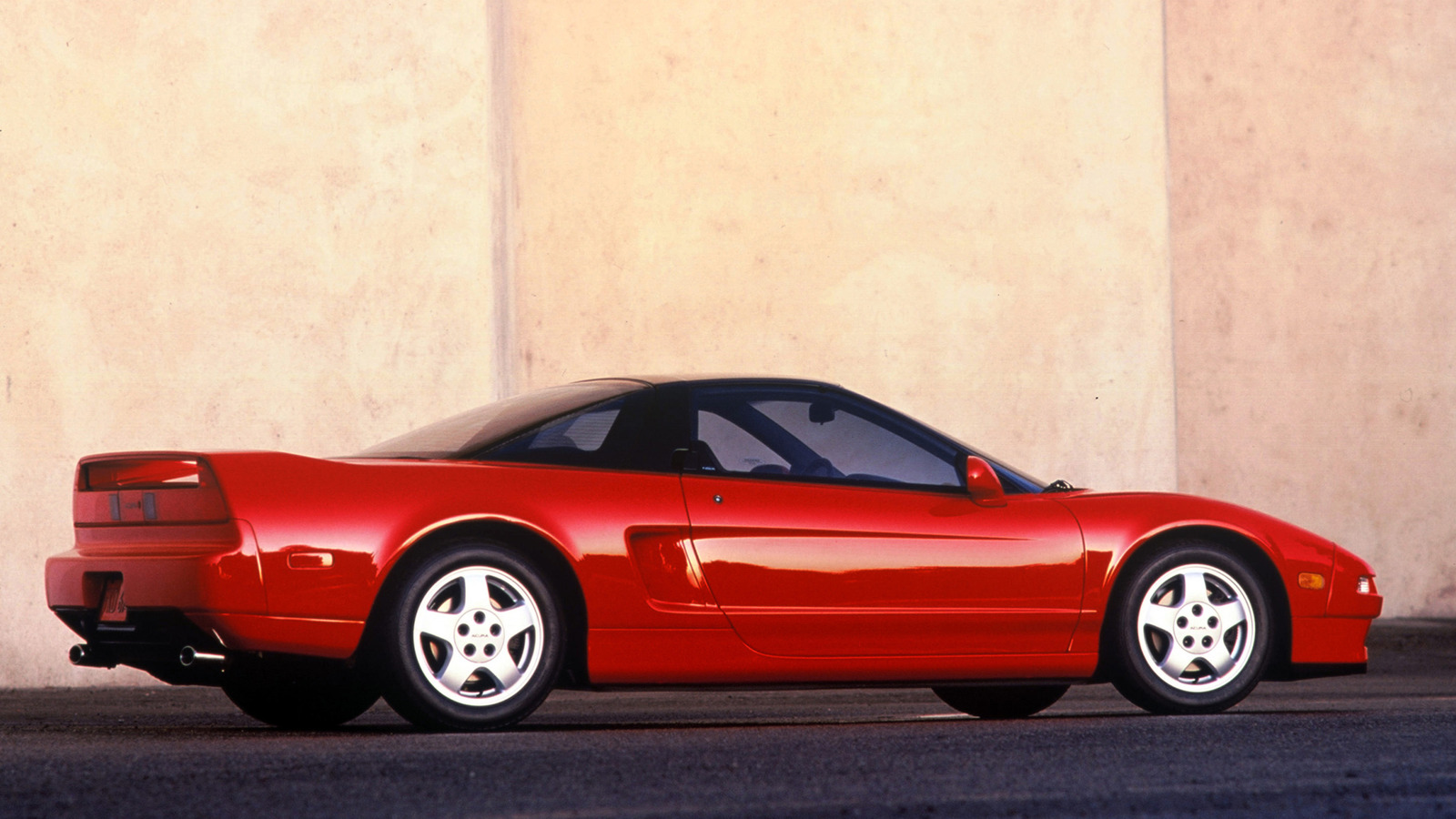
I remember playing the original PS1 Gran Turismo games and being perplexed as to why there was both an Acura and Honda NSX that seemingly were the exact same cars. Fast-forward almost 30 years and that trend is still going strong because of how many times I’ve seen rebadges — there’s always someone with an early USDM NSX, an already incredibly valuable and unique sports car, with Honda badges on it. I’ve actually had several heated arguments with people over the existence of the original Acura NSX because these rebadges are so common that people don’t even know they’re Acuras.
This is a case of badge-engineering in its purest form — the Acura and Honda NSX are the exact same cars, at least the base-models are. The main difference becomes apparent when you dive into trim levels; take the NSX-R, for example. It’s regarded as one of the purest driving machines in the world for a reason; it’s a stripped-down, racing-oriented version of what is ostensibly already an extremely driving-focused vehicle. And, of course, it’s only available in JDM markets.
It’s because it’s so identical and instantly recognizable that this car is often mistaken as a JDM car in spite of its Acura badging, but unlike the previous entries, this one honestly doesn’t matter that much. It has the same powertrain, the same options, weight distribution, driver-centric experience — everything is the same, apart from the driving position. And as someone who dailies a JDM car, I can say with certainty that it has many unexpected downsides, such as terrible blind spots when merging onto the highway. You don’t get that with a USDM NSX, but you still get the same experience, and that matters.
Honda Integra / Acura Integra Type R (DC2)
Last but not least is another car with a commonly-swapped front end: the Honda and Acura Integra. I’ll be specifically talking about the DC2 — the 90s ones with the quad round headlights we got in the States — the first and most obvious difference here is that Japan never got those lights. JDM Integras have their own front bumpers, boasting long single-piece lights with a central grille. The rest of the body looks fairly similar, though there’s a world of difference between the two at a deeper glance.
Let’s take a look at the JDM Integra Type R. A quick glance at the interior betrays a set of factory-equipped Recaro seats, whereas the USDM variants just had specially-upholstered units. The engine produced two more horsepower in JDM spec — 197 over the USDM 195 hp. And it was far lighter, to the tune of 2,380 pounds versus the USDM’s 2639 pounds. So you’re getting a car with slightly more power and far less weight, with aggressively-bolstered seats, a distinctive front end, and other modifications.
Of course, the parts-commonality between the two variants means it’s trivial to just buy a JDM front end and swap it over, in addition to parts-availability making it cheap to maintain — as is the JDM variant, for that matter. The end result, much like the 240SX, is a USDM car that appears to be a LHD Honda Integra. I think part of it is a case of the grass being greener on the other side. But unlike something like the NSX, the Integra Type R is demonstrably a better-performing vehicle in JDM trim versus USDM, which likely influenced more than one DIY JDM conversion.