A Relativistic Jet Could be an Indication of the ‘Missing-Link’ for Black Holes
A team of Chinese astronomers using the Very Large Array (NSF VLA) recently detected a rare transient event taking place in a dwarf galaxy 3.4 billion light-years from Earth. The event, known as AT2019ijn, consisted of an intermediate-mass black hole tearing apart a star, which appeared to reveal the afterglow of a powerful jet. It was first detected by the massive burst of radio energy that appeared as a bright blue flash in optical surveys, peaking just a few days before fading much more slowly than similar transient events normally do. Their results were recently published in the *Astrophysical Journal Letters*.
When examining the radio observations later, astronomers found that the radio emission continued to brighten for nearly two years, reaching a luminosity far beyond that observed in other stellar explosions, and then slowly faded over at least four years. The team concluded that this was due to a tidal disruption event involving a middleweight black hole (those with 100 to 100,000 Solar masses) and a star that fell into its gravity well. These findings address a “missing link” in astronomical observations regarding intermediate-mass black holes.
This refers to black holes that fall between stellar-mass black holes, which typically range from 5 to 100 Solar masses, and supermassive black holes (SMBHs), which range from 100,000 to tens of billions of times the mass of our Sun. As their name suggests, stellar-mass black holes are formed by collapsing stars, which can be found throughout the galaxy. SMBHs, in contrast, are found only within the cores of most galaxies and play a major role in their evolution.
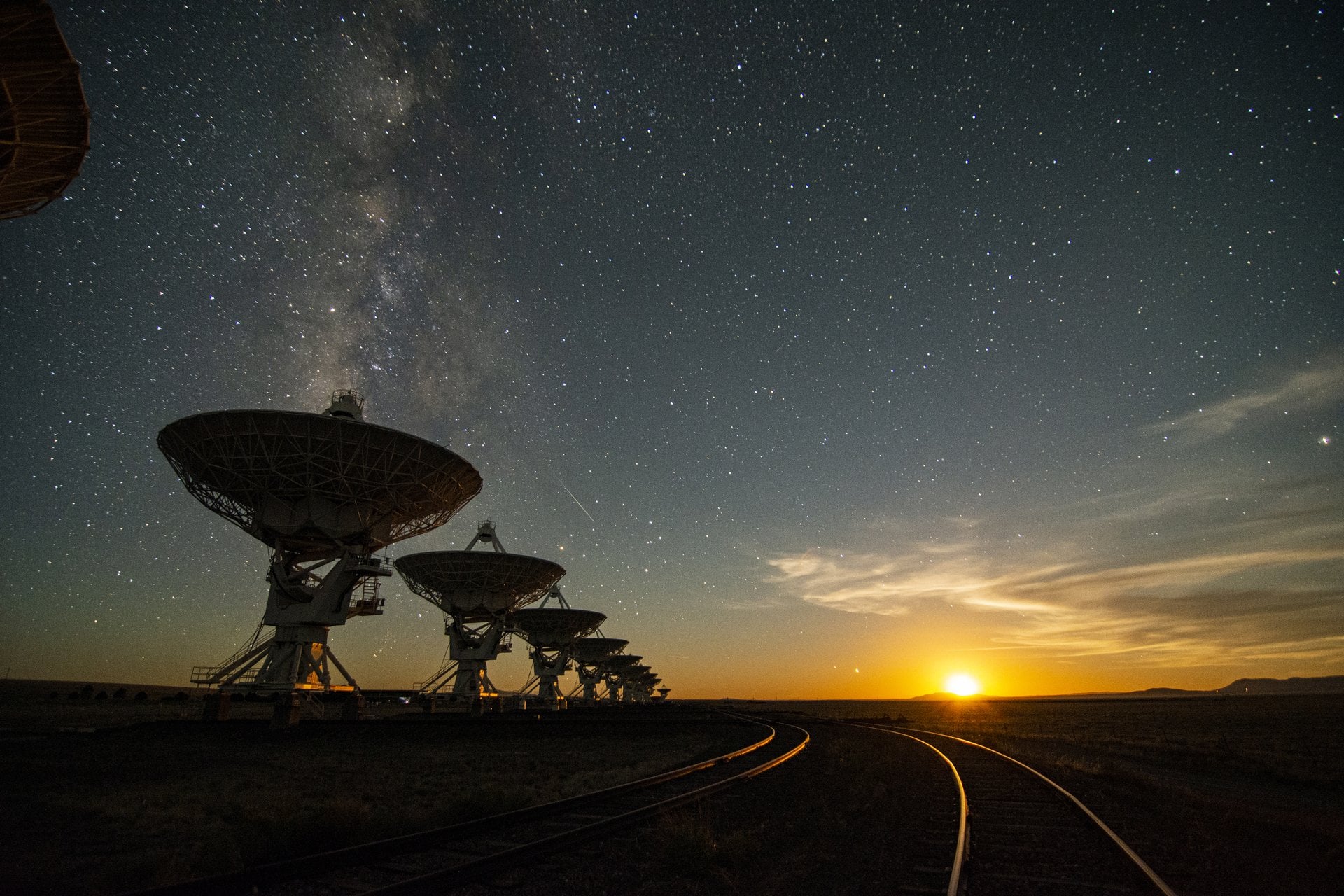 *The NRAO’s Karl G. Jansky Very Large Array (VLA) at sunset. Credit: NRAO/NSF*
The team combined optical survey data with radio observations from the NSF VLA, including the Very Large Array Sky Survey (VLASS), one of the largest all-sky radio observations ever mounted. They then included additional measurements from the Australian Square Kilometer Array Pathfinder (ASKAP) radio telescope in Australia, as well as the upgraded Giant Metrewave Radio Telescope (GMRT) in India. The broad coverage this enabled allowed the researchers to track how AT2019ijn’s signal changed over time.
This further allowed them to test various astronomical models for expanding outflows powered by tidal disruption events. The results suggest that the radio emissions originated from material accelerated to a significant fraction of the speed of light. This was best explained by a narrow relativistic jet moving perpendicular to our line of sight, which is why the radio flare appeared to arrive much later than expected.
These results are consistent with a new population of transient events that astronomers have noted in recent years, thanks to the development of high-cadence wide-field optical surveys. Known as fast-evolving blue optical transients (FBOTs), these events are characterized by a rapid rise to peak brightness within about 10 days and appear blue as they approach their peak. This is followed by a long period of dimming, lasting for about a month, until it reaches post-flare brightness.
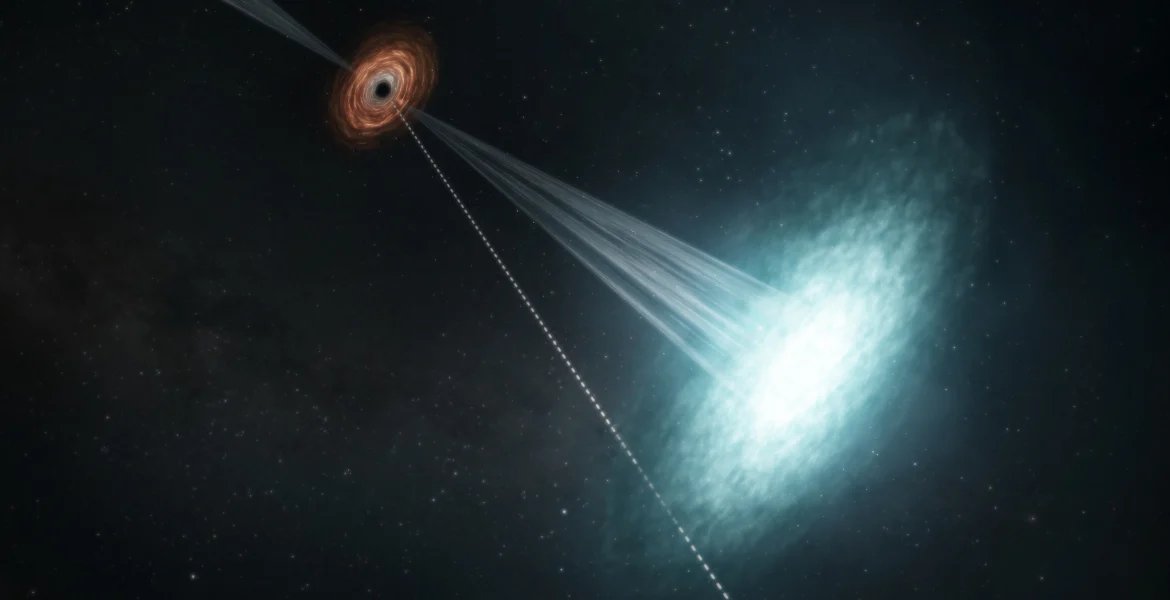
This presents exciting opportunities for future surveys, as intermediate-mass black holes have rarely been observed, and astronomers have been seeking new ways to identify them. AT2019ijn presents one such path, wherein an intermediate-mass black hole launches a jet that is not aimed directly at Earth. Such an event would appear unremarkable at first, but would then brighten dramatically at radio wavelengths as the jet slows and its afterglow becomes visible.
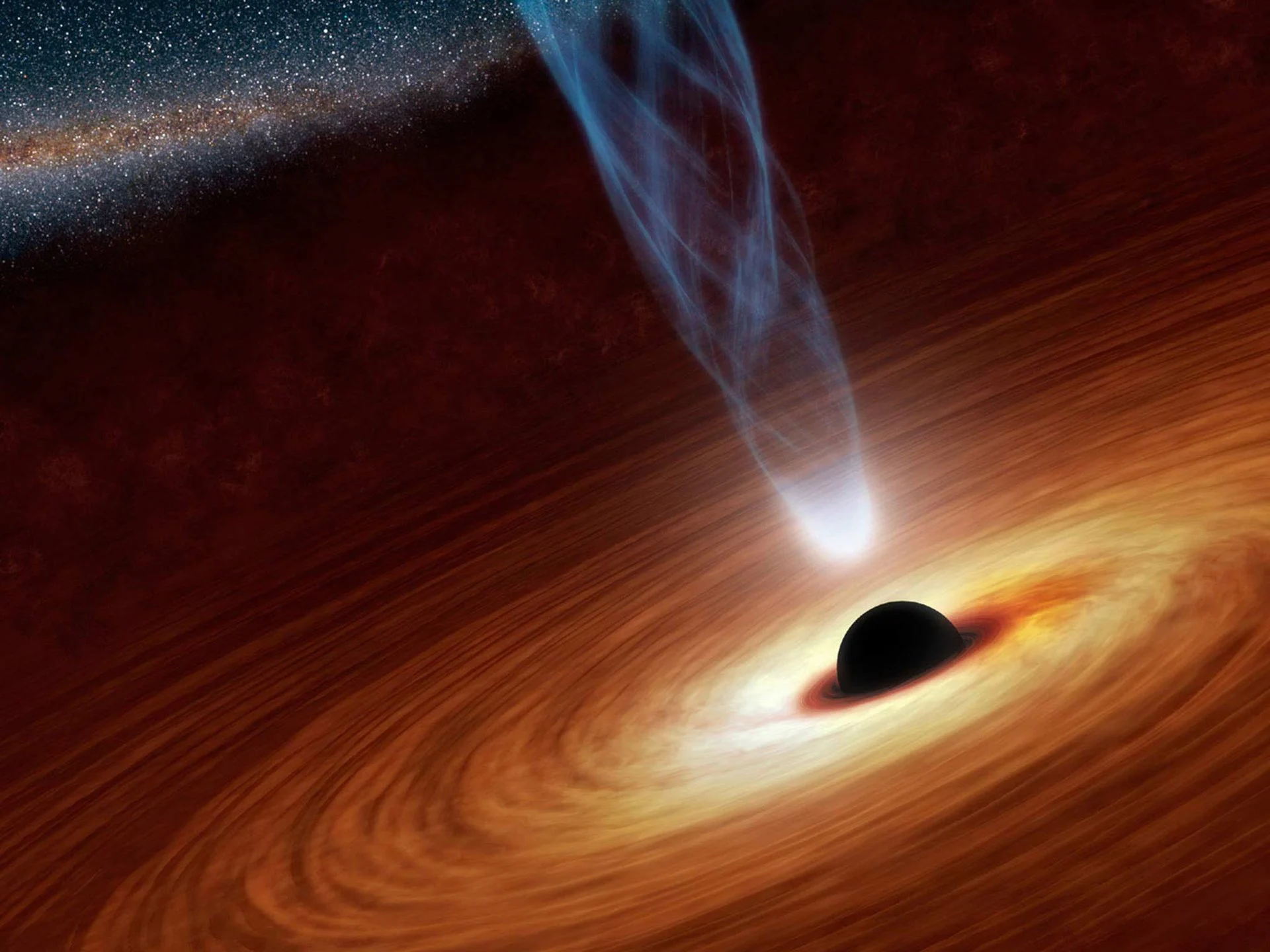 *Artist’s impression of a relativistic jet extending from a supermassive black hole at the center of a galaxy. Credit: NASA/JPL-Caltech*
What is particularly significant about this discovery is how it offers a new method for searching for hidden black holes and the extreme jets they launch. It also suggests that some unusual optical transients may actually be part of a new class of black hole-powered events that have been overlooked or dismissed because their radio peaks arrive long after the initial flash. Astronomers anticipate that new surveys that combine optical light and radio waves will find more events similar to AT2019ijn.
It also suggests that some unusual optical transients may be part of a broader family of black-hole-powered events that have been missed because their radio peaks arrive long after the initial flash. As new sky surveys repeatedly scan the heavens in both visible light and radio waves, astronomers expect to find more events like AT2019ijn. These events could lead to a new understanding of intermediate-mass black holes, revealing how they form, evolve, the frequency with which they consume stars, and produce jets.
Further Reading: NRAO, The Astrophysical Journal Letters