An Obscure Asteroid Turns Out to Be a Dark Comet — a Mysterious Group of Hidden Comets

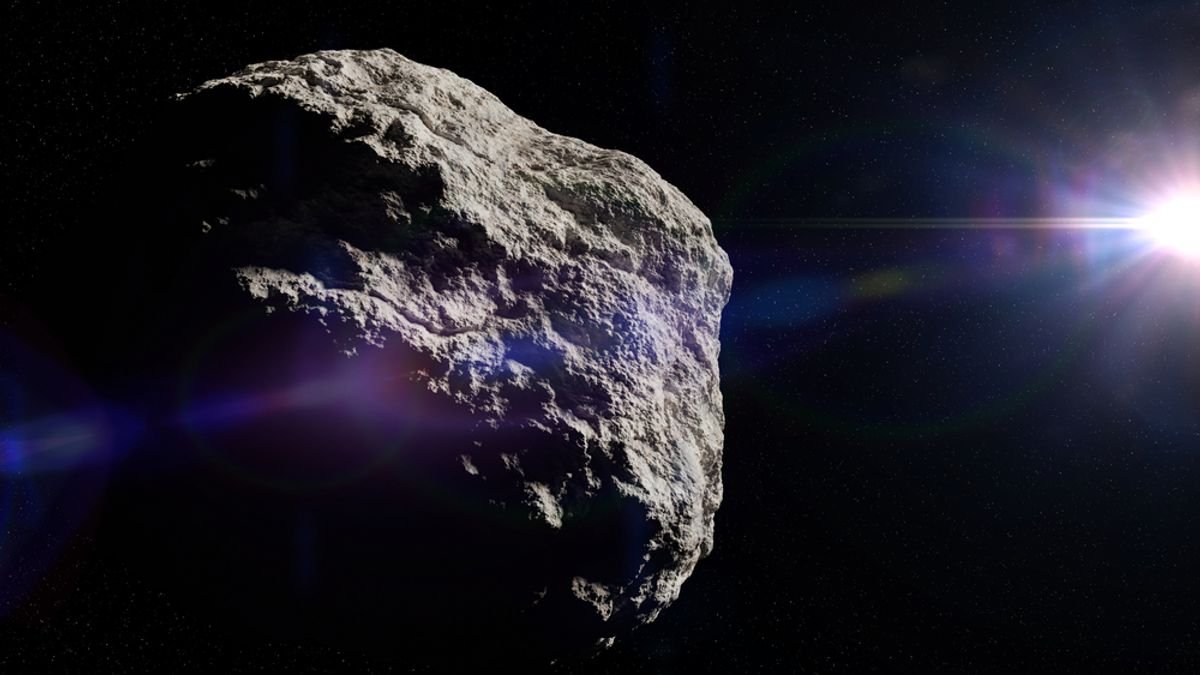
Some near-Earth objects orbiting in space have a serious identity crisis. They may look like asteroids, but in reality, they could be comets that don’t flaunt their glowing features despite behaving similarly to brighter and more active comets. These enigmatic objects are called “dark comets,” and there may be a lot more of them out there than we previously thought.
A new study published in Nature Astronomy has identified one mysterious dark comet, 1998 SH2. This object’s identity has always been a bit hazy — it’s currently classified as an asteroid, since previous observations hadn’t caught any activity typical of most comets. But more recent observations noticed something odd: 1998 SH2 displayed a faint tail, suggesting that it actually is a comet.
It turns out that 1998 SH2 is likely one of many objects in space that are secretly dark comets. Researchers say these objects have implications for planetary defense and understanding how water was delivered to an early Earth.
A Hidden Population of Dark Comets
The glowing cloud surrounding them (called a coma) and an extended tail typically identify a comet. Usually, comets formed much farther away from the Sun than asteroids, leading to a more icy composition.
Comets are also set apart from asteroids by changes in their movement, accelerating as they approach the Sun; this is because a comet undergoes outgassing as the Sun’s heat causes the ice on the comet’s surface to sublimate, meaning it goes straight from a solid to a gas.
Not all comets, though, exhibit the same brightness. In recent years, according to the new study, astronomers have observed 14 near-Earth objects that are inactive, yet behave like comets. These objects, given the name dark comets, have been separated into two groups: inner dark comets that are smaller in size and have orbits close to that of Earth, and outer dark comets that are much larger and have orbits similar to those of Jupiter family comets.
Read More: Origins of Comet 3I/ATLAS May Have Been Extremely Cold, Beyond Our Solar System
Tracking Down a Comet Tail
Although classified as an asteroid, 1998 SH2 has an orbit in line with other outer dark comets.
On Aug. 30, 2025, the object made a close approach to Earth, and the day after, an observatory in Brazil provided tracking data showing that it had experienced non-gravitational perturbations that a comet would usually go through.
After this discovery, researchers investigated the possibility that 1998 SH2 could be a comet. In September 2025, using the Canada-France-Hawai’i Telescope on Maunakea, Hawai’i, they tracked the object and found that it had displayed a faint tail.
Later that month, they obtained another series of images using the European Southern Observatory Very Large Telescope Unit 1 in Chile, confirming that a narrow tail was extended southwest from the object.
The images revealed that the object was releasing dust like a comet and that the release happened continuously.
Watching Out for Unpredictable Comets
There are a few potential reasons why 1998 SH2 and other dark comets are much fainter than the typical bright comets. According to a December 2024 article in The Conversation, it may be due to the small size of many dark comets, meaning they have less surface area for material to escape and create the tails and comas we usually see.
Another factor could be their rapid spin, making them less visible by scattering gas and dust in all directions. Or, it might just be that they’ve depleted much of their gas and dust.
As of late 2025, there are 2,009 known near-Earth asteroids with orbits that are similar to those of Jupiter family comets, according to the researchers. Some of these asteroids, like 1998 SH2, might actually be dark comets. The researchers claim that these objects could influence approaches to planetary defense, as they could have trajectories that are more unpredictable than previously believed (though the probability that 1998 SH2 will hit Earth is still zero).
There’s even a chance that these dark comets may have played a role in delivering water to Earth billions of years ago. Overall, these mysterious objects may be something that astronomers need to keep an eye on in the future, as more might turn out to be secret comets.
Read More: Comet MAPS Breaks Apart Near the Sun, Becoming a Rare Headless Wonder
Article Sources
Our writers at Discovermagazine.com use peer-reviewed studies and high-quality sources for our articles, and our editors review for scientific accuracy and editorial standards. Review the sources used below for this article: