NASA’s Viking I Landed on Mars 50 Years Ago and Transformed the Search for Life
In the 1970s, NASA scientists wondered about possible life on Mars. They weren’t expecting to find little green men like The Great Gazoo from The Flintstones. Rather, they suspected there might be microbial life on the Red Planet.
In 1976, NASA sent up two spacecraft, Viking I and Viking II. This year is the 50th anniversary of Viking I landing on Mars. Viking I landed on July 20, 1976, making it the first successful Mars lander.
The twin robotic spacecraft conducted experiments to detect life, and although they didn’t provide conclusive answers, they sparked a revolution in space study.
“Viking transformed Mars from a world of speculation into one of scientific exploration,” Aaron McKinnon, the science communication lead for the science directorate at NASA Ames, told Discover.
Viking I, The First Visitor On Mars

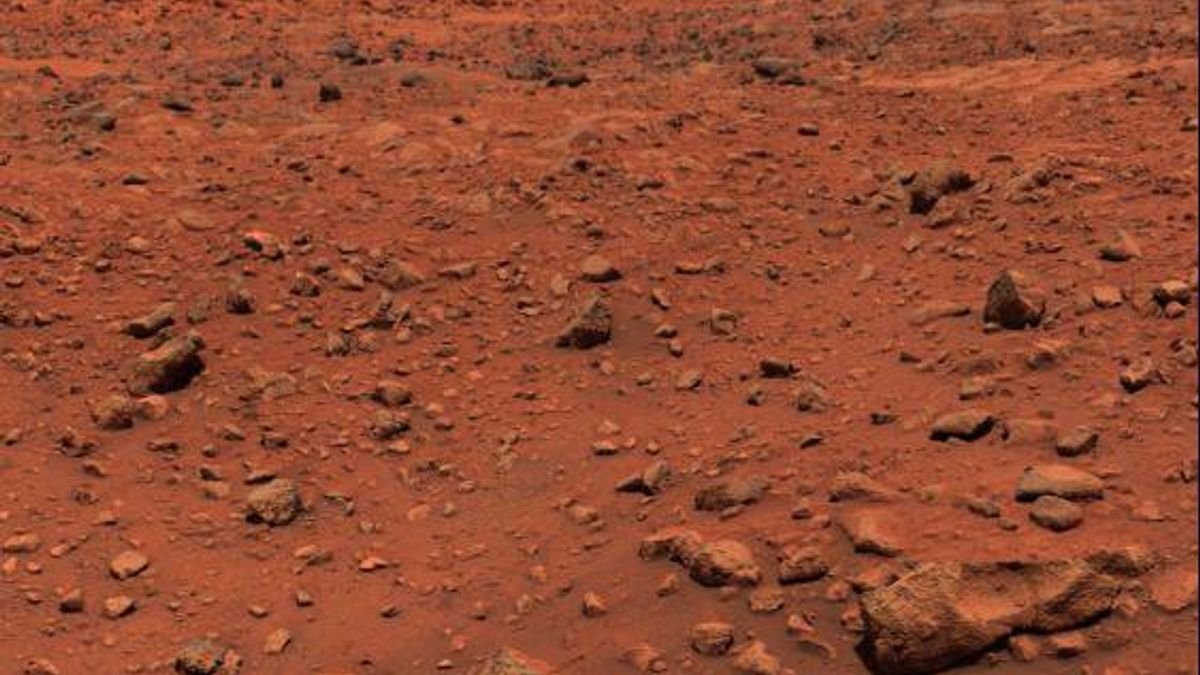
First panoramic view of the surface of Mars taken by Camera 2 on Viking 1. The image shows Chryse Planitia on July 20, 1976.
(Image Credit: NASA)
Currently, a rover dubbed Perseverance is on an active mission on Mars looking for signs of ancient life, according to NASA. Perseverance is one rover in a long line of robotic visitors dating back 50 years to Viking I.
In his NASA research, published in Astrobiology, McKinnon examined the archives and reviewed the plans for the Viking landing and tests. He saw the original engineering schematics and the notebooks the scientists kept.
“Viking is remarkable for both its ambition and its accomplishments. Scientists knew very little about Mars geology and atmospheric chemistry, yet they designed three independent experiments to test whether Martian regolith showed signs of metabolism or respiration,” McKinnon said.
Viking I had three biological experiments — Labeled Release (LR), the Pyrolytic Release (PR), and Gas Exchange (GEx) — each of which took samples from the red planet and conducted analyses to determine whether there were any traces of microbial life, according to a second Astrobiology study.
“Two of the experiments found no definitive evidence of life, while one produced results that sparked debate before scientists concluded that the presence of previously unexpected Martian surface chemicals reacting with the experiment, rather than biology, was likely responsible,” McKinnon told Discover.
Read More: Dust Devils on Mars Crackle and Pop with Electricity, Showing How Sparks Fly in Martian Storms
How Viking II Followed Viking I

NASA’s Perseverance Rover takes a selfie, highlighting the advances in space technology 50 years after Viking I touched down in 1976,
(Image Credit: NASA/JPL-Caltech/MSSS)
Viking II landed on Mars in September 1976 and sent its final transmission in April 1980, according to NASA. Viking I sent transmissions for more than six years, making it the longest extraterrestrial surface mission until the Opportunity rover operated for more than 14 years.
Both Viking missions gave scientists a wealth of data that is still valuable today. A 2025 study in Communications Earth & Environment, for example, used data from the Viking 2 landing site to analyze possibilities for perchlorate brine formation.
“Scientifically, Viking established the baseline for understanding Mars as a planetary environment, rather than a world imagined through science fiction,” McKinnon said.
What Did Viking I Discover?
Although scientists initially thought the Viking tests were inconclusive, they now have a different understanding about the possibility of life on Mars.
“Viking revealed a planet whose surface and atmosphere are influenced by dust storms and whose geologic history is complex,” McKinnon said. “It also provided evidence that liquid water once existed on the surface, prompting scientists to think about the possibility of finding evidence of ancient life.”
NASA has had a consistent presence on Mars since 1997, and scientists now have decades of data to scrutinize. Interestingly, McKinnon says many questions that are being asked today have similarities to the ones scientists wrote about in those archived notebooks all those years ago.
“Fifty years later, we’re still asking many of the same questions about Mars, but with better tools, better data, and an even greater appreciation for how difficult the search for life really is,” McKinnon concluded.
Read More: 50 Years Ago, a Forgotten Mission Landed on Mars
Article Sources
Our writers at Discovermagazine.com use peer-reviewed studies and high-quality sources for our articles, and our editors review for scientific accuracy and editorial standards. Review the sources used below for this article: