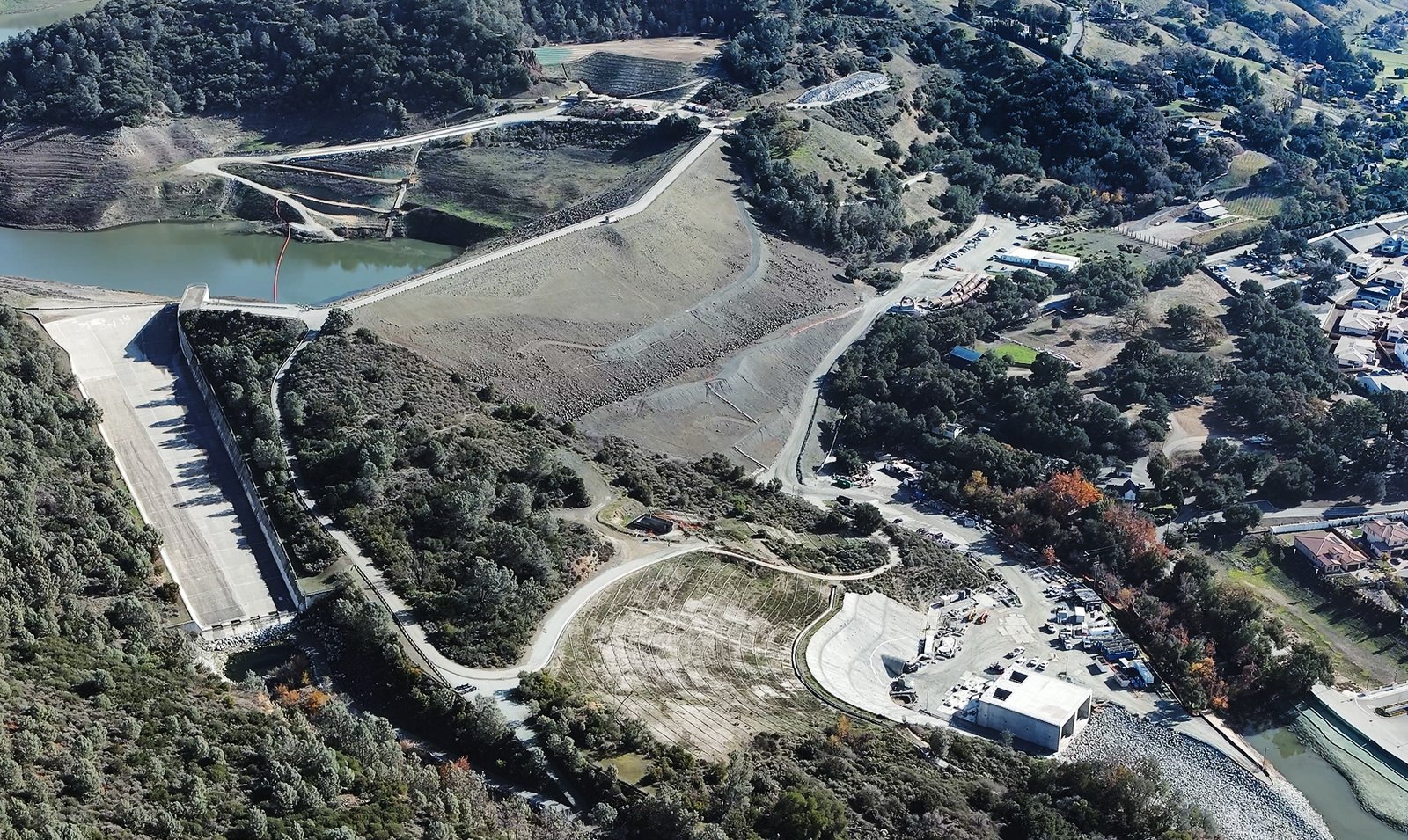
Anderson Dam: Water district awards construction contract in $3.2 billion project to rebuild largest dam in Santa Clara County
In a major milestone after years of delays and cost increases, the Santa Clara Valley Water District has approved a construction contract to tear down and rebuild Anderson Dam, the largest dam in Santa Clara County, and bring the aging 240-foot-tall structure up to modern earthquake standards.
The San Jose-based government agency awarded the $1.88 billion contract on Friday to Flatiron-Dragados-Sukut, a joint venture of major engineering firms Flatiron-Dragados and Sukut Construction based in Concord.
Work on the massive project, one of the largest public works projects in the Bay Area in recent years, is scheduled to begin Jan. 1 and finish by 2033.
 “I’m really happy that we’re here,” said Tony Estremera, chairman of the water district, which provides water and flood protection to 2 million residents of Santa Clara County. “We’re probably the only district that’s building a reservoir in the state right now. This is a rebuild, but it is a complete rebuild. We’re pretty proud that we’re at this point.”
Next year, crews will build six miles of haul roads and two temporary bridges in the lands around the dam. From 2028 to 2030, they plan to tear down the old dam, removing roughly one-third of it per year.
The dam, a hulking earthen structure along Highway 101 between San Jose and Morgan Hill, was built in 1950. When its reservoir is full, Anderson holds 89,278 acre-feet of water — more than the water district’s other nine reservoirs combined.
The new dam — nearly identical in size, but with more modern compaction, a wider base, better anchoring to bedrock, and modern drainage and instruments — will be built in 2031 and 2032, and should take roughly two years to fill under average winter rainfall, said Aaron Baker, one of the district’s civil engineers overseeing the project.
“The old dam was built to the standards of the 1950s,” Baker said. “But it has seismic deficiencies with the current standards. We are retrofitting this facility so it will be seismically safe during major events in the future. It’s a public safety project.”
When the district built the dam during the Truman administration, scientists thought the nearby Calaveras Fault was inactive. And water district officials believed that the dam was anchored in bedrock.
But an engineering firm performing tests required by federal regulators in December 2008 found that the dam’s foundation contains sand and gravel, which could shift in a major quake. Specifically, a 6.6 magnitude quake on the Calaveras Fault directly at Anderson Reservoir, or a 7.2 quake centered one mile away, could cause the huge earthen dam to slump and fail, they concluded.
Although unlikely, a complete failure of Anderson Dam when the reservoir was full could send a 35-foot wall of water into downtown Morgan Hill within 14 minutes, engineers concluded. The waters would be 8-feet deep in San Jose within three hours, potentially killing thousands of people.

In 2011, the water district planned to strengthen the existing dam; officials said the cost would be $193 million, with construction beginning in 2017 and taking three years. But new trace faults found in the area required a new dam to be constructed, doubling the price by 2016 to $400 million.
The water district began design work and searched for funding. But in 2017, everything changed when the spillway at Oroville Dam near Butte County, the tallest dam in the United States, crumbled during a major winter storm, causing emergency officials there to evacuate 180,000 people over fears the dam might collapse.
Frustrated at the slow pace of the upgrade and alarmed by the near-failure of Oroville Dam, the Federal Energy Regulatory Commission in February 2020 issued a dramatic order requiring the Santa Clara Valley Water District to drain Anderson and repair its dam.
Federal regulators also required the district to build a huge new outlet tunnel first to ensure the reservoir could be drained quickly in an extremely wet year. Breaking the project into two segments — the tunnel and the dam rebuilding afterward — increased the timeline, further raising the price tag.
The 1,700-foot tunnel project is under construction now and is scheduled to be finished in November.

By 2023, the district estimated the entire job would cost $2.3 billion. That included $1.9 billion to tear down and rebuild the dam, and $400 million for the tunnel and other related projects, like stronger flood protection on sections of Coyote Creek downstream in San Jose.
The current total cost has now risen by roughly 50% to $3.2 billion. Of that, $2.8 billion is for the dam, including Friday’s $1.88 billion contract and another roughly $900 million for staff time, engineering work, design work, environmental offsets and securing permits from 13 federal and state agencies between 2011 and 2033.
Estremera said inflation, the increased costs of labor and building materials under President Trump’s tariffs all drove the price tag higher. Most of the cost will be paid in higher water rates over the coming decades, although Estremera said the district will continue to seek federal and state funding.
“The public is experiencing the same problems we are,” he said. “Costs continue to go up. Unfortunately, the costs are way too high. We have too much inflation, too many tariffs, and this administration is not doing anything to help us. We try our best to keep costs as low as possible. But it is really necessary for us to rebuild Anderson.”
Last year, the district abandoned plans to build a new reservoir near Pacheco Pass amid rising costs and a lack of other water districts willing to share the price. Gov. Gavin Newsom has pushed to construct a huge new reservoir in Colusa County called Sites Reservoir that would be one of the largest off-stream reservoirs in the state and capture water in wet years for dry years. Its price tag has risen from $4.5 billion to at least $6.2 billion, with planners saying increases in concrete, steel and other materials are driving much of the hike.
A similar trend is taking place across the nation on water projects, said Del Shannon, a civil and geotechnical engineer who works with the American Society of Civil Engineers.
Shannon noted that the average age of a dam in the United States is 60 years, and thousands need to be replaced or modernized.
“They have been, in many cases, poorly maintained,” said Shannon, who works in Denver for Knight Piésold, a construction consulting company. “We didn’t really know the life expectancy of dams when we built them. These structures are so massive that the cost of working on them is huge. The amount of water they store is huge. The size of them, the embankments, everything is massive. It’s like a surprise bill to repair your roof. All roofs wear out. You should be putting money aside for that. But a lot of people don’t.”
Shannon said that inflation, tariffs, labor costs and tougher environmental regulations all have combined to cause water projects to increase in price in recent years. And few politicians are excited about asking taxpayers for more money for maintenance on a project that may not be finished until they are out of office, he said.
“Dams are not front and center,” he said. “You turn the tap on and water flows out. Almonds are still fairly well priced. Everything is fine until it’s not. But you’ve got to pay this bill one way or another.”