Are My Design Concepts Too Ambitious for a Portfolio?
 |
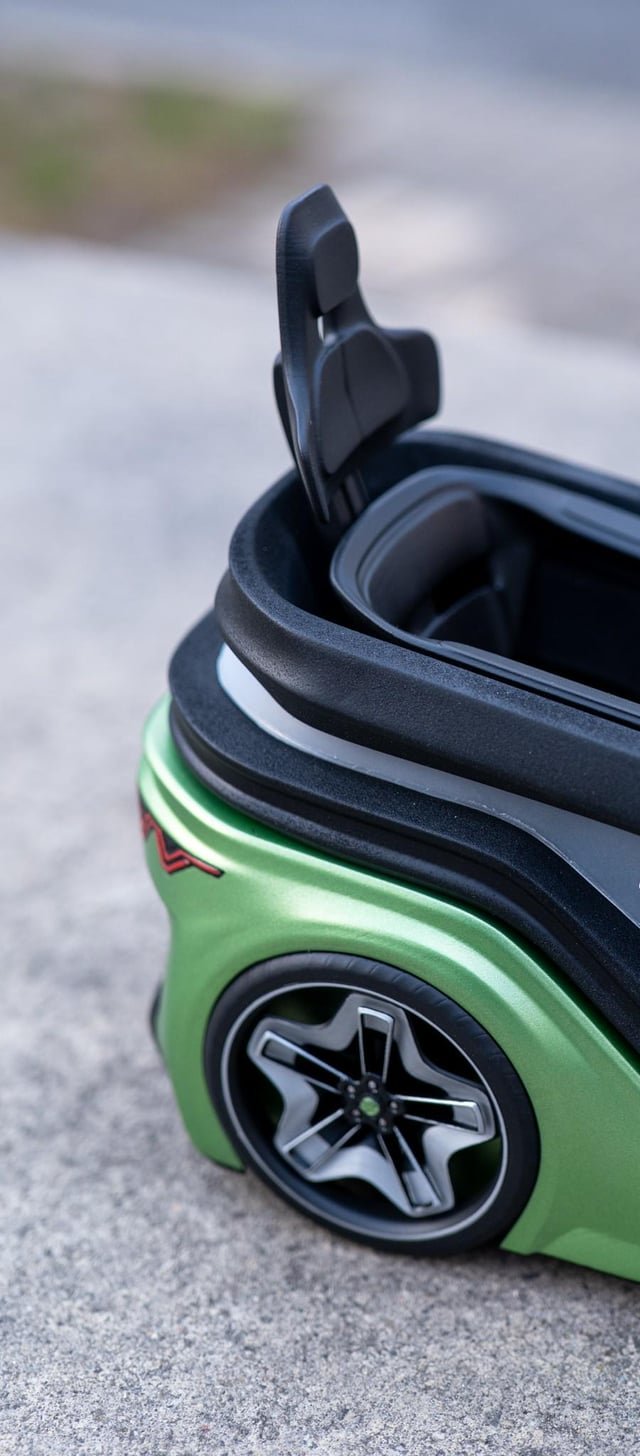
I often wonder whether I make my projects unnecessarily difficult by choosing concepts that are simply too large and complex. Many of my concepts contain a huge number of components, surfaces, materials, colors, mechanisms, and technical details. This means that creating a convincing final rendering takes an enormous amount of time. When I compare my work to projects by some of my fellow students, the difference can be significant. Someone might design an innovative bottle consisting of only a handful of components. They can spend much more time refining every material, surface, transition, and lighting detail. As a result, their final renderings often look extremely polished and almost indistinguishable from real product photography. For my bachelor project, for example, I designed a mobility vehicle intended both as a sharing concept for retirement homes and for private use. It includes:
At a concept-development level, relatively little is left undefined. I designed and modeled nearly every component required for the main functions, apart from elements such as the wiring harness, control electronics, chipsets, and other highly specialized electronic components. I also researched and selected real, commercially available components wherever possible, including the drivetrain, transmission, braking system, battery, wheels, tires, and other technical parts. The dimensions and overall layout of the vehicle were then developed around these components rather than being based purely on visual assumptions. In addition, I developed the chassis structure, suspension layout, steering system, steering geometry, axle arrangement, and general vehicle architecture. Because the user enters from the front, the chassis and running gear had to be arranged in a way that kept the central entry area clear. This meant that the technical package, suspension, steering, drivetrain, and body could not be treated as separate elements but had to be developed as one connected system. Of course, I know that a concept like this is still far from being genuinely production-ready. If an engineer reviewed it, they would probably identify countless details that would need to be changed, strengthened, simplified, or completely redesigned. However, I believe that many of the underlying mechanisms and technical principles could work, at least conceptually. I also have a technical background: before studying industrial design, I completed vocational training as a construction mechanic, focused on metal fabrication and technical assemblies. Because of that, I naturally tend to think about how components are constructed, connected, moved, and manufactured rather than designing only the visible exterior. The seat alone consists of several moving sections, and the vehicle combines mechanical, digital, ergonomic, and service-design elements into one concept. The project is also so extensive that I could easily fill 30 pages of my portfolio and still not explain every mechanism, component, design decision, and technical detail. Compared with designing something like a bottle, it sometimes feels as though I am doing 100 times the work within the same amount of time. Every additional component also introduces another material, surface, connection, reflection, and detail that needs to be modeled and rendered convincingly. I am happy with my final renderings, and I think they look good, but they are not at the level where someone might mistake them for real product photographs. You can still tell that they are renderings. So my question is: Am I making my life unnecessarily difficult by choosing concepts that are too ambitious for a portfolio, especially if the final presentation still looks like a rendering rather than an ultra-realistic product photograph? Would it be smarter for a portfolio to create smaller and more focused products that can be presented with near-photorealistic renderings? Or can the complexity, systems thinking, technical depth, and plausibility of a larger concept compensate for a rendering that is very good, but not completely photorealistic? I would especially appreciate opinions from industrial designers, recruiters, engineers, and people who review portfolios. submitted by /u/-Av3nTad0R- |