Cisco’s open-weight Antares models make vulnerability localization cheaper
A security analyst opens an unfamiliar repository, pulls up a vulnerability advisory, and starts hunting for the file where the weakness lives. The naming conventions belong to someone else. Evidence sits in scattered corners of a codebase that runs to thousands of files.
That first stage of triage burns hours and expertise, and it is the part Cisco set out to speed up. Today, the company released Antares, a family of small language models built to point analysts at the source files most likely to hold a known vulnerability. Two of them, Antares-350M and Antares-1B, ship as open-weight models on Hugging Face. A larger Antares-3B is coming.
Small enough to run in-house
Compact models run on local or on-premises hardware, so a team keeps sensitive source code inside its own walls and skips the round trip to a cloud provider. They cost less per job.
Cisco aims Antares at universities, public-sector institutions, research institutions, and smaller security teams. Those organizations maintain important software on tight budgets, and token-heavy models have sat out of reach for many of them.
The models search the way a person does
Each model works a repository the way an investigator would. It starts from a vulnerability description, searches for matching code patterns, reads candidate files, takes in new evidence, backtracks when a path runs dry, and narrows toward the files that matter. The output is a ranked list of source files, paired with the terminal trace that produced it.
The approach grew out of earlier Cisco Foundation AI research showing that compact models can learn to search, reflect, revise a strategy, and backtrack. That research pointed to a lesson about scale. Useful retrieval behavior can come from learned search strategies at modest model size.
Antares handles one step of a longer chain. The rest of the application security toolchain stays in place, including dependency and software composition analysis, secret scanning, dynamic testing, threat modeling, and expert review.
Cisco needed its own benchmark
General coding benchmarks measure a different task. They test whether an agent can find code tied to a software issue or a development ticket. Antares works from CWE-style security descriptions and advisories.
So Cisco built the Vulnerability Localization Benchmark, a set of 500 entries that ask a model to navigate an unfamiliar codebase and spot patterns linked to specific CWE categories. The closest prior work is CodeScout, which evaluates terminal-based code-search agents on suites like SWE-Bench Verified and showed that code localization can be measured with a standard Unix terminal.
Where the scores land
On the benchmark’s F1 score, the Antares models rank near the top of a field of much larger systems. Antares-3B, the model still to come, scores among the leaders, close to the strongest GPT-5.5 configurations. Antares-1B beats GLM-5.2 and Gemini 3 Pro at a small fraction of their size.
What it costs to run
On the benchmark, the Antares models run at a small fraction of the cost of the larger systems Cisco tested. The spread is wide at the top of the field.
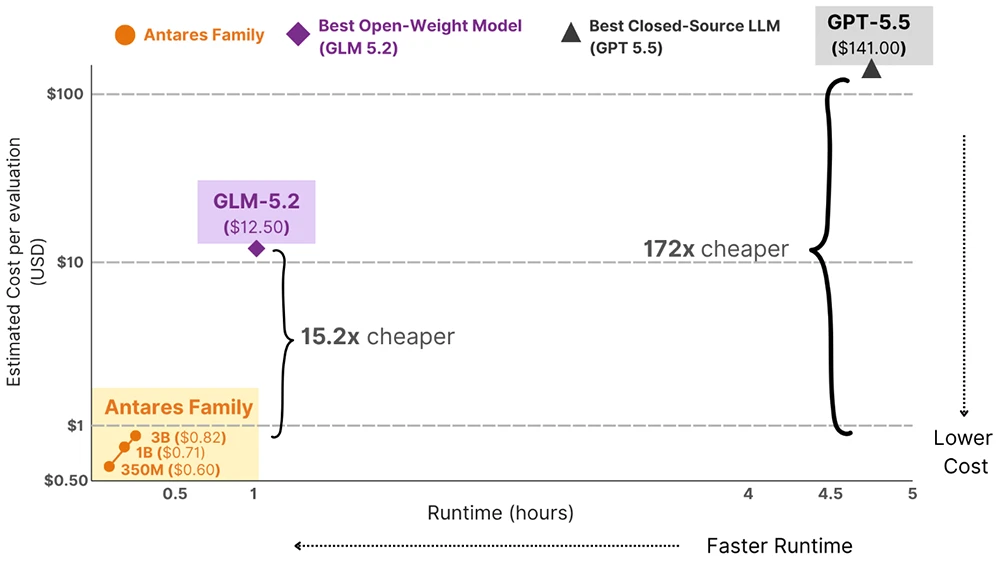
On the vulnerability localization benchmark, the Antares model family completes runs at substantially lower estimated cost and runtime than larger comparison models (Source: Cisco)
GPT-5.5, the strongest closed model in the comparison, costs about $141 per evaluation.
The Antares family does the same job for roughly 172x cheaper.
The best open-weight model in the set, GLM-5.2, costs about $12.50 per evaluation.
Against that, Antares runs about 15.2x cheaper. Runtime moves the same way, with the Antares models finishing quickly and the largest closed model needing several hours.
The cost gap caught attention outside Cisco. Amin Saberi, a professor of management science and engineering at Stanford University, tied it to who gets to defend their code.
“Security can’t be a luxury good, yet advanced AI-based detection has largely belonged to organizations with frontier-scale budgets. Antares’s results change that equation: near-frontier accuracy on secure code reasoning at a fraction of the cost, fast enough to run on every commit. At a moment when attackers are already using AI, that kind of efficiency isn’t a nice-to-have; it’s what makes always-on security scanning possible for every team.”
Antares joins two earlier Cisco releases that target other parts of the same problem: Foundry Security Spec, a blueprint for agentic security evaluation, and CodeGuard, a rules corpus for secure-by-default coding. The 350M and 1B weights are on Hugging Face now. Antares-3B follows.