Could robots play sports professionally? Carnegie Mellon researcher says yes
Humanoid robots at Carnegie Mellon University can’t play soccer like the professionals at FIFA.
But they soon could, said Changliu Liu.
An expert on humanoid robot motion learning, Liu leads the Intelligent Control Lab at Carnegie Mellon University’s Robotics Institute, where she’s an associate professor.
Liu is teaching robots to move dynamically for sports and entertainment. Factory robots have a single purpose. She is working to make robots that adjust and maneuver in real time.
Humanoids have great potential in the sports and entertainment industries, Liu said, perhaps even more so than in everyday life or for machine work.

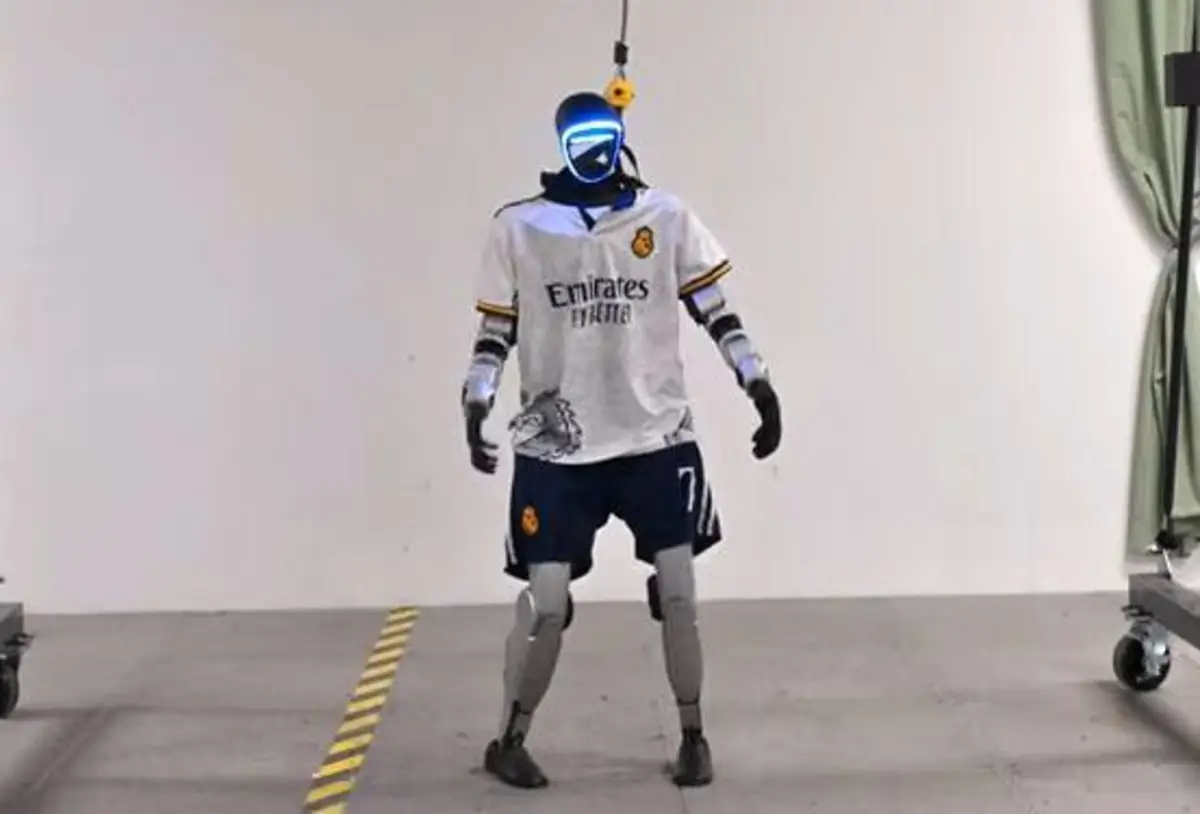
Changliu Liu demonstrates a humanoid robot that mimics the movement of a person wearing an Apple Vision Pro headset. (Courtesy of Carnegie Mellon University)
“If you build a humanoid for boxing, all he needs to know is those motions and boxing strategies. If you design humanoids for a marathon, then all he needs to know is to efficiently run and to not consume too much energy. You have clearly defined goals,” said Liu, who joined CMU in 2019. “People are interested in seeing those machines built by humans themselves, looking like humans and doing things similarly to humans, and maybe sometimes doing it better than humans.”
Progress of humanoid robots in sports and entertainment has accelerated over the past year. Just last year, researchers found that robots can copy human motions.
“As the humanoid is being controlled by a human, they can learn from how the human is making decisions, and that can be training data for the humanoid,” Liu said. “That humanoid can, basically, copy the decision logic of the human, and then make a decision by themselves in the future.”
The behavior foundation model translates muscle memory and physical commands to the robot. Robots interpret commands, hand motions and full-body references to generate their own motion, Liu said.
As a result, the robots have broken into the sports and entertainment realm: There’s a RoboCup Humanoid League, which pits robots against each other in soccer. The league’s goal is to develop a team of humanoid robots capable of defeating the reigning human FIFA World Cup champions by 2050.
“The humanoid will locate where the football is, and they even communicate with their team members to jointly decide a strategy,” Liu said.
Humanoid robots have also made their mark in boxing and running, she said. In those sports, robots still require some assistance from people for commands, but she predicts the robots will eventually be able to design their own strategies based on learning from humans.
There’s still a ways to go, however, before a humanoid can take on a real human in sports. More programming is needed for humanoid safety, and an efficient way to stop the robot in an emergency, Liu said.
“There’s still a lot of research that needs to be done to make sure that the humanoids do not do anything bad in the first place, and if we need to shut them off, they can be safely shut down,” Liu said.