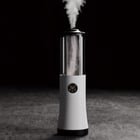
Design discussion: when a humidifier makes its mist visible
 |
I've been exploring a tornado humidifier concept built around a simple question: when an appliance changes the atmosphere of a room, should its work remain invisible? The form uses a glass cover as the stage for a mist vortex. Rather than treating visible vapor as decoration added after the functional work is done, the idea is to make the movement of mist part of how the object communicates its purpose in a room. What interests me is the shift in role. The object still needs to work as an appliance, yet it also has to live comfortably in an interior where it will be noticed even when no one is adjusting it. The glass cover does more than expose mist: it creates a boundary, concentrates attention, and frames an otherwise invisible event. That raises a useful design question: does making the process visible create meaningful feedback for the person in the room, or does it turn the appliance into a theatrical object? In a living-room setting, that distinction becomes more important. The appliance is not only adding moisture; its presence is contributing to the atmosphere of the space. A visible mist vortex can make that contribution easier to read, but it also raises the bar for proportion, materials, and restraint. I'd be interested in how other designers evaluate this direction: can visualizing an appliance's process create a more useful connection with its function, or does it risk becoming visual theatre? submitted by /u/Dense_Counter_8538 |