Robotican: Robots built for the front lines, and below them
“It’s the era of robots,” Robotican CEO Hagai Balshai told Defense & Tech by The Jerusalem Post.
Robotican began as a small engineering company in the Negev a short drive away from the Gaza border, built by robotics researchers who were trying to solve a problem that most commercial drone makers ignored: how to get to places where others can’t. How to move reliably through places where GPS fails, radio links drop, and the environment itself becomes a threat.
From its base in the Omer Industrial Park near Beersheba, the company has spent more than a decade developing autonomous systems for militaries, police units, and rescue teams that work in the tight, dark, and unstable spaces where conventional platforms cannot operate.
Balshai grew up as a farmer, in the fields, before he served in the IDF’s elite 669 search and rescue unit followed by a degree in mechanical engineering.
“I went from tractors to robots,” Balshai told D&T from the company’s headquarters in Omer, outside the southern city of Beersheba.

Recounting the milestones that brought him to found the company, Balshai said that he was in uniform when Hamas tunnels were first discovered by the IDF. Back then, he said, there weren’t any good solutions to handle the underground front. So, after finishing his degree, he founded the company in 2013 to build robotic platforms to solve such problems.
“When Hamas started sending over fire balloons and kites into the Gaza border communities, we understood that shooting them down wasn’t effective enough,” he continued, adding that the company found ways to cut the kites after looking at capability to mitigate the balloons.
The company focuses on unmanned platforms capable of operating in environments that are too dangerous, confined, or unpredictable for soldiers. The “4 Ds,” Balshai explained: dull, dirty, dangerous, and distant.
From hybrid drones to robot dogs
Robotican’s portfolio spans hybrid aerial-ground drones, unmanned ground vehicles, autonomous interceptors, and advanced simulation tools used for training and research.
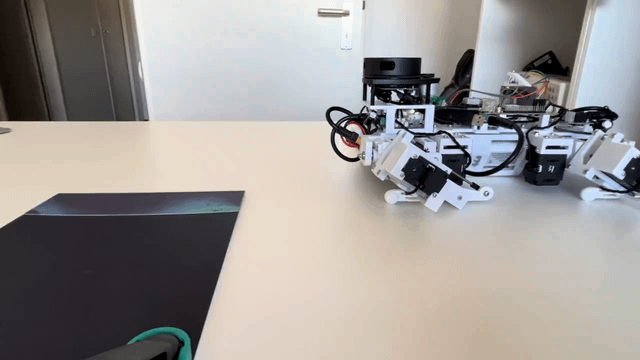
The company’s flagship system, the Rooster, is a hybrid drone designed for indoor and subterranean missions where GPS is unavailable and traditional UAVs struggle to navigate. The Rooster can roll along floors, climb vertical surfaces, and transition to flight to clear obstacles or reach upper levels. The platform has up to 15 minutes of flying time, 40 minutes of rolling time, and an average working time of up to 90 minutes.
It carries sensors for mapping and real-time reconnaissance, enabling troops to assess threats inside buildings, tunnels, and industrial facilities without exposing themselves to fire or toxic hazards.

Balshai told D&T that the company has sold Rooster to customers around the world.
The past three years of war in Israel have also seen the Rooster being used extensively by the IDF in Gaza and other fronts. The semi-autonomous platform has been used by commando units and special forces for Intelligence, Surveillance, and Reconnaissance (ISR) missions and tactical combat. With the underground environment causing communication issues, the platform uses mesh communication capabilities to complete missions.
In one operation behind enemy lines, one Rooster didn’t come back from the depth of the tunnel, and for Balshai that was better than losing a soldier. “If a Rooster wasn’t used, it could have been someone’s kid. And I’ve been there. I would give up a Rooster to solve a problem rather than a soldier,” he said.
Rooster was also used by Israeli forces during search and rescue missions during Operation Rising Lion, sent into buildings that had been hit by Iranian missiles.
Autonomous animals
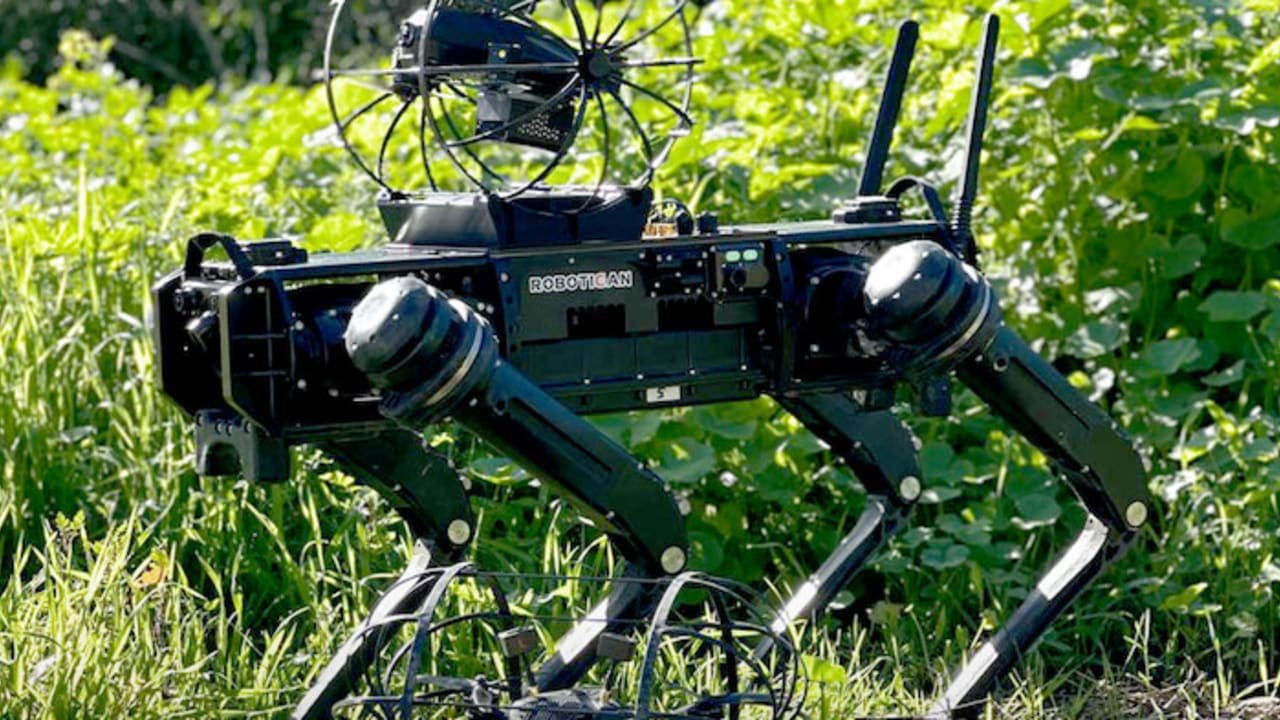
Robotican’s work in unmanned ground vehicles has expanded its reach into additional operational domains. The company develops robotic dog platforms that are built for reconnaissance, inspection, and autonomous navigation in tight or hazardous spaces. These platforms have a range of 10 kilometers and are designed to move through rubble, narrow corridors, and industrial sites, providing ground-level intelligence that complements aerial systems like the Rooster.
According to Balshai, the robotic dog can also carry the Rooster, expanding the operational range of the UAS.
By integrating shared autonomy frameworks across its air and ground platforms along with the mesh communications, Robotican allows operators to coordinate multiple robots during complex missions, creating a layered picture of the battlefield or disaster zone.
Another showcased platform was the Goshawk, Robotican’s autonomous interceptor, which addresses the growing threat of hostile drones.

The system uses onboard sensors and autonomous navigation to locate, pursue, and neutralize unauthorized unmanned aerial systems in civilian or military airspace. With drone incursions having become a major concern for security forces and critical-infrastructure operators, demand for rapid-response interceptors has increased exponentially around the world.
The Goshawk is launched from the Smart Nest launch pad, and then it captures the hostile drone in a net and delivers it to a pre-established disposal area. According to the company, the Goshawk has successfully captured close to 300 drones.
“We turned to countering hostile drones that are like mosquitoes,” Balshai explained. “We knew it would evolve. What we see in the North wasn’t a surprise; it started with the Islamic State. But it’s scary how fast these sorts of threats can adapt and be bought on Alibaba. It’s not only an Israeli problem.”
To support training and development, the company offers Sphera, a digital-twin simulation platform. Sphera allows operators to rehearse missions in realistic virtual environments and enables engineers to test autonomous behaviors before deploying them in the field. The platform is sold both as part of Rooster packages and as a standalone tool for customers.
The company’s platforms are all NATO and NDAA compliant and it works with customers in Europe, North America, the Middle East, and Asia. The company has employees in every country where their platforms are operational to meet the demands of units seeking reliable solutions. Robotican, which considers itself a bootstrap start-up, has factories in Israel and Florida and is looking at opening another one in Europe in the near future.
As militaries adapt to the challenges of dense urban combat, drone proliferation, and complex industrial terrain, Robotican’s technologies offer a clear view of how unmanned systems will shape future operations.