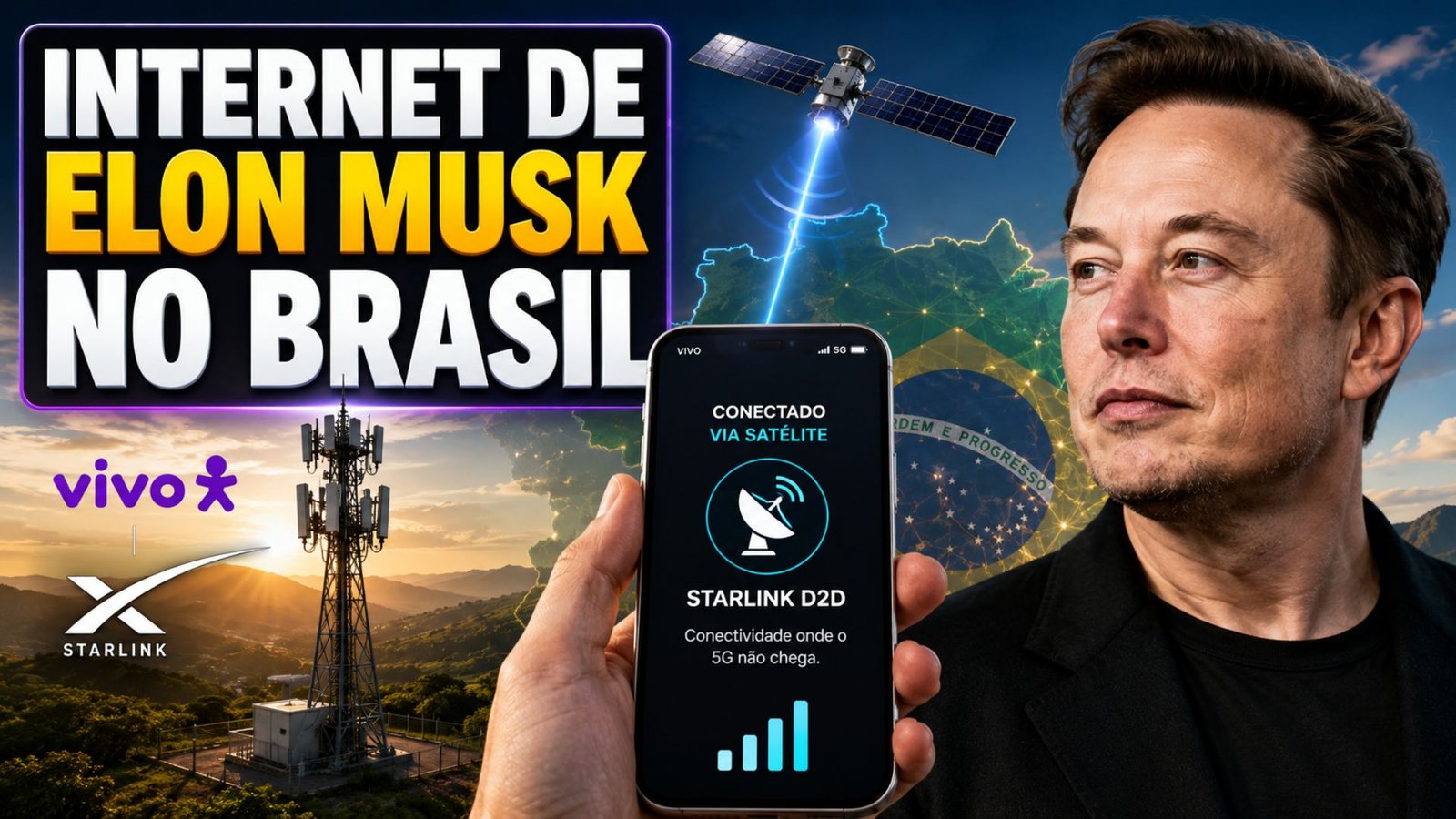
Elon Musk focuses on Brazil, and Vivo customers may soon use Starlink on their cell phones without an antenna, as satellite technology enters the phase of tests authorized by Anatel and promises coverage where 5G does not reach.
Negotiation between Vivo and SpaceX advances while Anatel authorizes national tests of direct connection between cell phones and satellites, technology aimed at regions without terrestrial coverage and still depends on technical evaluations, device compatibility, and regulatory definitions before a possible commercial offer.
Vivo is negotiating with SpaceX an agreement to offer in Brazil direct connectivity between cell phones and satellites, without an external antenna, but the service does not yet have a confirmed commercial launch or a defined date to reach the operator’s customers.
Announced by Tele.Síntese on July 21, 2026, the information emerged after Telefônica Brasil, controller of Vivo, received authorization from the National Telecommunications Agency to test the Direct-to-Device technology, known by the acronym D2D, throughout the national territory.
Although the conversations involve Elon Musk’s company, the regulatory act does not identify which company will be responsible for the satellite segment during the experiment, which is why the authorized tests cannot yet be officially associated with the Starlink constellation.
Vivo’s tests with direct satellite connection
With the authorization granted, Telefônica Brasil will be able to use up to 50 mobile terminals between July 19 and October 22, 2026, the interval established to evaluate the direct satellite connection in the experimental environment supervised by Anatel.
During the experiment, the frequencies of 2,567.5 MHz and 2,687.5 MHz will be used, located in the 2.5 GHz band, with a bandwidth of 5 MHz in each channel and maximum transmission power limited to 100 watts.
As these frequencies will be used on a secondary basis, Vivo will not have protection against interference caused by primary systems and must suspend transmissions whenever the operation harms services that already operate regularly in the same bands.
Throughout the authorized period, it will also be up to the operator to share documents and technical information with the agency, report identified interferences or risks, and deliver a final report intended to support the regulatory analysis on the functioning of the technology.
Commercial offer of Starlink on mobile
After rectifying the act related to the project, Anatel began to allow commercial exploitation within the rules of the experimental environment, however, this possibility does not equate to an automatic release nor does it guarantee immediate access for Vivo’s customers to the service.
For an offer to reach the market, the completion of negotiations between Vivo and SpaceX, the evaluation of technical results, device compatibility, and compliance with applicable regulations will be necessary, with no prices, plans, or schedule announced.
Contacted by Tele.Síntese, Vivo and SpaceX did not comment on the negotiations, while TIM and Claro are also in talks with the American company and other low-orbit satellite operators to analyze similar solutions in the Brazilian market.
How Direct-to-Device Technology Works
In practice, D2D allows compatible smartphones to communicate directly with low-orbit satellites when there is no signal from a terrestrial network, making the space infrastructure an extension of the coverage offered by mobile phone operators.
Mainly aimed at remote regions or areas with low population density, the technology can enhance connectivity in places where installing and maintaining conventional towers would be economically challenging, including areas far from major centers and main land routes.
Depending on the network capacity, available spectrum, and the device used, the system can support messages, calls, and internet access, although data transmission remains below the performance normally offered by terrestrial 5G Standalone networks.
Instead of replacing 4G or 5G, the service was developed as a complement to the cellular network and tends to be activated when the user is outside the area covered by conventional antennas installed by operators.
Anatel’s Rules for Satellite-Connected Cell Phones
Inserted in Anatel’s regulatory sandbox, Vivo’s tests take place in a temporary environment where companies can experiment with technologies and service models under supervision, before the creation or consolidation of permanent rules for the new service.
In early July 2026, the agency’s Board of Directors approved the inclusion of D2D in the Frequency Allocation, Assignment, and Distribution Plan, establishing secondary use in different bands used by Brazilian mobile telephony.
The decision also foresees that satellite companies operate in partnership with terrestrial operators holding the right to use the frequencies, while Anatel’s technical area prepares requirements to guide the coexistence between mobile networks and non-terrestrial systems.
Even with regulatory advancement, future commercial offers will still depend on technical definitions, business agreements, and satisfactory results in experiments, especially to avoid interference and ensure that the connection works integrated with existing mobile networks in the country.
For the consumer, the most relevant change may appear in locations without conventional signal, where a compatible device would automatically seek satellite coverage, without relying on the installation of a dedicated external antenna to establish communication.
When traveling through regions where 4G and 5G are not available, would the possibility of keeping the phone connected directly by satellite be enough to influence your choice of mobile operator?