Ex-Apple engineer’s Even Realities hits unicorn status: Can camera-free glasses outlast Meta’s privacy mess? — TFN
- Even Realities has raised $150 million in a Pre-B round reportedly led by Meituan and Tencent, bringing its valuation to $1 billion.
- This Shenzhen-based startup makes smart glasses without cameras, putting it in direct competition with Meta’s Ray-Ban models, which have raised privacy concerns.
- More than half of its users and about 80% of its developer community are based in the United States, the company said.
In 2026, Meta’s smart glasses came under scrutiny after reports that contractors viewed footage from users’ private spaces. Even Realities takes a different approach by leaving cameras out of its glasses.
The company just raised $150 million from Meituan and Tencent, bringing its valuation to $1 billion.
“The future isn’t about pulling out a device every time you need information. It’s about having the right information available exactly when you need it, while remaining fully present in the world around you,” says Will Wang, founder and chief executive of Even Realities.
A camera-free approach challenges the industry’s leading company
Wang started Even Realities in September 2023, bringing together colleagues from his former company JMGO and team members with experience at Apple, Anker, and Oppo.
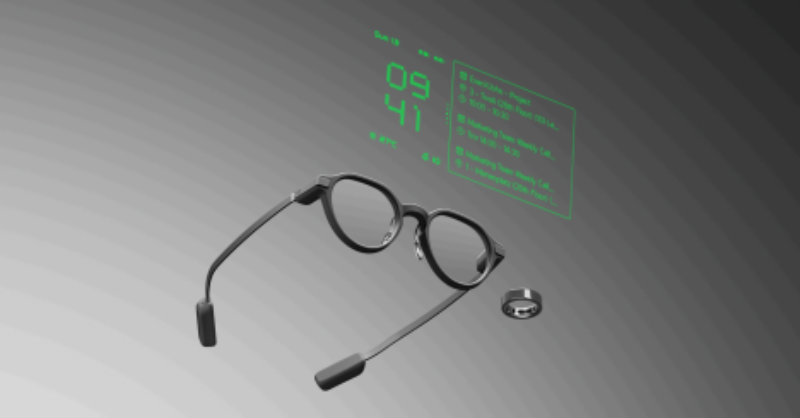
The company’s main product, the Even G2 glasses, does not have a camera. Instead, a micro-LED display in the lens shows notifications, translations, and navigation prompts. Users control the glasses with a companion ring called the Even R1, which works as a touchpad.
For example, when reading a menu in another language, users can see live translations right in their field of view, so they do not need to use their phone. According to Even Realities, people wear the G2 glasses for eight to ten hours each day, but this has not been independently confirmed.
Meta still leads the market, holding about 69% of shipments thanks to its Ray-Ban Display and Neural Band products and its partnership with EssilorLuxottica. However, a federal lawsuit claims the company sends users’ footage to contractors overseas, and some state lawmakers are working on laws to limit smart glasses’ recording features.
Other companies in the display-glasses market have also raised significant funding. XREAL raised $433 million across five rounds, reaching a $1 billion valuation in January 2026. Viture raised two $100 million rounds in six months, totalling over $200 million by February.
Even Realities believes that removing the camera entirely, rather than relying on privacy settings, gives it a stronger, longer-lasting advantage.
Meituan’s investment strategy and pending confirmation
Wang Xinyu, a partner at Meituan, described the investment as a preference for restraint over the addition of excessive features.
“Most players still build with smartphone-era logic, piling on features. Even Realities takes a different path: returning to first principles, rethinking natural AI interaction with restraint,” he says.
Meituan’s involvement aligns with its broader investment approach. Its venture arm, Long-Z Investments, has backed Chinese AI and hardware companies in 2026, including leading Moonshot AI’s $2 billion round at a $20 billion valuation in May.
The smart glasses market is at a key turning point. Grand View Research expects the global market to top $3 billion in 2026, with a 24% annual growth rate through 2033. IDC reported a 167% year-over-year jump in shipments of display-free smart glasses in early 2026.
Even Realities had already raised over $10 million in three earlier rounds, with backers like Cyanhill Capital, Beyond Capital, China Growth Capital, Monolith Capital, and CDH Investments. With the latest round, total funding now exceeds $160 million.
The company says the new funding will help develop its next-generation glasses, improve AI features, and grow its global presence. Its long-term success will depend on whether users continue using the glasses after the initial excitement fades and whether its “quiet AI” approach is less distracting than smartphones’.