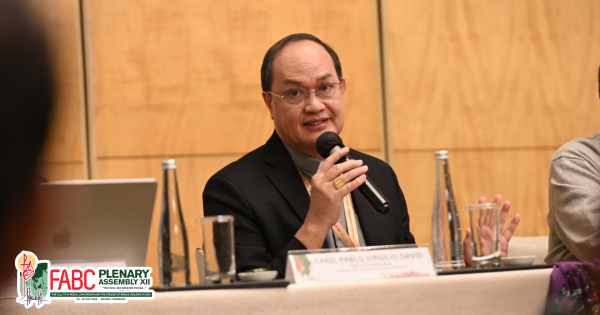
FABC Vice President Urges Ethical Scrutiny of AI Project, Says Technology Must Serve Humanity
Cardinal Pablo Virgilio David, vice president of the Federation of Asian Bishops’ Conferences (FABC), has called for greater transparency and ethical discernment over the proposed Pax Silica initiative, saying artificial intelligence must strengthen local capabilities while serving the common good.
In a social media post, Cardinal David, who is also bishop of Kalookan, Philippines, said the debate over Pax Silica should move beyond geopolitics and focus on whether the project will genuinely benefit the Filipino people.
Pax Silica is a proposed Philippine initiative aimed at developing the country’s semiconductor and artificial intelligence industries through partnerships with foreign investors. The project has drawn public attention over questions about technology transfer, environmental impact, and whether it will create lasting benefits for the country’s scientific and industrial development.
Cardinal David said it is natural for major powers such as the United States and China to pursue their own strategic interests. The more important question, he said, is whether the Philippines will emerge stronger through the initiative or merely provide land, natural resources, energy, water, tax incentives, and labor while foreign partners receive the greater benefits.
“These are legitimate questions, not because we oppose foreign investment, but because genuine partnership should strengthen the nation that hosts it,” Cardinal David said.
Cardinal David stressed that any large-scale technology partnership should include transparency, meaningful technology transfer, the participation of Filipino scientists and industries, responsible environmental stewardship, and a long-term commitment to building the country’s scientific and industrial capacity.
“The goal,” Cardinal David said, “should be to help the Philippines move beyond being merely a supplier of raw materials and inexpensive labor.”
Beyond economic and technological concerns, Cardinal David urged society to consider the moral implications of artificial intelligence.
Quoting Magnifica Humanitas by Pope Leo XIV, Cardinal David said the decisive question is not what artificial intelligence can do, but “what kind of human beings we are becoming.”
“Technology must remain the servant of humanity, never its master,” Cardinal David said.
Cardinal David also cited Pope Francis and his encyclical Fratelli Tutti, which warns against allowing competing national interests to shape the future without regard for the common good. He cautioned that the digital revolution must not become another arena where technological power is used for domination rather than cooperation.
The Catholic Church, Cardinal David said, offers a moral vision that transcends geopolitical rivalry by encouraging nations to place their legitimate interests at the service of the entire human family.
Cardinal David concluded that the true measure of projects such as Pax Silica should not be economic gains or more powerful artificial intelligence, but whether they contribute to what Pope Leo XIV describes as a “civilization of love”, one in which technological progress promotes human dignity, social fraternity, care for creation, and peace among nations.