Lightning strikes Long March 3B after liftoff, Kinetica-1 launches 5 satellites
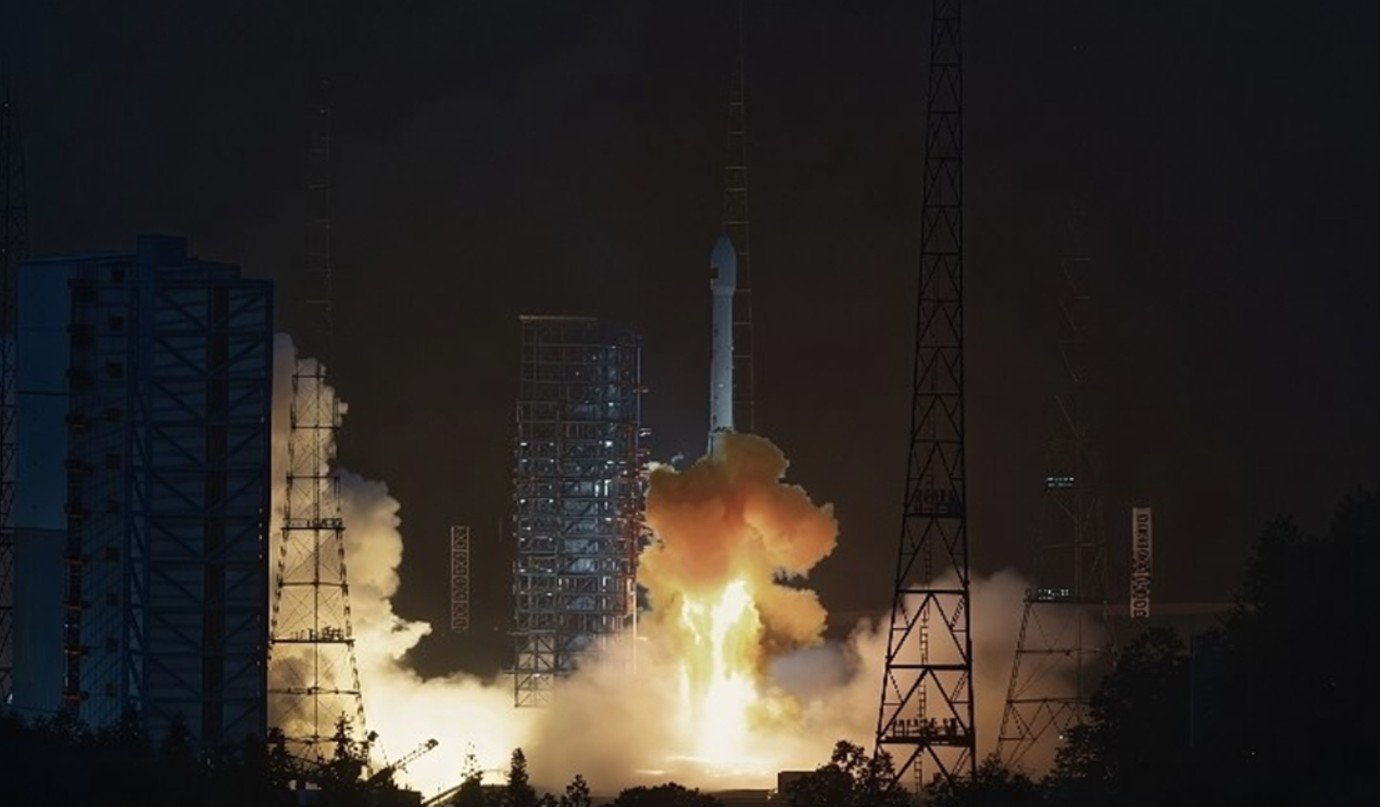
HELSINKI — China conducted a pair of launches Thursday, including a Long March 3B rocket which delivered its payload to orbit despite a lightning strike.
The Long March 3B rocket lifted off at 8:00 a.m. Eastern (1200 UTC) July 23 from Xichang Satellite Launch Center in southwest China, heading for geostationary transfer orbit. However, lightning struck the launch vehicle around 30 seconds into the flight, amateur footage captured from a nearby viewing area and shared via Chinese social media revealed.
The strike was reminiscent of the famous lightning strike affecting the crewed Apollo 12 lunar mission in 1969 and a 2019 Soyuz launch carrying a Glonass-M satellite. The 1987 Atlas-Centaur 67 flight ended in failure after a lightning strike, prompting the tightening of modern Lightning Launch Commit Criteria.
Despite the lightning strike, the payload, revealed by the China Aerospace Science and Technology Corporation (CASC) to be the Tianlian-2 (06) relay satellite, successfully reached its intended orbit. CASC’s post-launch statement did not mention the lightning event, only announcing the mission to be a complete success.
CASC’s China Academy of Space Technology (CAST) developed the satellite, which is part of a geostationary program to provide communications relay and tracking and control support for crewed spacecraft, the Tiangong space station and other missions. The second generation Tianlian satellite, Tianlian-2 (01), launched in 2019.
Kinetica-1 launches five satellites
A Kinetica-1 (Lijian-1) solid rocket rideshare mission followed the Tianlian-2 (06) mission a matter of hours later, lifting off at 7:33 p.m. Eastern (2333 UT) July 23 from Dongfeng Commercial Aerospace Innovation Test Zone at Jiuquan spaceport, northwest China.
The rocket successfully delivered five satellites into orbit: Chenguang-1, Gande-1 (01), Xiguang-2 (03), Jitianxing A-04 and Yinglong Fengguang-1.
Chenguang-1 is a space computing satellite for Beijing Orbital Chenguang Technology, built by commercial satellite maker Spacety. Orbital Chenguang in April secured $8.4 billion in credit lines for its orbital data center plans. Gande-1 (01), jointly built by Liangxi Aerospace Technology Group and Aotian Technology, is described as China’s first commercial space debris monitoring satellite, equipped with a wide-field survey camera and a high-precision imaging camera to detect small debris. Xiguang-2 (03) is a three-band high-resolution infrared “intelligent” remote sensing satellite from Xinghuo Chuanming (Beijing) Technology, while Jitianxing A-04 is an Intelligent computing satellite developed by Zhejiang Lab in collaboration with a consortium of players. Yinglong Fengguang-1 was described in reports as a commercial meteorological satellite, including a humidity sounder and infrared camera.
CAS Space told Chinese state media Global Times that it planned regular, monthly launches across the second half of 2026.
The launches were China’s 50th and 51st orbital launch attempts of 2026, with the country targeting more than 100 launches in a calendar year for the first time.