LLNL Harnesses AI, Robotics to Boost Manufacturing
Lawrence Livermore National Laboratory (LLNL) scientists and engineers, in conjunction with the Department of Energy (DOE) and National Nuclear Security Administration (NNSA), are increasingly looking to AI, robotics and automation to help accelerate advanced manufacturing, materials discovery and experimental science.
The work is part of a broader push to move faster from concept to deployment in mission-relevant technologies. For Chris Spadaccini, who leads LLNL’s Materials Engineering Division and has helped drive much of the Lab’s advanced manufacturing research, that urgency is straightforward.
“In our national security space, agility is paramount as we move forward,” Spadaccini explained. “To be able to go from concept to deployment on timescales that are commensurate with the changing global threat environment is extremely important for our mission.”
Tools such as AI, robotics and increasingly autonomous laboratories, he said, can help make scientific workflows faster and smoother. Across the Lab, teams are developing systems designed to reduce bottlenecks in materials development, process optimization, inspection and production. They see this work as one of the clearest examples of how AI can move from software into real scientific and engineering workflows.
Spadaccini highlighted a distinction between automation and autonomy. Whereas in an automated lab, robotic systems carry out pre-programmed tasks and move through a defined workflow, an autonomous lab goes a step further: using AI to collect data, analyze results and determine what should happen next.
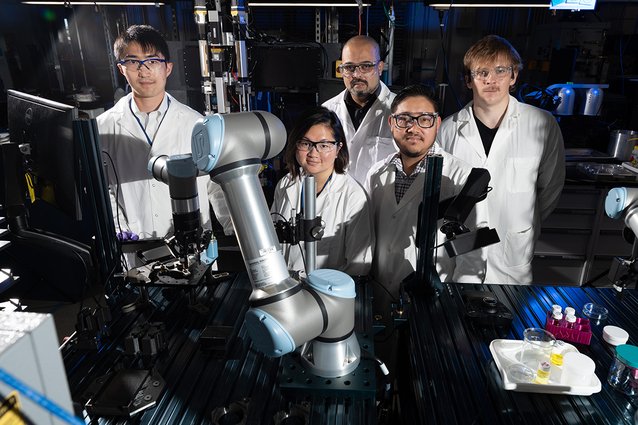
That distinction is becoming more important at the Lab’s Advanced Manufacturing Laboratory, where researchers are combining robotics, automated experimentation and AI to build more adaptive systems. Staff Engineer Aldair Gongora said the work operates on two levels: teams are using autonomous systems to accelerate science while also building the tools and methods needed to make those systems possible in the first place. As part of that effort, Gongora leads Project ARMOR, which explores more flexible robotic execution, including robots that can adapt when samples or objects move in an unstructured environment.
In practical terms, Gongora said, autonomous laboratories add a learning layer, using AI to guide the next experiment. The concept is rooted in the familiar scientific cycle of “design, build, test, learn,” but with AI helping researchers navigate experiments more quickly and at greater scale.
“We’re going beyond just rigid automation,” Gongora said. “The AI and the machine learning is what’s allowing the Lab to think, reason and decide what experiments to run next, and how to run them.”
That doesn’t mean scientists are being pushed out of the process. Instead, Gongora and other researchers describe these systems as tools that can take over repetitive, time-consuming tasks and free scientists to focus more on designing experiments, interpreting results and deciding where to go next. Gongora compared the shift to what high-performance computing (HPC) did for computational science: not replacing researchers but giving them the ability to tackle bigger and more complex problems.

The same approach is also showing promise in materials discovery, where the design space can quickly become too large for humans to explore manually. Staff robotics engineer and principal investigator Mason Sage is involved in both Project ARMOR and APEX (Alloy Prediction and Experimentation), which combines AI, robotics and automated workflows to accelerate alloy development. The idea is to use AI algorithms to design experiments, automation and robotics to conduct them, and AI again to analyze the results and guide the next round of experiments. Both ARMOR and APEX are supported by LLNL’s Laboratory Directed Research and Development program.
For alloy design, that approach matters because the number of possible combinations is enormous. Sage said the design space is so large that even running one experiment every second since the birth of the universe would not come close to exploring it fully. Autonomous experimentation, he said, offers a way to search that space more intelligently.
“What autonomous labs gives us is the ability to think very outside the box,” Sage said. “These machine learning algorithms don’t think how a traditional human scientist would. They think in hyper-dimensional space, and they can reason over dozens and dozens of variables simultaneously.”
Sage said one of the biggest technical challenges is that most scientific equipment was designed around human workflows, not robotic ones.
“In some cases, vendors provide software interfaces that make automation easier. In others, we have had to write our own software or retrofit legacy equipment to allow various types of laboratory equipment to communicate with our autonomous lab,” Sage explained. “This work can be painstaking, but it’s our secret sauce and is absolutely essential to closing the loop between AI, robotics and real experiments.”
Timo Bremer, who leads the Machine Intelligence Group in LLNL’s Center for Applied Scientific Computing, said advanced manufacturing stands out as a particularly rich target for AI-enabled autonomy, because it sits at the center of a long chain of delays. The challenge is not only designing something new, but finding or qualifying materials, developing a process, making the part, inspecting it and getting it to production.
“It takes an extraordinary amount of time,” Bremer said in describing the production workflow. “By the time we are understanding what material we need and getting comfortable with that material and making sure that we know where to source it and that we get it from somewhere where we trust … all that is very difficult.”
The complexity of that process is exactly why advanced manufacturing has emerged as a major proof point for the Lab’s broader AI strategy: a place where AI and robotics could reduce bottlenecks and shorten the path from experimentation to production. The work also aligns with the broader goals of DOE’s Genesis Mission, which aims to connect AI, computing, data and scientific infrastructure in ways that can accelerate discovery and move promising ideas more quickly toward mission impact.
Brian Giera, associate program director for data science, AI & manufacturing, said the wider goal is to use AI and robotics to not just automate isolated tasks, but to accelerate physical processes in areas where the Lab already has deep expertise. He pointed to the intersection of manufacturing, fusion science and HPC as a particularly important area for LLNL, where robotics, sensing and simulation can increasingly be connected inside the same workflow.
“We are implementing robotic systems, including fluid handling, robotic arms and other equipment, that can accelerate the physical tasks required for lab-based discovery and programmatic delivery,” Giera said. “At the same time, we’re using what we learn from those systems to generate valuable datasets that help us move faster in exploring parameter space, expedite operations in unsafe or high-throughput areas and combine those capabilities to explore new technical frontiers.”
Bremer and Giera said LLNL and other NNSA and DOE national laboratories are especially well positioned in this area because the challenge in getting to full autonomy is not just an AI problem or just a robotics problem. It depends on bringing together experts in computing, engineering, hardware, manufacturing and science. “The innovation is going to come from these cross-discipline teams,” Bremer said.
The DOE labs also bring together something many commercial AI companies do not: a combination of subject-matter expertise, specialized equipment, computational capability and mission-driven problems, Bremer explained. While frontier AI companies may provide powerful general-purpose models, he said, the labs have the scientists and engineers, the data and physical systems needed to push those tools into domains that matter for science, manufacturing and national security.

That convergence helps explain why this work matters now. AI-driven progress is increasingly seen as self-reinforcing, with the potential to accelerate further as systems are used to improve the next generation of tools and workflows. Giera pointed to a more immediate reason: the emergence of cheaper, more deployable robotics with AI models that are now capable of handling more structured lab tasks.
“We’re at an intersection point of two innovation trends,” Giera said. “Robotics have become affordable enough to deploy more broadly, and AI models are now built for this kind of tasking. They used to help read documents and process emails. Now they can interpret clearly defined lab tasks and data sets, and they’re getting close to helping with hypothesis generation and testing. Humans are now becoming managers of these AI-powered robotic systems.”
For LLNL, that doesn’t simply mean moving faster for efficiency’s sake. It means developing capabilities that could help the United States remain competitive in strategically important technologies tied to manufacturing, materials and national security. Still, researchers caution that the full vision remains a work in progress, while some pieces are already showing promise.
Spadaccini said one of the biggest opportunities for AI in manufacturing may be in inspection and qualification of components on-the-fly, during the manufacturing process, which he sees as one of the most significant bottlenecks in the overall workflow. Giera pointed to one example, where LLNL researchers are applying machine learning to images captured during the 3D printing process to inspect printed structures layer-by-layer in near real time, replacing what once took minutes of manual review per image with automated analysis performed in milliseconds.
But connecting everything into an end-to-end autonomous pipeline remains a longer-term challenge, with technical, organizational and cybersecurity hurdles still ahead. Safety and security are especially important when AI is connected to physical systems.
Cindy Gonzales, acting director of the Lab’s Data Science Institute, and cybersecurity analyst Henry Williams are among those studying the questions that arise when AI begins to influence robotics and lab equipment.
In a scientific setting, they note, an error isn’t always trivial. It could mean damaged equipment, invalid results or unsafe actions involving sensitive materials. Gonzales said the Lab needs to ensure these systems are “secure by design, especially as we start integrating AI into workflows.”
Williams put it bluntly: “You have to be prepared for the risks that are introduced by letting someone else control your robot.” In those situations, he said, human oversight remains essential, especially when systems are handling expensive or sensitive materials.
“We have a very bright future ahead if we do it right,” Gonzales said.

![What if a model could only learn what trusted LoRA adapters can express? [R]](https://jobssz.com/wp-content/uploads/2026/07/t1vmc27m5vbh1.jpg)