Modern games have a readability problem – Saros shows how to fix it
Saros stands as one of 2026’s best releases, a relentlessly hardcore shooter that demands mastery over many repeated runs and deaths. But even though it’s not a game designed for you to just slow down to admire the view, that doesn’t mean it’s short of eye-catching art direction, even if it’s a different aesthetic to PlayStation Studios’ mainstream blockbusters – a little more arthouse, if you will.
PlayStation’s first-party output these days, from The Last of Us to Ghost of Yotei, can be summed up as being blockbuster-driven, where every game is a cinematic spectacle pushing the PS5’s hardware to its limits. But all the acclaim of the God of War reboot, for instance, diehard fans will still tell you that Kratos’ original adventures were more interesting to play. Against this backdrop, a major exception has been Housemarque, the Finnish developer that Sony acquired back in 2021 and which still prides itself on being a gameplay-first studio, and it’s a reason Saros remains an outlier for PS5 releases.
“Gameplay is very much part of the process of doing art at Housemarque,” says Saros’ art director, Simone Silvestri, even referring to it as a constraint to some extent. “We know immediately, the player is going to be super fast, there’s going to be thousands of bullets on screen, the gameplay reactions that we ask of the players are quite fast as well. So we need to create something that has a style that allows that clarity in motion, and allows the image to be readable at all times.”

Arguably, the studio successfully pulled this off with its previous game Returnal, which was arguably also the PS5’s first exclusive must-play, marrying its hardcore gameplay with a more cinematic and emotional narrative (and inspired others, not least the recent Luna Abyss). Silvestri was inspired to follow up on this. “I played Returnal a lot; it’s a masterclass in atmosphere, so we wanted to preserve that, although the atmosphere and tonality we needed from Saros was very different because its story and themes are very different.
Crafting alien architecture
Set in the hostile and ever-shifting environments of alien planet Carcosa, it’s one that has its own civilisation, and so the team decided to look at what architectural influences could suit both the setting and the gameplay, where your protagonist Arjun would typically be racing through as you blast away hordes of deadly projectile-firing enemies.
“The gameplay needs spaces for you to move through, so we went with Neoclassical, as there’s not too much detail, so the gameplay is very visible on it,” Silvestri explains. “It also has arches, and arches are really good when you’re going really fast, because it’s like if the player is a Formula One car and it feels good when you go under them.”
However, he also found that Neoclassical felt too safe as an aesthetic, contrasting with the story’s themes of obsession and violence, as well as the stress you should be feeling when being attacked from all directions. The solution? Mix it up with another style. “We fused it with Italian futurism, and that gave us the sharper edge that we needed. It also added this obsessive rhythm of lines that always go vertical. It’s just one example [of] how art direction finds what it needs from gameplay and from the narrative themes, and then finds a form that can express these functions within a functional gameplay space.”

Making art out of bullets
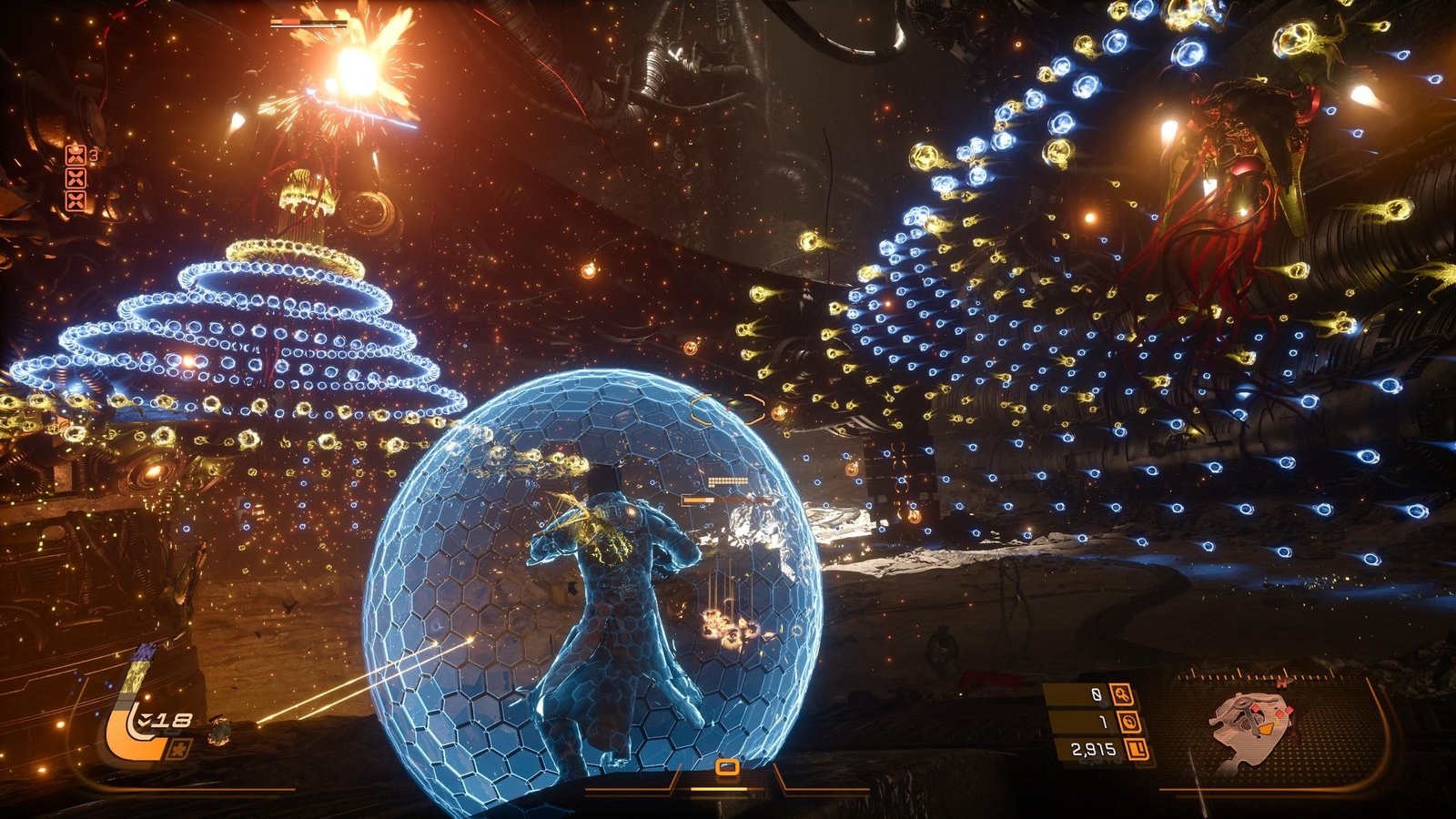
Speaking of function, one of the most important visuals in Saros is from the barrage of bullets you’re facing. Given the different colours you encounter, which all have their own meaning, such as the absorbable blues and the parryable reds, and the kaleidoscopic patterns, they are very much their own work of art. Nonetheless, they serve primarily as visual information that the player needs to parse and react to quickly, though that didn’t stop Silvestri from trying to find a way to do something more interesting.
“When I started, I wanted to make the art direction of the bullets with fire, electricity and all sorts of effects, but the game designers told me, ‘They are beautiful, but we cannot see anything,'” he explains. “So we went back and collaborated better. But we track the distance of the bullet from the player, and when they are shot, they have a very simple shape and colour. As they get closer, they start to mutate, and the art starts to appear when they are close to you. So when you see the detail, you’ve already made your input choices. But psychologically, you are going to attribute the same level of art and detail to the bullets that are far away as well. So we have the best of both worlds.”

There’s another trick to ensuring how Saros dazzles you without also getting in the way. Some of that comes from using simple yet expressive shapes to communicate a mood, but it’s also where your eyes are focused.
“We move a lot of detail up, so when you finish a combat moment, if you look up, there is so much for you to take in: the history, the lore, the mechanisms, but it’s not in the way of combat,” Silvestri explains. “It’s not in that mid-ground because we created that to be a canvas. Then you, the player, are the painter, and you’re painting with gameplay.”
The other key visual in Saros is the way Carcosa will change when you activate an eclipse, suddenly transforming the world into an even more dangerous place. Naturally, that’s represented on screen too, though when you’re already in a hostile environment, it’s arguably more challenging to convey than the contrast of, say, a light and dark world. It was also a challenge for the team to ensure that everything would remain readable.
“You have to account for every biome with its own palette, its own enemy combinations, and then you have a secondary palette with the eclipse,” Silvestri says. “There’s quite a lot of challenge in making sure that there’s a lot of spectacle, but it’s not coming in between the player and the gameplay. There is colour theory and shape language, but there is no shortcut. You have to try it, and try it, until we see that we have the intensity, the drama of the narrative themes, and the gameplay visibility. But the point is that as the narrative escalates, and the gameplay escalates, so too the art has to escalate with it. It needs to be a complete package.”

Down to Earth
Yet for all the beautiful bullet hell and alien architecture, the part I’m most surprisingly struck by in Saros is the moments that are, ironically, not gameplay. I’m talking about the moments when Arjun is briefly transported back to life on Earth, in particular a scene on what feels distinctly like a London street that leads to a nightclub where dance music can be heard booming from (fittingly, those who reach the end of the game will be treated to a banger of a track produced by London-based producer and DJ Daniel Avery). This was also something of a visual palette cleanser for Silvestri, and a unique challenge in its own right.
“I think it’s actually harder to do our grounded reality than an alien world, because there are no expectations for an alien world, but for something you know so well, there are things you expect,” he explains, opting to take a more cinematic approach in regards to lighting, taking the moody cinematography of Wong Kar Wai films as a source of inspiration. “But my heart is still all about the fringe, the extreme, and just weird stuff that I can put on the screen. I love that Housemarque has a licence to be weird. Everybody here is very happy to explore things unseen and go into planets and places that we haven’t explored before.”

Saros is out now exclusively on PS5.

![‘Street Fighter’ Meets ‘Mortal Kombat’ in New Four-Player Action Game [Exclusive]](https://jobssz.com/wp-content/uploads/2026/07/final-boss-issue-5-cover-1-768x432.jpg)