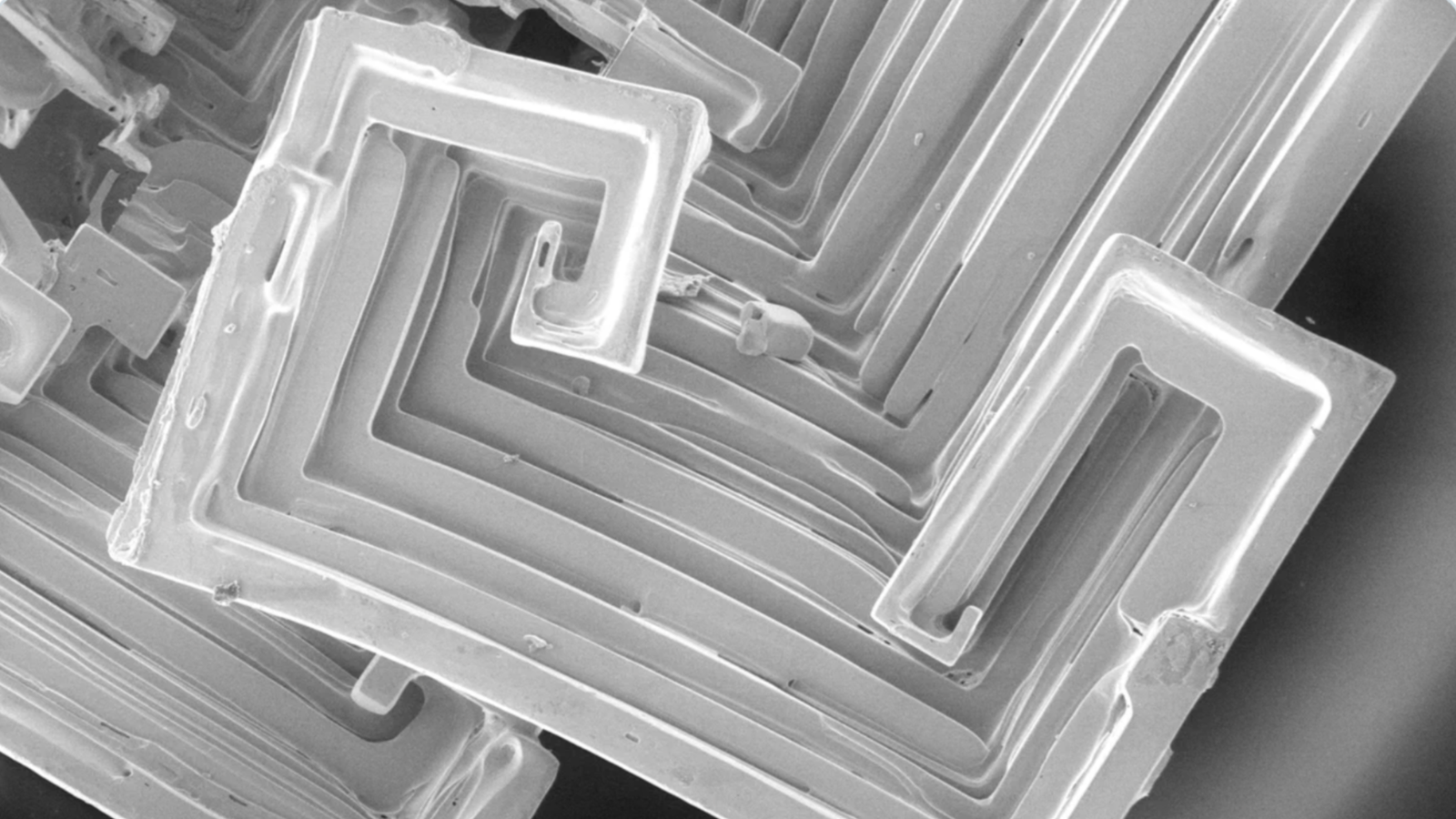
Astronauts have grown a common crystal in space — but this extraterrestrial version is exhibiting a very uncommon behavior. Under a microscope, the crystal looks more like a tiny futuristic sculpture than something that formed naturally. The pyramid-like assembly curls in on itself in stair-stepped layers, seeming almost too orderly to be real. But according to scientists, the striking shape is what happens when gravity stops calling the shots.
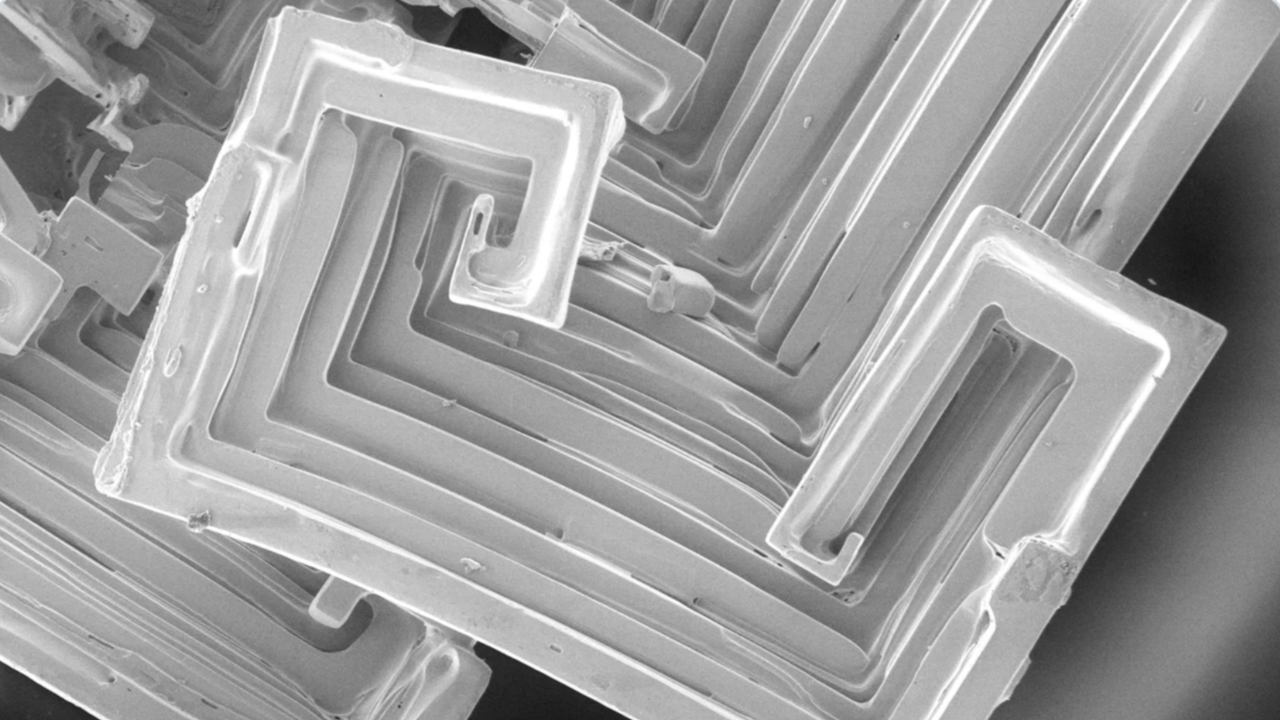
The image, shared on July 18 by NASA astronaut Don Pettit, and accompanying video were captured aboard the International Space Station (ISS) and show potassium chloride crystals growing in microgravity — the near-weightless environment experienced in orbit.
Microgravity isn’t quite zero gravity; astronauts experience a gravitational pull roughly a million times weaker than on Earth’s surface, Anne Wilson, a professor of chemistry and biochemistry at Butler University, told Live Science. That reduction in gravity’s tug has profound impacts on the human body, and, as the new image shows, completely changes how liquids and crystals behave as well.
“[Other] forces start to become far more pronounced than gravity forces,” Wilson said, pointing to molecular attraction and polarity as two influences that suddenly take over once gravity fades into the background.
Those conditions enable potassium chloride — a common salt used as a sodium substitute in foods and sports drinks — to crystallize in ways that are nearly impossible to reproduce in a terrestrial lab.
On Earth, growing crystals eventually get heavy enough to sag, break or settle at the bottom of their container. But in microgravity, they keep growing outward from wherever they started.
Potassium chloride naturally forms cube-shaped crystals, Wilson said. In microgravity, those crystals grow mainly from their edges and corners instead of across their faces, leaving the center hollow and creating the striking pyramid-like structures seen in the image.
Get the world’s most fascinating discoveries delivered straight to your inbox.
In microgravity, crystals experience “hopper growth,” where the outer edges and corners grow at faster rates than the flat faces, creating a step-like appearance. This timelapse records their growth inside a thin water film. Look closely, and you will see the patterns emerge! pic.twitter.com/iSlqJvke1GJune 6, 2026
Scientists call this pattern hopper growth, and it isn’t unique to potassium chloride (ordinary table salt forms the same way). As new corners emerge during growth, the crystal can change direction entirely, producing the elegant scrolling pattern visible in the new image.
While the crystal is visually stunning, the science behind it could prove just as valuable. Materials grown without gravity’s interference often form with fewer defects, giving researchers a rare look at what a truly “ideal” structure looks like. This insight could help refine manufacturing processes for semiconductors and other advanced materials back on Earth.
For Wilson, images like this serve another purpose: inspiring curiosity.
“I love seeing videos of how things behave in space,” she said. “Who would think that something as simple as potassium chloride could still be super cool?”
ISS astronauts spend a significant amount of their time conducting science experiments that would be near-impossible on Earth. Recently, astronauts used the space station’s newly upgraded Cold Atom Laboratory to create and study an elusive fifth state of matter called the Bose-Einstein condensate. And last year, researchers demonstrated how moss spores exposed to space for nine months on the outside of the ISS continued to grow after being returned to Earth.
Impact assessment Core model and total facility emissions The main output of this study is a generic, universal SPA-DEC framework that can be applied across diverse facilities of certain characteristics, which merit their distinct presence in the governing (high-level) equations as follows, to calculate the time-resolved greenhouse gas (GHG) emissions through the SPA-DEC framework, detailed…
With its dagger-like teeth, bone-crushing bite and behemothic size, the fearsome Tyrannosaurus rex ruled western North America during the late Cretaceous period. Now its fossilised remains are about to dominate the auction house, with a price tag to terrify punters. On Tuesday, one of the largest and most complete T rex skeletons discovered to date…
Some near-Earth objects orbiting in space have a serious identity crisis. They may look like asteroids, but in reality, they could be comets that don’t flaunt their glowing features despite behaving similarly to brighter and more active comets. These enigmatic objects are called “dark comets,” and there may be a lot more of them out…
When Airtel Kenya broke ground on its US$150 million Nxtra data centre in Tatu City last September, the announcement stood out for one reason: scale. A planned 44-megawatt campus promised to become East Africa’s largest data centre, purpose-built for artificial intelligence, cloud computing and enterprise workloads. Ten months later, the project tells a much bigger…
The Wabanaki people have a deep well of creation myths explaining the rocky coastlines of the Bay of Fundy, Downeast Maine, and Acadia National Park. Many involve Glooscap—a magical figure said to have floated down the Bay of Fundy in a stone canoe, sculpting coastal features by scraping the vessel across the landscape and scattering enormous…