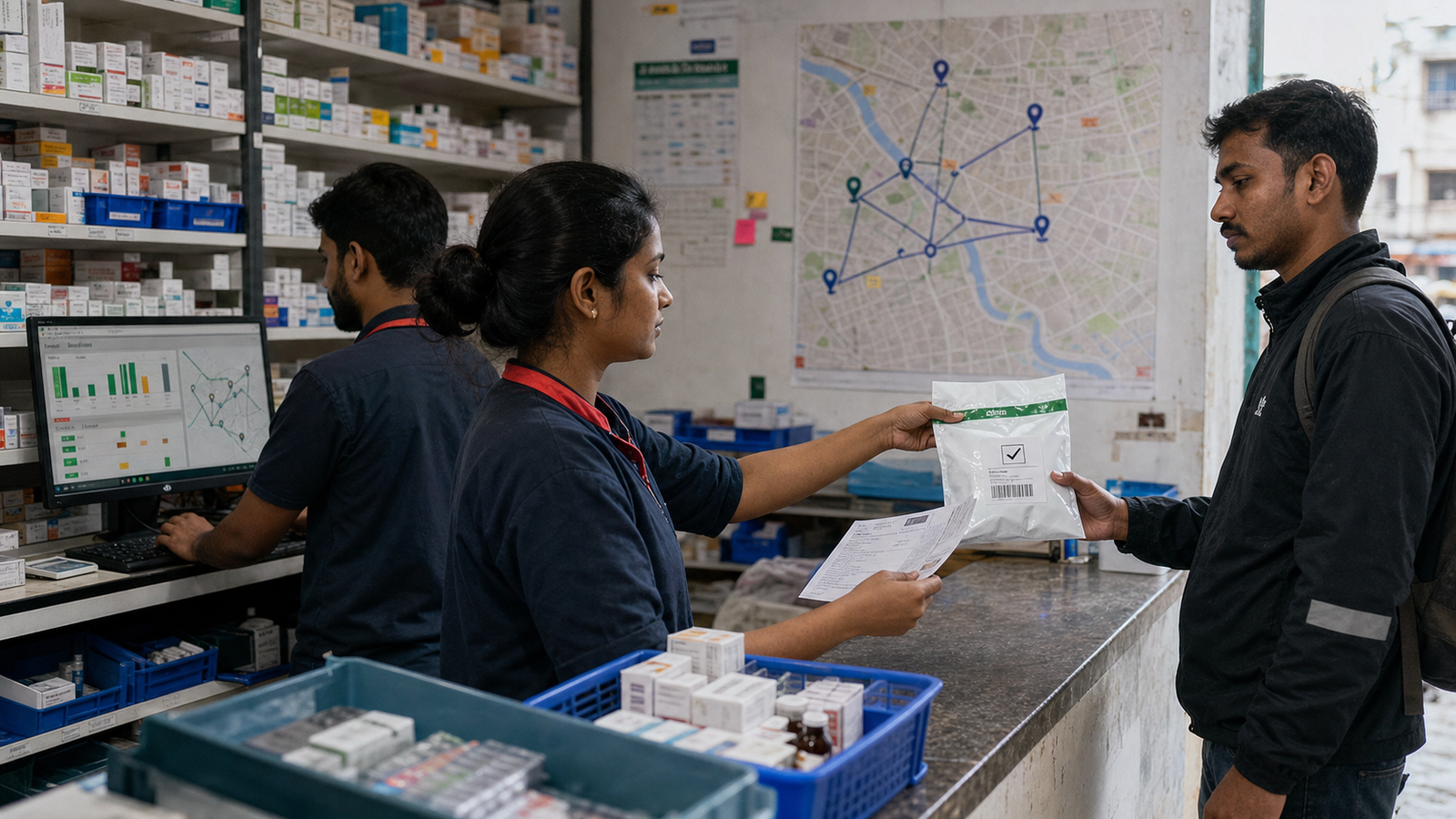
Plazza Raises $15M for AI Pharmacy Delivery in India
Plazza has raised $15 million in Series A funding to expand its AI-driven pharmacy retail and rapid medicine delivery platform across India. The round was co-led by Accel, Elevation Capital and Nexus Venture Partners, with participation from All In Capital and Better Capital, according to YourStory’s funding report published on July 20, 2026.
The capital is intended for AI-powered inventory intelligence, operational expansion and new pharmacy locations. Plazza’s proposition is not simply to deliver medicines faster; it is to use neighbourhood-level demand data to improve availability before an order is placed. That distinction will matter as the company moves from a Bengaluru-focused operating model toward a broader Indian network.
What Plazza’s Series A changes
The immediate change is financial capacity. Plazza’s new round is substantially larger than its $1.4 million seed raise announced in September 2025, giving the company more room to invest in software, pharmacy operations, fulfilment infrastructure and market expansion. The funding sequence was also reported by The SaaS News in its July 21, 2026 update.
For a healthtech company, however, a larger round does not automatically translate into a defensible business. The next stage will test whether Plazza can maintain availability, delivery reliability and regulatory discipline while adding stores. Investors are effectively backing an operating system for local pharmacy supply, not only a consumer delivery interface.
That means the funding should be assessed through three questions:
- Can the company predict demand accurately enough to reduce stock-outs without creating excess inventory?
- Can each new location achieve dependable fulfilment economics at a local level?
- Can rapid delivery remain compatible with prescription controls, licensed dispensing and traceable records?
Why inventory is the central problem

Medicine delivery is constrained by availability. A customer may be willing to pay for a fast courier, but speed has limited value when the prescribed product is missing from the nearest store. YourStory reported that Plazza is addressing this gap by combining neighbourhood pharmacies with AI-based inventory planning that recommends what each outlet should stock.
The company says its stores carry more than 40,000 stock keeping units and achieve prescription fulfilment rates above 95%, while medicines are delivered within 15 to 30 minutes. These are company-reported operating claims rather than independently audited market benchmarks, so they should be treated as performance statements to verify over time. The SaaS News separately described Plazza’s system as AI-powered inventory intelligence designed to improve local availability.
The practical advantage of this model is potentially cumulative. If the system learns from prescriptions, substitutions, repeat orders and missed fulfilment, it can create a more precise view of demand for each neighbourhood. But the model also depends on clean product data, accurate stock counts, disciplined replenishment and pharmacists who can validate exceptions.
How the AI layer could create value
Plazza’s AI does not need to make clinical decisions to be commercially useful. Its more immediate role is operational: forecast demand, identify likely stock-outs, map products to local prescribing patterns and help stores allocate limited shelf space.
That is a narrower and more measurable use case than positioning AI as a replacement for pharmacy expertise. A useful inventory system should improve decisions such as which strength, brand or pack size is likely to be needed in a particular area. It should also show why a recommendation was made, because store teams need to distinguish a genuine demand signal from a temporary anomaly.
For the next phase, Plazza should be judged on operational metrics rather than AI branding alone:
- prescription fulfilment rate by neighbourhood and medicine category;
- stock-out frequency for recurring medicines;
- inventory turns and expiry-related losses;
- substitution or cancellation rates;
- delivery time measured from verified order acceptance to handoff;
- repeat-order behaviour after the first purchase.
These indicators connect software investment with patient access and unit economics. A model that predicts demand but increases expired inventory would not solve the underlying problem.
Why quick commerce is different for medicines

Rapid medicine delivery cannot be evaluated in the same way as snacks, household goods or other quick-commerce categories. The transaction may involve a prescription, a pharmacist’s review, product substitution rules, patient privacy and a chain of custody that must remain clear from dispensing to delivery.
India’s official position is important here. The Press Information Bureau states that medicine sales remain regulated under the Drugs and Cosmetics Rules, 1945, and that drugs in Schedules H, H1 and X require a prescription from a registered medical practitioner and must be sold from a licensed premises. The government also highlighted record-keeping and seller-identification requirements in its official explanation of the e-pharmacy legal framework.
This creates a basic execution rule for Plazza: delivery speed must come after lawful dispensing. A fast interface cannot compensate for an unclear seller, missing prescription validation or incomplete records. The company’s growth plan therefore needs compliance processes designed into the store and software architecture rather than added after geographic expansion.
What investors are funding beyond delivery
The investor group gives the round institutional weight, but the announced use of funds is more revealing than the names alone. Plazza plans to strengthen its technology platform, expand operational capabilities and grow its pharmacy network into new geographies, as reported by both The SaaS News and YourStory.
This suggests a hybrid model: software intelligence paired with physical pharmacy capacity. The software can coordinate assortment and demand, but the company still needs licensed premises, pharmacists, local delivery coverage, supplier relationships and quality-control routines.
That combination can be harder to scale than a pure marketplace. Each new city introduces different demand patterns, operational density, local partnerships and compliance workflows. A repeatable expansion playbook should therefore specify the minimum store density, inventory depth, pharmacist coverage and delivery radius required before Plazza launches in a new area.
The economics Plazza will need to prove
A Series A gives Plazza time to build, but it also raises expectations for evidence. The company should show that faster fulfilment and deeper inventory produce attractive contribution margins after medicine procurement, pharmacist labour, packaging, delivery incentives, returns, spoilage and customer support.
Reported growth indicators can be useful but require context. YourStory said Plazza reported nearly 27-fold GMV growth between June 2025 and March 2026 and that repeat customers had average basket sizes around 30% larger than first-time buyers. These figures were attributed to the company and do not, by themselves, establish profitability or long-term retention.
The more durable signal will be cohort performance. A strong cohort should continue ordering after introductory discounts, generate enough basket value to support delivery and show improving fulfilment without a proportional increase in working capital. If growth is driven mainly by paid acquisition or one-off urgent orders, the model may remain expensive even with strong headline demand.
Key risks in the expansion plan
The first risk is inventory complexity. Carrying a broad assortment can improve prescription completion, but it can also tie up cash and increase expiry exposure. Plazza’s AI will need to balance availability against product shelf life, local demand volatility and supplier lead times.
The second risk is operational inconsistency. A 15-minute promise may be achievable in dense neighbourhoods with concentrated demand, but the same promise may be uneconomic or unreliable in lower-density markets. The company should publish service levels by geography rather than relying on a single network-wide average.
The third risk is compliance and patient safety. The government’s framework makes clear that licensed premises, prescription requirements and records remain central to medicine sales. Any expansion strategy that treats pharmacy operations as interchangeable fulfilment nodes would create avoidable legal and trust risks.
There is also a data risk. Prescribing patterns and order histories can improve forecasting, but health-related information requires careful access controls, retention policies and transparent handling. The company’s technology roadmap should explain how operational intelligence is separated from unnecessary exposure of patient information.
How to assess Plazza’s next milestones
Readers, founders and investors should focus on evidence that links funding to better healthcare access. Store-count growth is easy to report, but it says little about whether patients can consistently obtain the medicines they need.
The most useful milestones to watch through the rest of 2026 are:
- the number of active locations and the cities in which they operate;
- fulfilment and stock-out rates by medicine category;
- delivery reliability without excessive discounting;
- repeat-order retention and contribution margin by customer cohort;
- inventory expiry, cancellation and substitution levels;
- the company’s process for prescription review, licensed dispensing and record retention.
Plazza’s stated plan is to use the new capital to make pharmacy inventory more responsive to local demand. If the company can demonstrate that this improves fulfilment while preserving compliance and sustainable economics, it may establish a differentiated position in Indian healthtech. If it only adds delivery capacity, the funding will place it in a much more crowded quick-commerce contest.
What the round means for India’s pharmacy market
Plazza’s raise is a signal that investors still see room for technology-led improvements in Indian pharmacy retail, especially where fragmented inventory creates friction for patients. The opportunity is practical rather than purely digital: better information about what is available, where it is available and how quickly it can be dispensed.
The next step for the company is disciplined rollout. Plazza should expand only where its data, pharmacy partners, fulfilment processes and compliance controls are strong enough to support a dependable service. For customers, the meaningful outcome will not be the size of the funding round; it will be whether a valid prescription can be fulfilled safely and predictably when it matters.
Also read: