Rocky Planet 48 Light-Years Away May Be First in a Habitable Zone With a Confirmed Atmosphere
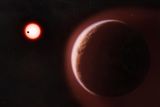
Before Collin Cherubim turned a telescope toward LHS 1140 b, he did the math. The model he built with his co-authors predicted that this rocky planet, 48 light-years away, carried a helium-rich upper atmosphere that was slowly escaping into space. One of his own advisors was skeptical that a prediction based on mathematical calculations could be confirmed around a rocky world.
Observations from a telescope in Chile matched the prediction, giving astronomers their first evidence of an atmosphere around a rocky planet inside another star’s habitable zone, the region where temperatures could allow liquid water under the right conditions.
The findings, published in Science, come from a team led by Cherubim, who completed the work while earning his Ph.D. at Harvard, alongside researchers from Carnegie Science and several other institutions.
“An atmosphere is essential for a planet to support life as we know it,” said Cherubim in a press release. “This is the first time anyone has found an atmosphere on a rocky planet in the habitable zone of another star.”
How Astronomers Confirmed an Exoplanet’s Atmosphere
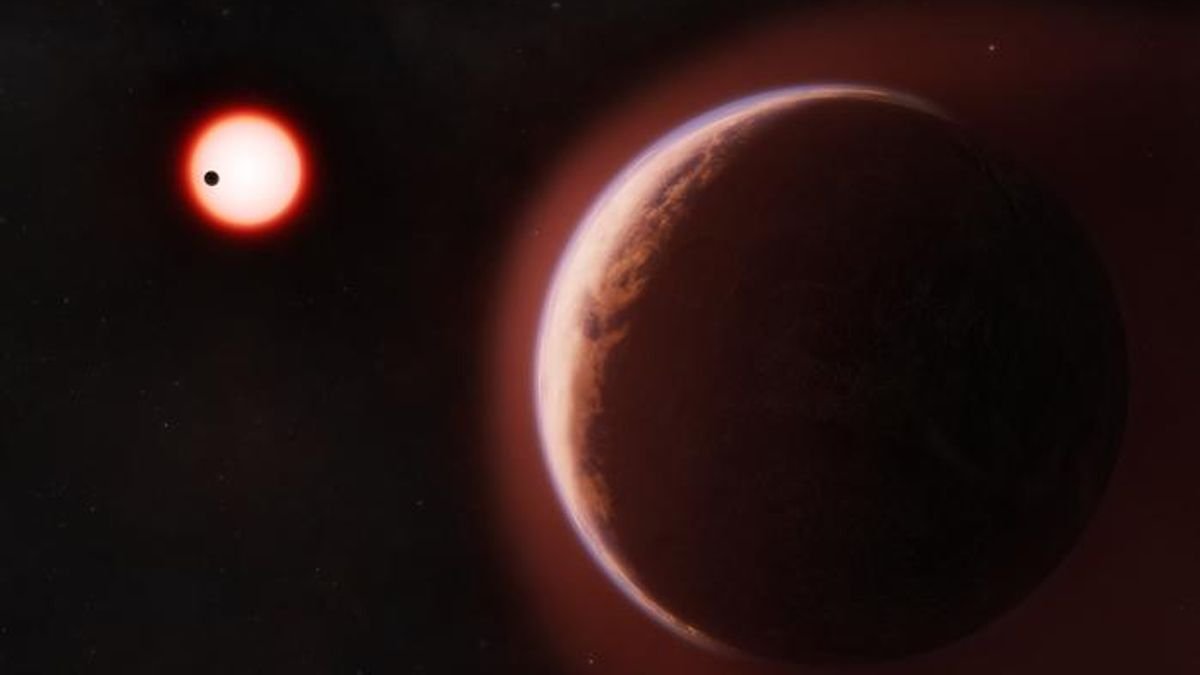
LHS 1140 b is a super-Earth about 5.6 times Earth’s mass and 1.7 times its radius. It circles a small, cool red dwarf star every 24.7 days and receives roughly 42 percent as much stellar radiation as Earth.
Rather than searching for water or carbon dioxide, whose signals are extremely difficult to detect in the lower atmospheres of habitable-zone planets, the team looked for helium escaping from higher altitudes.
Researchers used the WINERED spectrograph on the Magellan Clay Telescope in Chile to observe the system in 2024. They also caught an alignment: LHS 1140 b and a smaller neighboring planet crossed their star on the same night.
Only LHS 1140 b showed evidence of an atmosphere. Its spectrum contained the signature of helium escaping into space, and the neighboring planet showed no comparable signal.
“This was clear evidence of an atmosphere on a habitable-zone exoplanet,” study co-author Shreyas Vissapragada said in a separate press release. “It was an absolute thrill to see the transit spectra and slowly realize the implications of what we were looking at.”
Read More: These Rare Super-Puff Planets Are Less Dense Than Cotton Candy
Why a Skeptical Advisor Changed His Mind
David Charbonneau, one of Cherubim’s advisors and head of Harvard’s astronomy department, initially doubted the plan. The prediction came from a mathematical model, and no one had observed this kind of helium signal around a rocky world before.
“Collin analyzed the planets we knew about and predicted that this one would have a helium atmosphere,” Charbonneau said. “Then he organized telescope time, got the data, and the detection was statistically rock solid.”
Robin Wordsworth, another of Cherubim’s advisors, placed the result within two decades of exoplanet discoveries. Astronomers first wondered whether rocky planets existed beyond our Solar System, then found that they were common and that some orbited within habitable zones.
“The next question was whether any of them had managed to keep an atmosphere,” Wordsworth said in the press release. “Now we know at least one has.”
Why the Escaping Helium Changed Within a Year
When researchers observed LHS 1140 b again in 2025, they did not detect escaping helium, suggesting that atmospheric escape varies over time rather than occurring at a constant rate.
The team concluded that stellar X-rays and extreme ultraviolet radiation heated the planet’s upper atmosphere and drove helium into space during the 2024 observations. Why the signal was absent the following year remains an open question.
“It is a rare privilege to witness the atmosphere of an extrasolar planet change on such short, human timescales,” Vissapragada said.
Models suggest LHS 1140 b has a layered atmosphere with a helium-rich, hydrogen-poor upper region, while molecules such as water may remain trapped closer to the surface. The atmosphere has also likely survived for more than 3 billion years.
Astronomers still do not know whether the planet has oceans or conditions suitable for life. But its long-lived atmosphere makes it a valuable target for future observations.
“This has been a model validation, and hopefully it’s just the first of many more observations to come,” Cherubim concluded.
Read More: Cereal Box-Sized Satellite Shares First Images of Stars While Searching for Life on Exoplanets
Article Sources
Our writers at Discovermagazine.com use peer-reviewed studies and high-quality sources for our articles, and our editors review for scientific accuracy and editorial standards. Review the sources used below for this article: