Scientists Find a More Precise Way to Grow Artificial Blood Vessels, Using Magnets : ScienceAlert
Science may one day give us a way to replace damaged and diseased parts of the body with artificial replacements – but reproducing organs and tissues in the lab isn’t easy.
That’s especially true for networks of blood vessels, which at the level of fine, thread-like capillaries are microscopic – these capillaries can be as small as 0.005 millimeters (34 times thinner than a human hair), and only let blood cells through in single file.
Researchers led by a team from MIT have now published a study in PNAS that details a way of engineering blood vessels in the lab with significantly greater precision than before.
Getting the blood vessels (and therefore the blood flow) right is crucial to the success of any lab-grown organ or tissue, as fine capillaries perfuse tissue, delivering oxygen and nutrients.
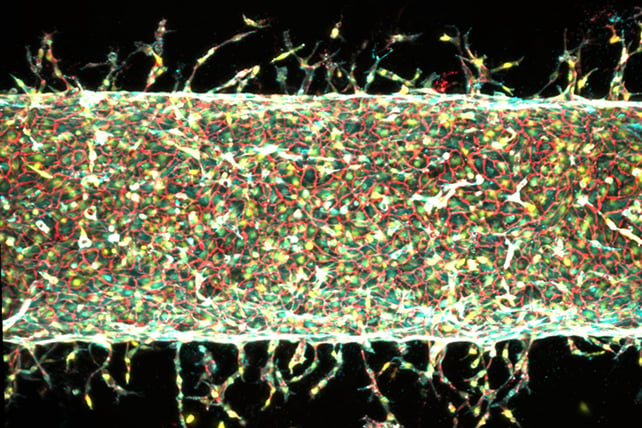
The new approach is based on using magnetic forces that gently stretch and pull blood vessel cells into position.
“Healthy tissues depend on organized blood vessel networks, but state-of-the-art protocols don’t enable fabricating such networks within engineered tissues,” says mechanical engineer Ritu Raman, from MIT.
“The ability to program blood vessel growth with physical cues may enable reproducible and scalable fabrication of engineered tissues that can be implanted in the body to restore function after debilitating disease or injury.”
frameborder=”0″ allow=”accelerometer; autoplay; clipboard-write; encrypted-media; gyroscope; picture-in-picture; web-share” referrerpolicy=”strict-origin-when-cross-origin” allowfullscreen>
The system is based on a small chip containing endothelial cells (the cells that line blood vessels), grown in the lab, and suspended in a gel of collagen – the protein that’s one of the most important building blocks in the body.
A tiny magnet was also placed inside the chip, which was then controlled by several external magnets in three dimensions. As the force on the chip magnet was adjusted, the researchers could determine how new blood vessels grew.
It’s an adapted form of the same approach the researchers have previously used to create artificial muscles and nerves.
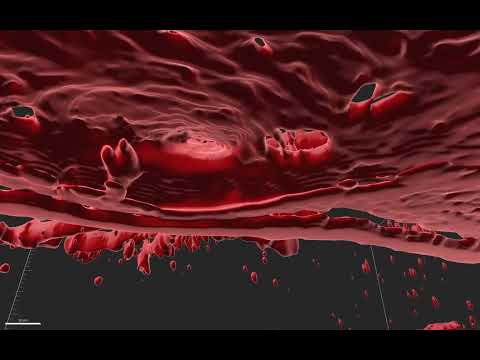
By changing the strength of the external magnetic pull, the researchers were also able to control the length and number of new vessels that appeared. We’re still at an early, prototype stage with this, but the initial results are promising.
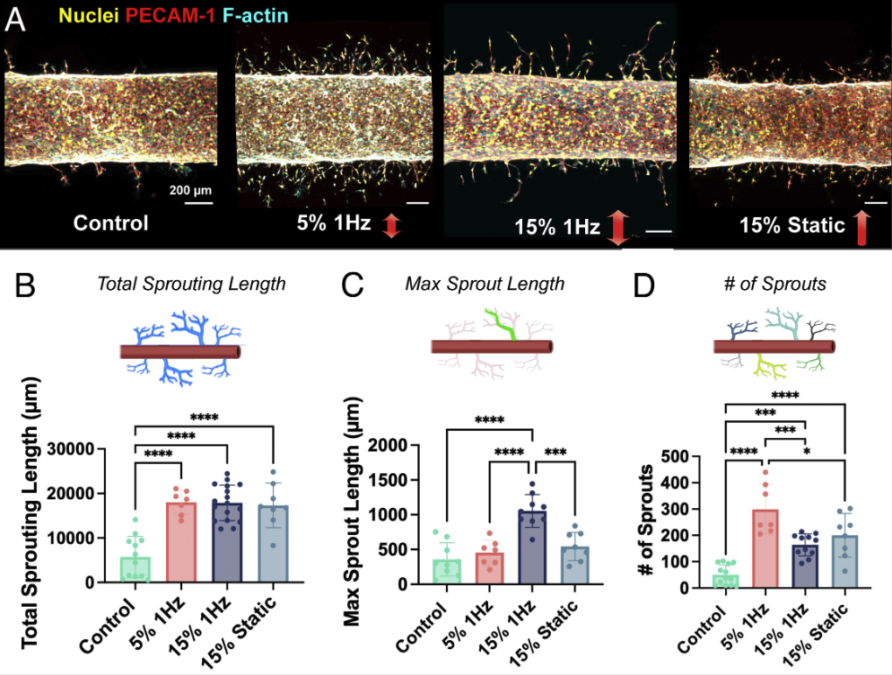
“The main takeaway is: Stretching the blood vessel back and forth seems to enhance the number of new capillaries that grow,” says Raman.
“Mechanical forces play an important role in our bodies. That means that if you want to grow more or less vessels, or shorter or longer vessels, or vessels in certain directions, we now know how to do that.”
Technically, the formation of new blood vessels is known as angiogenesis, but previous methods to recreate it artificially haven’t provided sufficient control.
Blood vessels can currently be 3D-printed or grown from individual cells in Petri dishes filled with nutrients and other chemicals, but scientists have been looking for something that works with greater precision.

“You can try to pattern chemical cues, like growth factors, to direct where vessels grow, but you can’t do this very precisely,” says Raman.
“We thus need other types of patternable cues that can help us build tissues with organized vessels.”
The research team also investigated the underlying mechanisms at work here. They repeated their experiments using cells genetically engineered to function without the PIEZO1 gene.
This gene controls ‘cell gatekeepers’ – ion channels in charge of what goes in and what comes out of a cell, in this case, a specific type that responds to mechanical pressure. Fewer blood vessels were created with PIEZO1 switched off, showing that ion channel activation is crucial.
Related: Your Blood Type Affects Risk of Early Stroke, Study Reveals
The next steps are to see how well blood actually flows through the arteries, veins, and capillaries created with the chip, and to actual lab-grown organs and tissues around the blood cell structure – starting with muscle.
“We are now investigating how precisely patterning blood vessel growth can help improve muscle function,” says biomedical engineer Jessica Shah, from MIT.
The research has been published in PNAS.
This article was fact-checked by Clare Watson and edited by Rebecca Dyer. While we pride ourselves on our process, we are only human. If you spot a mistake, please let us know.