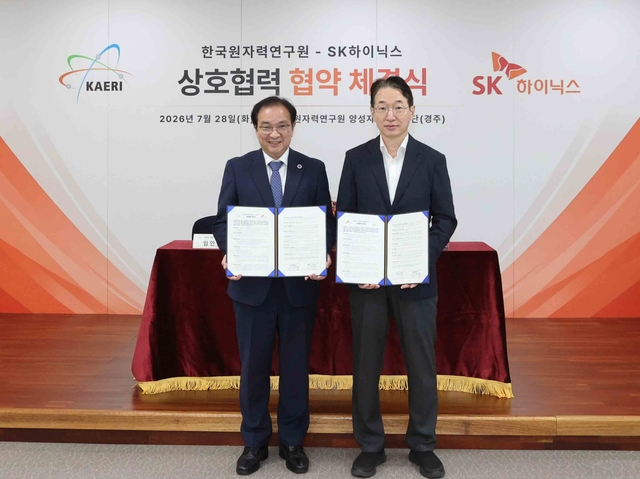
SK hynix, KAERI join hands on space semiconductor research

SK hynix Inc. has teamed up with the Korea Atomic Energy Research Institute (KAERI) to develop space-grade semiconductors, signaling a broader push by major Korean companies into the fast-growing commercial space, or NewSpace, industry.
KAERI said Wednesday it signed a memorandum of understanding with SK hynix on cooperation in radiation impact assessment for semiconductors.
Under the agreement, the two entities will establish a semiconductor radiation reliability research center at KAERI’s Korea Multi-purpose Accelerator Complex (KOMAC) in Gyeongju, North Gyeongsang Province, and pursue joint research on space semiconductors.
The Gyeongju accelerator is Korea’s only research facility capable of simulating space radiation. Because space semiconductors must withstand radiation, the facility is essential for domestic testing. Using overseas proton accelerators could expose semiconductor designs and other sensitive technologies.
Most Korean semiconductor companies already use the Gyeongju accelerator, with demand exceeding available slots by more than two to one. The competition makes it difficult to secure testing time when needed. SK hynix has used the facility since 2018 but had not previously disclosed its work there.
The partnership will give SK hynix priority in booking the accelerator and allow it to conduct in-depth research at the new center when needed, accelerating its space semiconductor development.
The agreement could also bolster Korea’s position in the global space semiconductor market, where overseas buyers typically require test data on radiation resistance and other performance measures.
The global space semiconductor market is expected to grow 8.67 percent annually to $1.88 billion by 2034, according to Fortune Business Insights. Demand is expected to rise as major countries advance satellite and space exploration programs.
The market is currently dominated by U.S. companies. North American firms including Texas Instruments Inc. and Microchip Technology Inc. account for more than 45 percent of the market, while Korean companies have virtually no share.
SK hynix Senior Vice President Song Jun-ho said the company will strengthen radiation reliability technologies to lead the global semiconductor radiation reliability ecosystem.
KAERI is also considering upgrading the proton accelerator to meet growing demand from the semiconductor and space industries. The facility currently operates at 100 megaelectronvolts (MeV), with plans to increase its capacity to 200 MeV.
The current capacity trails facilities widely used for space semiconductor testing overseas, including a 500 MeV accelerator in Canada and a 230 MeV facility in the U.S., potentially weakening Korea’s competitiveness in the sector.
“We will use our advanced facilities to boost Korea’s semiconductor and space industries and build a safer ecosystem,” KAERI said.
By Choi Won-seok and Chang Iou-chung
[ⓒ Pulse by Maeil Business News Korea & mk.co.kr, All rights reserved]