The dark horse of biology: how RNA is becoming a nanotool maker’s dream

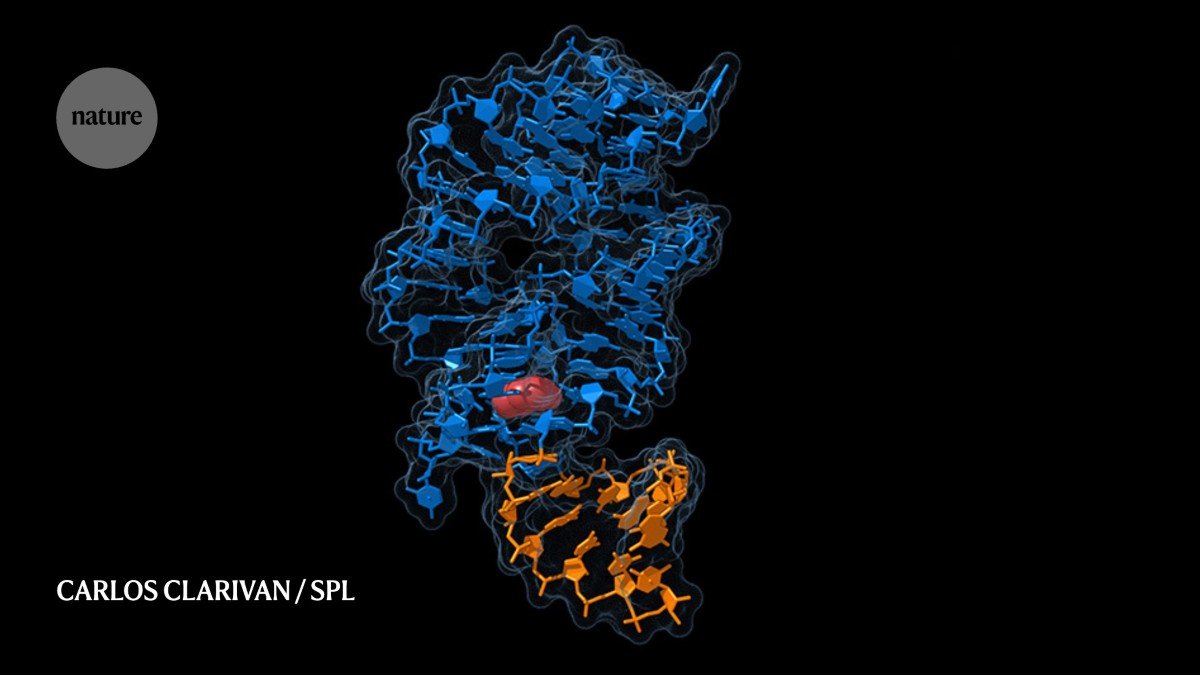
The binding of a molecule to a riboswitch alters its control region (orange).Credit: Carlos Clarivan/SPL
For decades, RNA was the overlooked ‘middle child’ of cellular molecules. DNA was celebrated as the blueprint of life, proteins carried out the work of the cell, and RNA was cast in a supporting role as the messenger that relayed the genome’s instructions to the cell’s protein-production machinery.
This view has since shifted, with research, especially since the 1990s, showing that RNA behaves in far more active and unconventional ways than previously recognized. “It’s kind of like a dark horse of biology, it does so many things,” says Elisa Franco, a bioengineer at the University of California, Los Angeles.

Nature Index 2026 Nanoscience and nanotechnology
Biologists have identified RNAs with catalytic functions that resemble enzymes, for example, or that bind tightly to specific target molecules, an important consideration for the development of safe and effective drugs. Researchers are learning how to fold RNA into complex three-dimensional structures, enabling it to perform as a scaffold for molecular interactions or biological tasks. The versatility of RNA has energized the field, says Franco. “There’s a lot of RNA that nobody knows what it actually does.”
That versatility, together with the simplicity of its code — comprising just four nucleotides, adenine (A), uracil (U), cytosine (C) and guanine (G) — has made RNA remarkably adaptable as a biological tool. Its ability both to carry genetic information and to take on functions that are typically performed by proteins has made it especially appealing to researchers who are seeking to manipulate the behaviour of living cells for therapeutic or biotechnology applications, says Fei Zhang, a chemist at Rutgers University at Newark in New Jersey.
Supported by advances in nanotechnology, these properties are now being harnessed to build a new generation of molecular tools and technologies. From simple genetic ‘switches’ that let scientists tweak cell behaviour, to more elaborate structures that could underpin tiny production lines for the manufacture of drugs and other useful materials, there is a growing sense of what RNA-based nanodevices could be capable of.
But there are major knowledge gaps about how RNA behaves inside living cells that need to be resolved before RNA architects can reliably translate their designs into working technologies.
An unexpected switch
To understand the versatility of RNA, it helps to start with how it behaves at the molecular level. To make a protein, a cell first copies its DNA into messenger RNA (mRNA), which carries the genetic instructions to the protein-making machinery of the cell. Although mRNA is often depicted as a simple linear string of letters, its nucleotides can pair with each other in specific ways (A with U, or C with G, for example), which allows the RNA to fold over on itself as different sections stick together. This creates ‘secondary structures’ such as loops and stems, which can provide binding sites for proteins and influence how the cell reads the RNA to build a protein.
In some cases, these shapes also allow RNA to carry out more complex tasks. One example is the ‘riboswitch’ — an mRNA-based structure that acts like a molecular toggle, binding to specific targets and then flipping protein production on or off. Researchers are exploring ways to engineer these switches into compact control modules that can precisely regulate the activity of individual genes.

Ribosomes (blue) attach to an mRNA strand to read its code and build proteins (green).Credit: Elena Kiseleva/SPL
There is one big complication, however: most naturally occurring riboswitches are triggered by metabolites — small molecules that are produced or used as part of routine chemical processes within cells — which means they can be difficult to control. To get around this, researchers are screening large numbers of RNA sequences to identify and engineer switches that respond predictably to existing medicines with proven safety records.
In 2025, a team led by Jörg Hartig, a chemist at the University of Konstanz in Germany, demonstrated an engineered riboswitch that increased expression of a target gene in mammalian cells by up to 100-fold in response to allopurinol, a clinically approved treatment for gout1. He says that newer switches being developed by his lab can boost gene expression by as much as 1,000-fold.
Such switches could, in principle, be embedded in gene therapies and delivered to a patient’s cells using established approaches such as viral vectors or lipid nanoparticles. Once inside the cells, they could be controlled in real time using widely available drugs, allowing gene activity to be dialled up or down like a dimmer switch.
A patient with a metabolic deficiency might receive a gene therapy that restores production of a missing metabolite, for example, but keeping that gene switched on 24/7 could result in a toxic overdose of that metabolite. This problem could be averted using a second drug to control expression of the therapeutic gene.
“You could just swallow a pill in the morning and then, over the day, get gene expression,” says Hartig. “If you don’t need it or have adverse effects, then you would not swallow your pill.”
Hartig says his team has tested such approaches in mouse models, and he hopes that this work will ultimately pave the way for clinical applications.
Other groups are pursuing more elaborate designs by ‘daisy-chaining’ several RNA switches together into complex circuits. Researchers led by Jongmin Kim, a synthetic biologist at the Pohang University of Science and Technology in South Korea, have developed RNA-based ‘logic gates’ that activate genes only when the right combination of signals is present2 — much like the decision-making rules that computers use to process information. A gene, for instance, might be activated only after several other RNA switches have been switched on, allowing precise control over cellular behaviour.
These circuits combine different RNA-based control tools, including riboswitches that respond to drugs or metabolites and ‘toehold switches’ that respond to specific RNA signals. Using these components, Kim’s team has built circuits that activate genes in response to particular combinations of biological signals. They are now exploring the use of these circuits to engineer therapeutic bacteria that could help to mitigate or prevent tissue damage in disorders such as inflammatory bowel disease.
Frontiers of folding
Using the same base-pairing rules that shape DNA double helices and RNA stems and loops, researchers can fold RNA into sophisticated nanoscale architectures that could form the basis of next-generation vaccines and new ways of controlling cellular behaviour.
Known as RNA origami, this approach builds on concepts first developed for DNA origami3, a technique that uses DNA strands to create structures ranging from simple geometric shapes to intricate flower-like designs. Past work by Zhang and others has demonstrated the remarkable versatility of these DNA-based architectures, and the durability of the structures they form.
“It’s very stable, and it’s super robust,” says Zhang. But that stability comes at a cost: once folded, DNA nanostructures are rigid and difficult to reconfigure.
RNA, by contrast, is far more dynamic. Its flexibility allows it not only to adopt a wide variety of shapes, but also to remodel itself in response to specific molecules or changes in its surroundings — properties that Zhang and her colleagues are now seeking to exploit.
RNA origami is still a young field, and much of the work to date has focused on designing and testing structures under carefully controlled laboratory conditions. But early studies are beginning to hint at its practical potential.
A team led by Arizona State University biochemist, Hao Yan, has been investigating RNA origami as the basis of a new kind of cancer vaccine. The approach is based on how the immune system responds to RNA that exists outside cells: because ‘free’ RNA molecules are often associated with viral infection, they tend to trigger immune alarm bells and can provoke a strong inflammatory response. Yan and his colleagues have designed RNA origami structures that harness this sensitivity in a more controlled way, selectively activating receptors and immune cells to produce a targeted response that helps to wake up dormant immune cells around a tumour4.
In experiments, Yan’s team coupled these engineered RNA structures to other immune-stimulating molecules and injected them into mouse models of cancer, where they triggered strong tumour-specific immune responses and improved survival.
“We’ve tried breast cancer, melanoma and a few other models, and it worked out well,” says Yan, who is planning to move this work into clinical testing.
Several other groups are attempting to build RNA nanostructures directly inside living cells. This presents a major engineering challenge, because as RNA molecules are transcribed, they begin folding almost immediately, leaving little opportunity for separately encoded strands to find one another and assemble into larger structures. As a result, most designs rely on a single RNA strand that has been engineered to adopt the desired shape as it is produced, says Lorenzo Di Michele, a nanotechnologist at the University of Cambridge, UK.
Di Michele and others have identified various solutions to this problem. One approach uses RNA sequences that fold into simple, lollipop-like shapes comprising a stem with a loop at the end. These stem-loops can be configured so that they interact with one another, forming more complex ‘kissing loop’ assemblies that give rise to even higher-order structures. Based on these and other RNA architectural principles, researchers can create genes encoding sequences that fold into complex two- or three-dimensional structures as the RNA gets transcribed.
In work published last year5, Zhang and colleagues used this approach to generate RNA strands that self-assemble within the nuclei of human cells into large-scale structures, including zigzag scaffolds, rings and fishnet-like meshes. She says her team can tune the design of these constructs to predictably alter their size, shape and geometry.
“We could use this two-dimensional array to display different types of protein-binding domains, so we can harvest or enrich RNA-binding proteins in this environment,” says Zhang.
This could enable the design of biosensors that track gene expression in live cells in real time, or DNA-binding scaffolds that interact with chromosomes to control cell function by directly regulating gene expression at the source.
Folding into a fluid
Other groups are engineering nanostructures that mimic naturally occurring phenomena known as biological condensates. These assemblies of proteins, nucleic acids or other molecules group together in fluid droplets that remain separate from the surrounding liquid environment of the cell — similar to how droplets of oil remain suspended as separated entities in water.
Engineering nanostructures that mimic this separation mechanism could create controlled microenvironments within cells, allowing specific enzymes to be concentrated in one place or groups of genes to be expressed in a tightly coordinated manner. And because these condensates remain fluid, with no physical barrier surrounding them, they retain the potential to merge or separate from one another if conditions change. This enables them to combine or redistribute their contents, such as to pool ingredients that are needed for a particular biochemical reaction.
Synthetic condensates can, in principle, be built from many different kinds of molecules, but some are easier to engineer than others. Designing proteins that dynamically interact in complex ways requires precise control over their folding, for example, which is still largely beyond scientists’ capabilities.