The Roman Space Telescope Will Find Ancient Black Holes By Watching How They Eat Stars
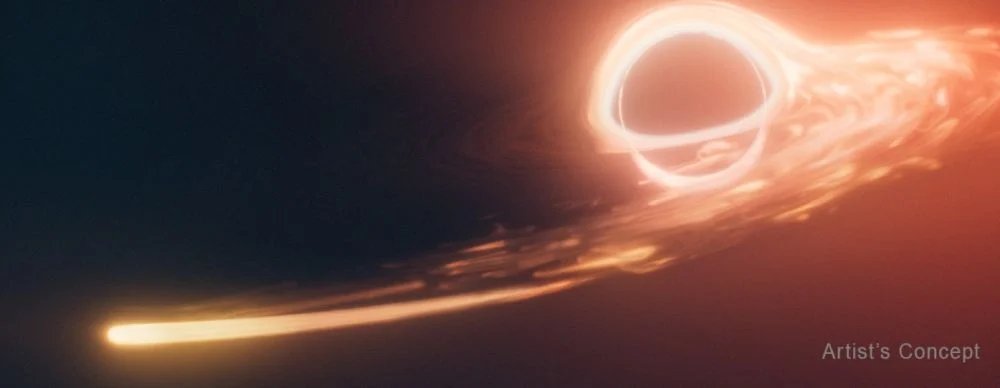
Supermassive black holes (SMBH) can be extraordinarily messy eaters. When a star comes to close, the SMBH’s overwhelming tidal force can not only suck the star in, but it stretches it out and tears it apart before it consumes it. This is actually a good thing for astrophysicists, since it makes SMBHs easier to detect.
When an SMBH tears a star apart, it’s called a tidal disruption event (TDE). Once torn from the star, the stellar material gathers in an accretion ring around the black hole, heats up, and becomes extremely luminous, sometimes outshining the SMBH’s entire galaxy for weeks. This flaring alerts astronomers to the presence of an SMBH, and can render an otherwise-invisible black hole detectable.
This isn’t all just for fun. As scientists try to understand how SMBHs become so massive, they need data, and lots of it. Not just of SMBHs in the local Universe, but from all across cosmic time. New research in The Astrophysical Journal predicts how many TDEs some of our most powerful telescopes will find.
The research is titled “Tidal Disruption Event Rates across Cosmic Time: Forecasts for LSST, Roman, and JWST and Their Constraints on the Supermassive Black Hole Mass Function.” The lead author is Mitchell Karmen, a graduate student at Johns Hopkins University.
“Measuring the mass distribution of supermassive black holes (SMBHs) over cosmic time remains particularly challenging for the low-mass population at z > 1,” Karmen and his co-authors write. “This population is also the most sensitive to SMBH seeding and early growth models.”
TDEs occur at these lower mass SMBHs in the range of about 100 thousand to 100 million solar masses or less, while more massive ones swallow stars in one gulp. TDEs are one of the only ways of detecting SMBHs in this mass range. “Tidal disruption events (TDEs) are phenomena unique to these lower-mass SMBHs,” the authors write. ”
The problem is, astrophysicists need to find more of them at more redshifts to understand how SMBHs grow. Specifically, TDEs can reveal the population of these lower-mass SMBHs at different times in the life of the cosmos. The upcoming Nancy Grace Roman Space Telescope, due to launch this summer, will help.
One of the Roman Space Telescope’s main efforts is its High-Latitude Time Domain Survey (HLTDS). It will regularly and repeatedly observe the same region of the sky. This is a tried and true method of finding astronomical transients like TDEs.
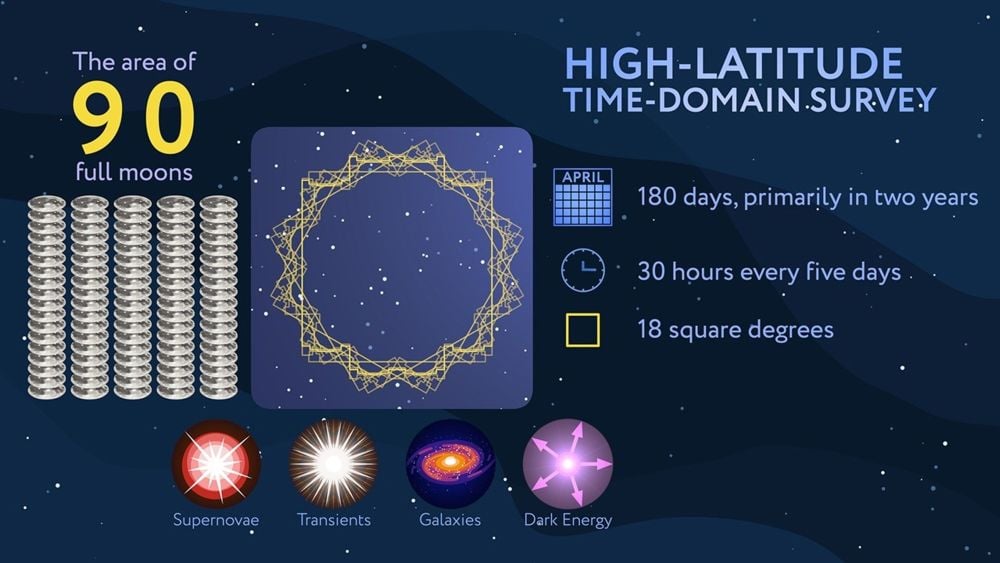 *This infographic explains the Nancy Grace Roman Space Telescope’s High-Latitude Time-Domain Survey. Among the transients it will detect are tidal disruption events, and scientists predict it will find about 100 of them per year. Image Credit: NASA’s Goddard Space Flight Center*
The rate of TDEs must change over cosmic time because SMBH masses have changed over time. Previous work shows that the number of TDEs should be smaller at greater distances, when SMBHs were not massive enough to create TDEs. In this work, the researchers dug more deeply into this issue. They built a new model of SMBHs and TDEs including factors that change over time.
“In this work, we construct a semiempirical model for the redshift evolution of the tidal disruption event (TDE) rate under multiple SMBH mass function prescriptions, and show that the observed redshift-dependent rate of TDEs is very sensitive to the SMBH mass function and its evolution with redshift,” the researchers explain. They also incorporated things that change with redshift, like increasing stellar density in galactic nuclei, a higher rate of galaxy mergers, dust obscuration, and other factors. Then they quantified how all these factors would affect the TDE rate.
Based on their model, the researchers forecast how many TDEs the Roman is likely to detect. They did the same for the Vera Rubin Observatory’s Legacy Survey of Space and Time, and for the JWST and its COSMOS-Web survey.
“We find that including these effects generally results in a volumetric TDE rate that increases with redshift until a maximum near cosmic noon, before declining at higher redshift, where SMBHs that can disrupt stars become increasingly scarce,” they write. So more TDEs will be detected the further back in time the Roman looks, peaking at Cosmic Noon.
The authors say the Rubin’s LSST will find tens of thousands of TDEs in each year of its decade-long survey. That’s impressive, but the LSST is limited in how far back it looks. The Roman is an infrared space telescope and can observe light from the ancient Universe. The authors say that the Roman will find only 100 TDEs per year, but they will be much more distant. The Roman’s detections will also be superior. “While the absolute number is smaller than in LSST, the Roman TDE sample is expected to be exceptionally clean and well characterized,” they write.
Since they’re so ancient, they SMBHs detected by the Roman will provide important information about SMBH mass at a critical time in the Universe. These observations will help astrophysicists determine which model of SMBH growth is more accurate.
The JWST isn’t likely to find many TDEs, but the ones it does find will be at extremely high-redshifts, making its contribution important.
There are basically two ways of predicting how many black holes in different mass ranges existed at different times in the Universe, either empirically or using powerful simulations. Shankar’s mass function is empirical, and uses observations of galaxies to infer the population of SMBH at different masses. Illustris TNG is a supercomputer hydrodynamical simulation that predicts black hole masses based on the evolution of factors like gas and stars over time.
This is where the Roman and its HLTDS will make a difference. “The HLTDS will sensitively probe both the normalization of the TDE redshift distribution and its shape. Therefore, the HLTDS will be a powerful discriminator between BHMF models,…” the authors write.
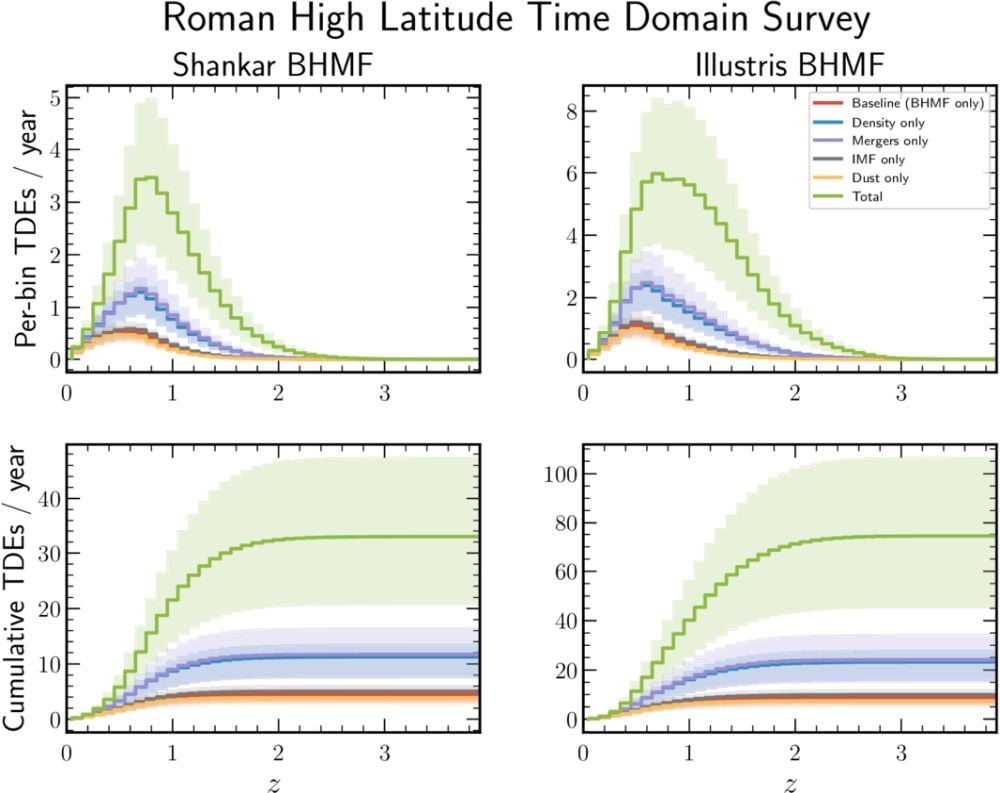 *This figure from the research shows the predicted observed TDE rates in the Roman HLTDS. Image Credit: Karmen et al. 2026. ApJ*
“Just by counting the number of TDEs as a function of redshift, you can put meaningful constraints on the population of million-solar-mass black holes,” said co-author Suvi Gezari, an associate professor of astronomy at the University of Maryland. “Roman will be transformative in that it can probe tidal disruption events out to greater distances, so you can look at how the rate of TDEs evolves over time.”
As the powerful JWST has shown, there are some extremely massive black holes in the early Universe that our theories and models struggle to account for. They couldn’t have formed this large, so they must have grown over time.
“Just like Webb has transformed our understanding of distant, high-redshift galaxies, Roman is poised to transform our understanding of high-redshift transients,” Gezari said.
There are a couple of potential explanations for these early massive black holes, and one is called “light seeds.” In this scenario, massive stars collapse into stellar mass black holes that have about 100 solar masses. Over time they merge and become larger, while also building mass by accreting gas. By this explanation, every young galaxy would have a SMBH.
The other is called “heavy seeds.” Theoretically, an SMBH up to one million solar masses could form directly from the collapse of a massive gas cloud. That would be a rarer occurrence, and SMBHs would be much less numerous in the early Universe.
“Tidal disruption events help us probe the population of light supermassive black holes, which can help us discriminate between these models,” Karmen said.
“By leveraging the complementary observations of LSST, Roman, and JWST, future TDE samples will enable population-level measurements of the evolution of the TDE rate and the SMBH mass function. This work provides a framework for interpreting those measurements and shows that TDE samples in upcoming surveys will play a central role in constraining the origin and growth of SMBHs,” the researchers conclude.