The Sky Today on Monday, July 20: Moon landing throwback
Tonight, the waxing crescent Moon will look just as it did on the night of July 20, 1969, when humans first set foot on our satellite.
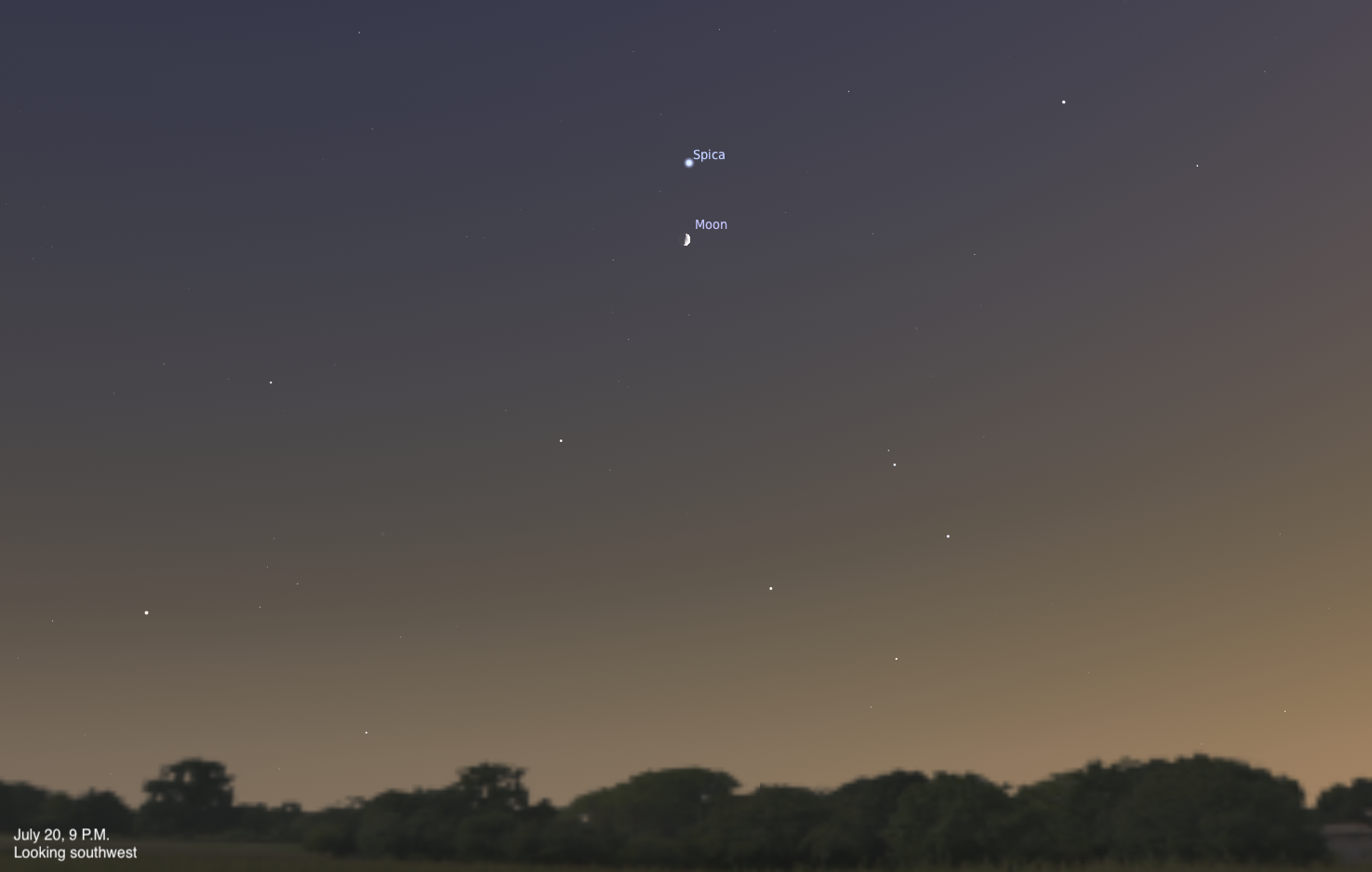
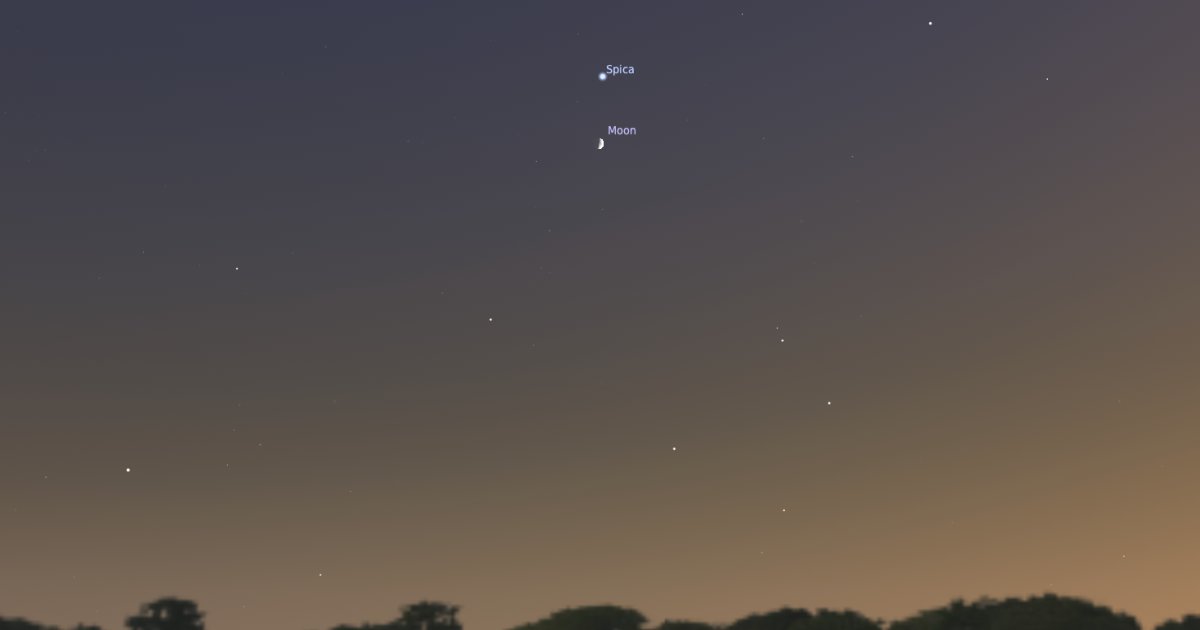
Look southwest after sunset to catch the Moon hanging beneath the bright star Spica in Virgo. The lunar phase exactly matches that as on July 20, 1969, when Neil Armstrong became the first man on the Moon. Credit: Stellarium/USGS/Celestia/Clementine
Looking for a sky event this week? Check out our full Sky This Week column.
July 19: An oval-shaped nebula
Astronomy is full of cycles, as orbits align and phases return. Tonight, a lunar cycle completes such that the nearly First Quarter Moon looks exactly — yes, exactly — the same as it did in 1969, as humans took their first step on our satellite’s surface. This is because the Moon’s phases repeat exactly on the same calendar date every 19 years, called a Metonic cycle. Today marks 57 years — or three of these cycles — since July 20, 1969, when the Eagle landed at Tranquillity Base.
Related: One small step: A look at how Apollo 11 made history
Rising shortly after noon, the Moon hangs in the post-sunset sky for hours, remaining visible until nearly midnight. Our satellite is moving through Virgo and appears to hang beneath that constellation’s brightest star, Spica, in the southwestern sky about half an hour after sunset. You have plenty of time to observe, as the Moon remains visible until shortly before local midnight.
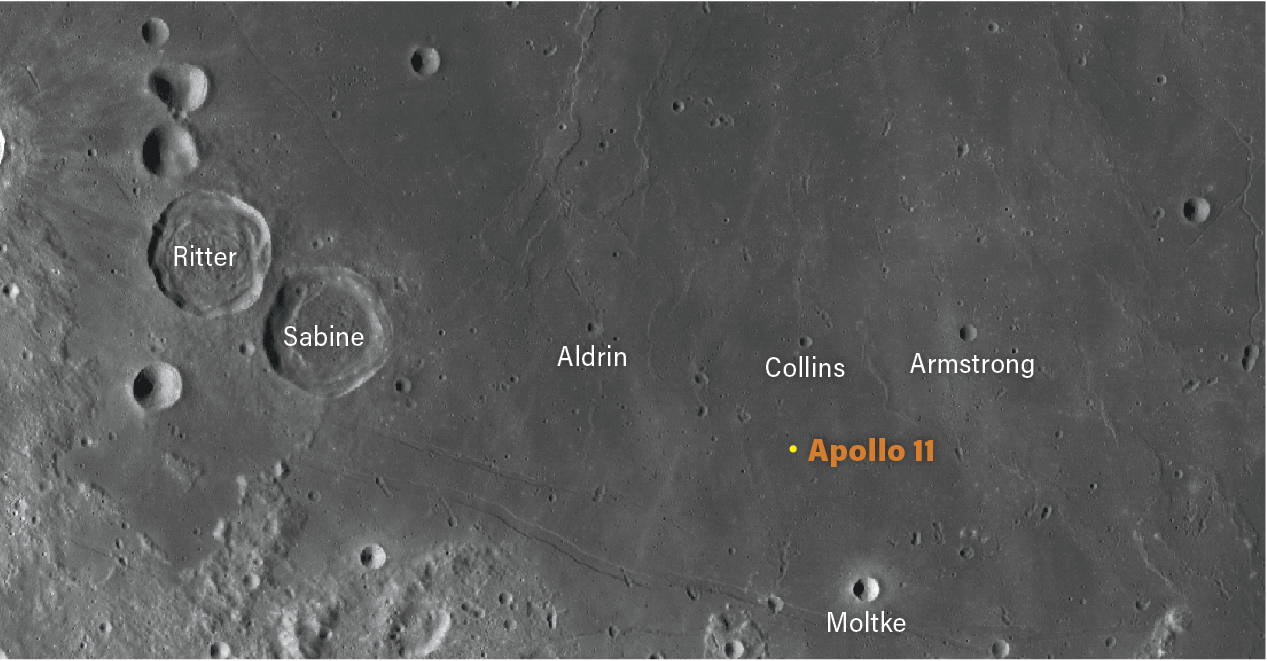
For a closer look, pull out binoculars or a telescope — with the latter, you can even search out the site where Neil Armstrong and Buzz Aldrin landed, though of course you cannot make out the actual landing site with your eyes. But to find its location, look near the center of the Moon, just to the right of the terminator (the line dividing night and day). Near the southwestern rim of Mare Tranquillitatis (the Sea of Tranquillity), you’ll find two large, shallow-floored craters: Ritter and Sabine. Just east of this pair is the Apollo 11 landing site, along with three small craters named for the mission’s crew: Aldrin, Collins, and Armstrong.
Sunrise: 5:48 A.M.
Sunset: 8:24 P.M.
Moonrise: 12:52 P.M.
Moonset: 11:44 P.M.
Moon Phase: Waxing crescent (47%)
*Times for sunrise, sunset, moonrise, and moonset are given in local time from 40° N 90° W. The Moon’s illumination is given at 10 P.M. local time from the same location.
Saturn’s largest and brightest moon is mid-8th magnitude Titan. The morning of the 21st, this moon will be easy to view through a telescope once the ringed planet rises high enough to easily catch in your optics.
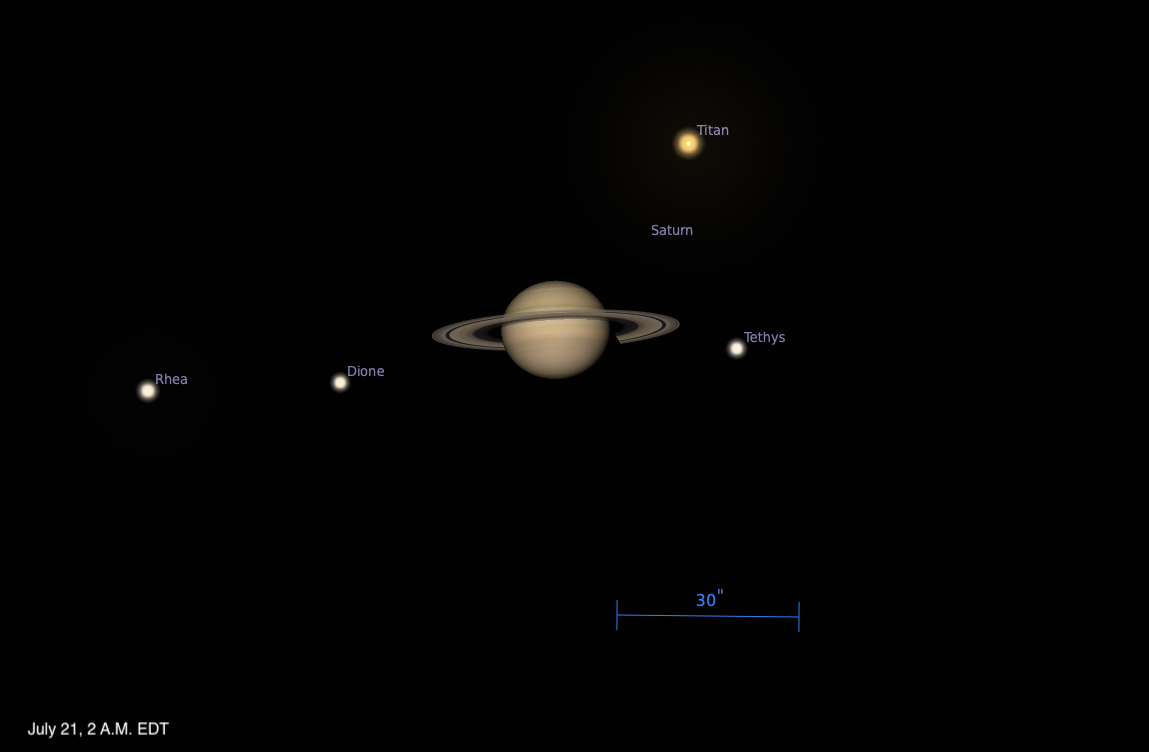
By about 2 A.M. local daylight time, Saturn has reached roughly 25° above the eastern horizon. It’s the brightest point of light here, hanging above the large figure of Cetus the Whale. Zoom in on Saturn with a telescope and you’ll easily pick up Titan, which lies just northwest of the planet this morning. It’s moving westward as the hours pass, pulling farther away from its parent world over time, but still in the same telescopic field of view.
You’ll likely see other moons as well, such as 10th-magnitude Dione, Rhea, and Tethys. The former two lie east of Saturn, but the latter is just to the west, and depending on when you look, closing in on Saturn’s southwestern limb. It won’t quite make it, though — shortly before 4:30 A.M. CDT (as the Sun is nearly rising along the East Coast), Tethys disappears into Saturn’s shadow, which also stretches southwest of the planet.
Alison Klesman is senior editor of Astronomy magazine. She holds a Ph.D. in astronomy and has studied a variety of topics, from minor planets to supermassive black holes.