Surgeons Use Teleoperated Humanoid Robots to Perform Live Surgery – a World First
What are the benefits of a humanoid robot in the operating room?
Indeed, humanoid robots could address one major issue in healthcare: access.
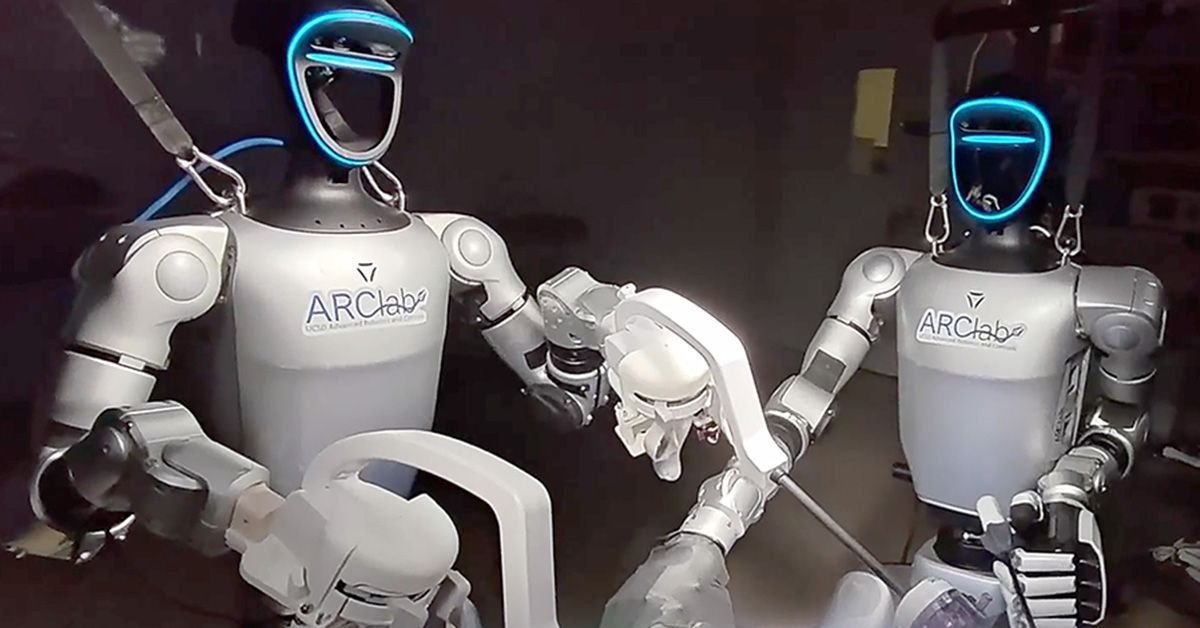
Specialized surgery systems are typically equipped with three or four robotic arms, specialized tools and proprietary software. These systems weigh about 1,800 pounds, require a large team to set up, and take up a significant footprint in operating rooms, which usually need to be retrofitted to accommodate them. By contrast, humanoid robots are mobile and more compact. The robots used in this study, nicknamed Surgie, are 5 feet tall and weigh 60 pounds. These relatively light, compact robots are especially useful in remote, under-resourced areas. Building specialized operating rooms for robotic surgical systems or finding large teams to operate a specialized piece of equipment would be prohibitively expensive in these settings, Yip said.
Unlike a typical surgical operating system, humanoid robots fit seamlessly in the operating room. Although researchers did have to build adapters to allow Surgie to hold traditional surgical tools, controlling humanoid robots also feels more natural, especially for those not trained on specialized systems, researchers said. “We were surprised at how well Surgie meshed with our workspace and workflow,” said study co-author Nikita Thareja, MD, a general surgery resident at UC San Diego School of Medicine.
A procedure performed by a teleoperated humanoid robot is just as precise as one performed with a teleoperated surgical robotic system, said Shanglei Liu, MD, an assistant professor of surgery at the UC San Diego School of Medicine, one of the paper’s senior authors, who teleoperated the robot during the study.
“It’s a fraction of the cost and it takes a fraction of the space in an operating room. So it’s easy to deploy, anywhere from rural areas, to the battlefield, and even to space,” said Liu, who is also affiliated with the Shu Chien-Gene Lay Department of Bioengineering.