“They’re all on runners’ wrists these days”… What is smart ‘edge AI’ that works without a phone?
‘edge AI’ that performs machine learning computations directly Real-time analysis of heart rate and sleep patterns Processes data without a smartphone Detects signs of falls, arrhythmia, and other abnormalities
![[Image generated by AI]](https://wimg.mk.co.kr/news/cms/202607/12/news-p.v1.20260710.5aeb6eb107b14688b409ff3409ba3993_P1.png)
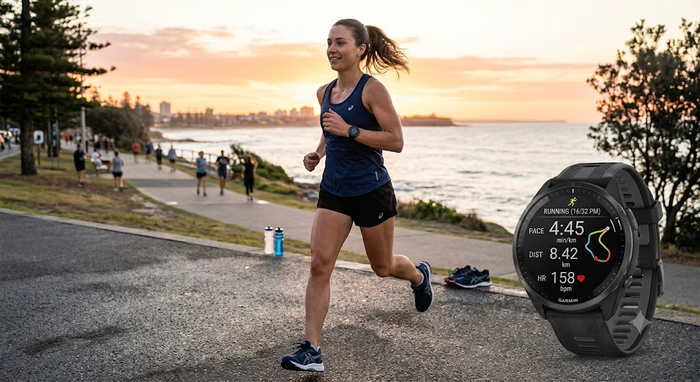
As the global running craze has recently swept the world and parks and tracks are filled with runners, the smartwatches on their wrists are becoming smarter. As edge AI technology, which performs machine learning computations directly on the device itself, is rapidly being integrated into smartwatches, observers say the era of an ‘AI coach on your wrist’ has arrived, one that can diagnose health conditions and manage pace in real time without a smartphone or Cloud connection.
According to the Global Smartwatch Shipment Tracker released on the 12th by Counterpoint Research, global shipments of edge AI-enabled smartwatches in the first quarter of 2026 jumped 70% from a year earlier. That accounts for 25% of the overall smartwatch market.
The rapid growth of the market has been driven by advances in low-power AI chips. By solving the battery drain problem that had long been the Achilles’ heel of smartwatches, these chips have made it possible to run heavy AI functions smoothly on the device itself.
Mohit Agrawal, a director at Counterpoint Research, said, “Edge AI in smartwatches has moved beyond dedicated chip adoption and into the software optimization phase,” adding that “by the end of this year, the share of edge AI adoption will expand to 32%.”
The biggest beneficiaries of this technological progress are the rapidly growing number of runners. In the past, smartwatches were limited to storing workout records or displaying screens linked to smartphones. Now, they analyze heart rate, sleep patterns, body temperature, and other data in real time to provide personalized feedback.
In particular, edge AI processes data instantly inside the device without going through a smartphone or external server. This allows it to detect warning signs such as falls or arrhythmia without delay and issue alerts. Another major advantage is stronger privacy protection, since sensitive personal health data is not exposed to the outside.
Demand for healthcare features is also surging in the market. In the first quarter of this year, shipments of smartwatches with blood pressure monitoring functions doubled from a year earlier, while products equipped with sleep apnea detection tripled. The industry is now accelerating development so that even diseases that are difficult to diagnose, such as diabetes, can be managed from the wrist.
Competition among chipset makers, which serve as the brains of smartwatches, is also heating up. Apple Inc. has already unveiled its S9 chip, equipped with a four-core neural engine dedicated to machine learning computations, while Huawei is targeting the market with its in-house KirinW80 chip and the Celia AI assistant.
This year, Qualcomm joined the counteroffensive by announcing the Snapdragon Wear Elite, which includes a dedicated neural processing unit, and Google is also expected to further strengthen AI features with its next-generation Tensor-based wearable chip.
With new operating approaches also emerging, such as Ambiq’s Apollo platform, which maximizes power efficiency by using vector cores instead of a dedicated NPU, the global tech companies’ battle for edge AI leadership to win over runners’ wrists is expected to intensify further.
An industry source said, “The era when smartwatches merely served as accessories to smartphones or devices for recording workouts is over,” adding that “as edge AI technology becomes more sophisticated, smartwatches will be able to independently function as personalized digital trainers on the wrist, updating and delivering customized training programs in real time without a smartphone.”
This article has been translated by GripLabs Mingo AI.