Top 10 humanoid robot startups to watch in 2026, ranked by total funding — TFN
Investment in humanoid robotics startups hit a new record in 2026. So far this year, startups have raised $8.6 billion, already 1.8 times more than all of 2025, even though the year is only halfway over, according to Dealroom data.
Robots are on factory floors at BMW, Amazon, Mercedes-Benz, and Hyundai. Funding is breaking records. And the companies building these machines, from San Francisco to Shanghai, Munich to London, are raising capital at a pace the venture industry has rarely seen.
Here are the 10 most funded humanoid robot startups right now, ranked by total venture funding raised.
Figure AI

Founders: Brett Adcock
Founding year: 2022
Total funding: $2.34B
Figure AI has raised about $2.34 billion and is valued at $39 billion, making it the best-funded pure-play humanoid company in the world. Its Series C closed in September 2025, bringing in just over $1 billion. Parkway Venture Capital led the round, with Brookfield, Nvidia, Intel Capital, and Salesforce also investing.
Figure is developing the Figure 02 humanoid, a 168-centimetre bipedal robot with five-fingered hands and a 20-kilogram payload. It runs on the company’s own Helix vision-language-action model. In January 2026, an update gave the robot full-body autonomy from visual input, so it could complete an eight-hour factory shift on its own.
Figure runs its own manufacturing facility, BotQ, aiming to produce 12,000 units per year. The company already has robots working at BMW’s Spartanburg plant and employs about 500 people.
NEURA Robotics

Founders: David Reger
Founding year: 2019
Total funding: $1.84B
NEURA Robotics, based in Metzingen, Germany, is Europe’s top-funded humanoid robotics company, backed by HV Capital, Primepulse, and VSquared Ventures.
The 4NE1 humanoid, co-designed with Studio F.A. Porsche, can lift up to 100 kilograms, which is a record for the sector. It uses 42 degrees of freedom, a 360-degree sensor skin, and Nvidia’s Isaac GR00T N1 model. NEURA also makes MiPA, a small quadruped, and LARA, a collaborative robot arm. All are connected through its Neuraverse software platform, shown at CES 2026.
In June 2026, NEURA closed a Series C round worth up to $1.4 billion, led by Tether, with Amazon, Nvidia, and the European Investment Bank also investing. This brought the company’s estimated value to $7 billion. NEURA plans to ship five million robots by 2030 and has about 1,200 employees.
Physical Intelligence
Founders: Adnan Esmail, Chelsea Finn, Lachy Groom, Karol Hausman, Brian Ichter, Sergey Levine, and Quan Vuong
Founding year: 2024
Total funding: $1.07B
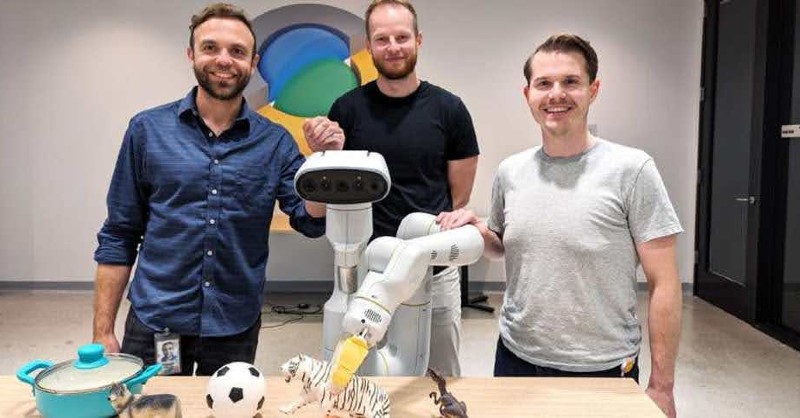
Physical Intelligence, based in San Francisco, creates AI models for use in other companies’ hardware instead of building its own robots. The company has raised about $1.1 billion, including a $600 million round in November 2025 at a $5.6 billion valuation.
Physical Intelligence is reportedly in talks to raise another $1 billion in a Series C round at a valuation of over $11 billion. Founders Fund, Lightspeed Venture Partners, and Thrive Capital are expected to take part.
Its π0 and π0.5 vision-language-action models are trained on many types of robot platforms. This lets a single model handle tasks like folding laundry or loading a dishwasher on different hardware.
Apptronik

Founders: Jeff Cardenas, Gordon Daugherty, Bill Helmsing, Nick Paine, Luis Sentis, and Bill Welch
Founding year: 2016
Total funding: $966M
Apptronik, which spun out at the University of Texas, has raised nearly $966 million and is valued at about $5.3 billion.
The Apollo robot can carry up to 25 kilograms and has hot-swappable batteries. It runs on Nvidia’s GR00T AI. Apollo is used at a Mercedes-Benz factory to handle assembly kits by teleoperation, at GXO Logistics warehouses to move pallets and scan inventory since early 2024, and at Jabil, in partnership with Google DeepMind.
Apptronik’s Series A funding grew from $350 million in February 2025 to over $935 million by February 2026. Other investors include Mercedes-Benz, Japan Post Capital, Ryder System, and John Deere. The company has about 350 employees.
Agility Robotics

Founders: Damion Shelton and Jonathan Hurst
Founding year: 2015
Total funding: $683M
Agility Robotics plans to go public by merging with Churchill Capital Corp XI. This SPAC deal values the company at about $2.5 billion and is expected to bring in over $620 million.
Agility’s Digit robot, which came out of Oregon State University, is a bipedal machine that can lift 35 to 50 pounds and work for up to 16 hours straight. The robots are trained using simulations on Amazon Web Services.
Digit robots are used in Amazon fulfilment centres and have moved over 100,000 totes at GXO Logistics. They work in nine customer facilities and have logged more than 65,000 hours of live operation. Investors include Amazon, Nvidia, and SoftBank Vision Fund 2.
AgiBot

Founders: Peng Zhihui and Deng Taihua
Founding year: 2023
Total funding: $314M
AgiBot was founded in Shanghai by former Huawei engineers and has raised about $314 million through seed, Series A, and Series B rounds. Backers include GL Ventures, Miracleplus, and Gaorong Ventures. Tencent Investment led the Series B in March 2025 at a $2.1 billion valuation, with BYD and Huafa Group also joining in.
The A2 humanoid is 169 to 175 centimetres tall, has up to 49 degrees of freedom, and can hold spoken conversations using its onboard AI. A special A2 Ultra version reportedly walked 106 kilometres on its own, setting a Guinness World Record.
AgiBot reports it shipped over 10,000 units by March 2026, has about 100 employees, and was looking to raise a Series C round as of August 2025.
Unitree Robotics

Founders: Xingxing Wang
Founding year: 2016
Total funding: $265M
Unitree offers some of the most affordable humanoid robots available. The G1 is a 127-centimetre, 35-kilogram robot that can move at 4.5 miles per hour and costs between $13,500 and $16,000. The H1 is the first full-size humanoid built in China that can run.
Unitree, founded in Hangzhou, has raised $265.36 million in venture funding. Early investors include HSG Hong Kong, AC Capital, and Source Code Capital. Later, two large Series C rounds were led by Ant Group, China Mobile, and Tencent Holdings.
In March 2026, Unitree filed to go public on the Shanghai Stock Exchange, aiming to raise about $610 million. This would make it China’s first publicly listed humanoid robotics company.
Humanoid

Founders: Artem Sokolov
Founding year: 2024
Total funding: $252M
Humanoid, founded in London, is Europe’s first pure-play humanoid unicorn. It has raised about $270 million so far, including a $152 million Series A, the largest ever for a European humanoid startup, led by Prime Movers Lab at a $1.35 billion valuation. Other investors are Aglaé Ventures, Bosch, and Schaeffler.
Humanoid’s robot uses wheels instead of legs, based on the idea that wheeled robots will reach factory floors sooner than bipedal ones. This is partly because there is no European ISO standard yet for bipedal machines in industry. The company’s KinetIQ software manages fleets of robots by combining reasoning, vision-language-action models, and whole-body control.
Partners include SAP, Nvidia, Bosch, and Siemens. The company has around 200 employees.
1X Technologies
Founders: Bernt Børnich
Founding year: 2014
Total funding: $140M
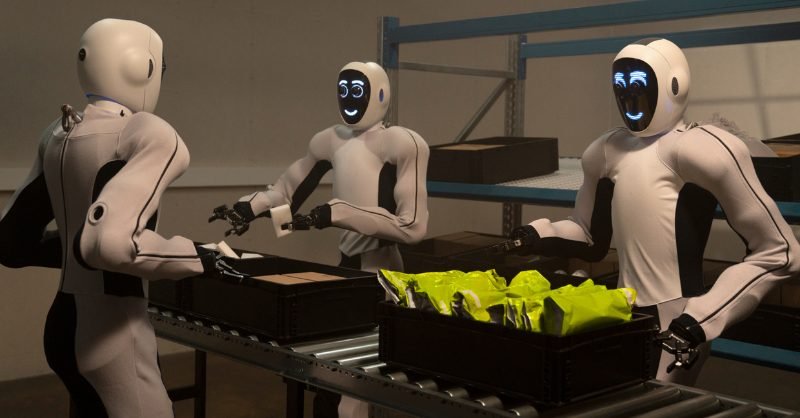
1X started in Norway as Halodi Robotics and switched to home robotics in 2022. The company, based in Moss, Norway, has raised about $143 million from investors like the OpenAI Startup Fund, EQT Ventures, and Tiger Global.
The NEO robot has 22 degrees of freedom in each hand and runs quietly at just 22 decibels. It uses Redwood AI, 1X’s generalist model, and is available to buy for $20,000 or by subscription for $499 per month.
1X received 10,000 pre-orders within five days of opening orders in late 2025. In April 2026, the company opened a 58,000-square-foot factory in Hayward, California, aiming to produce 100,000 units per year by 2027. 1X has about 200 employees.
Boston Dynamics

Founders: Marc Raibert
Founding year: 1992
Total raised: $37M
Boston Dynamics has been making legged robots since 1992, long before the current surge in humanoid robotics funding. Amanda McMaster is now interim chief executive officer and chief finance officer after Robert Playter retired in February 2026.
Hyundai bought 80% of Boston Dynamics for $880 million in 2021. In July 2026, Hyundai purchased the remaining 9.65% from SoftBank for $325 million, making it the sole owner and valuing the company at about $3.3 billion.
The Atlas robot is fully electric, has 56 degrees of freedom, and can lift up to 50 kilograms. It is set to start work at Hyundai’s Georgia EV plant in 2028, with a goal of producing 30,000 units per year. Boston Dynamics has about 1,300 employees.
This list focuses on companies with significant global market presence and English-language verified funding data. Several Chinese startups, including Galbot ($1B+) and UBTECH, may qualify by total funding but are excluded due to limited independently verified data in English-language sources