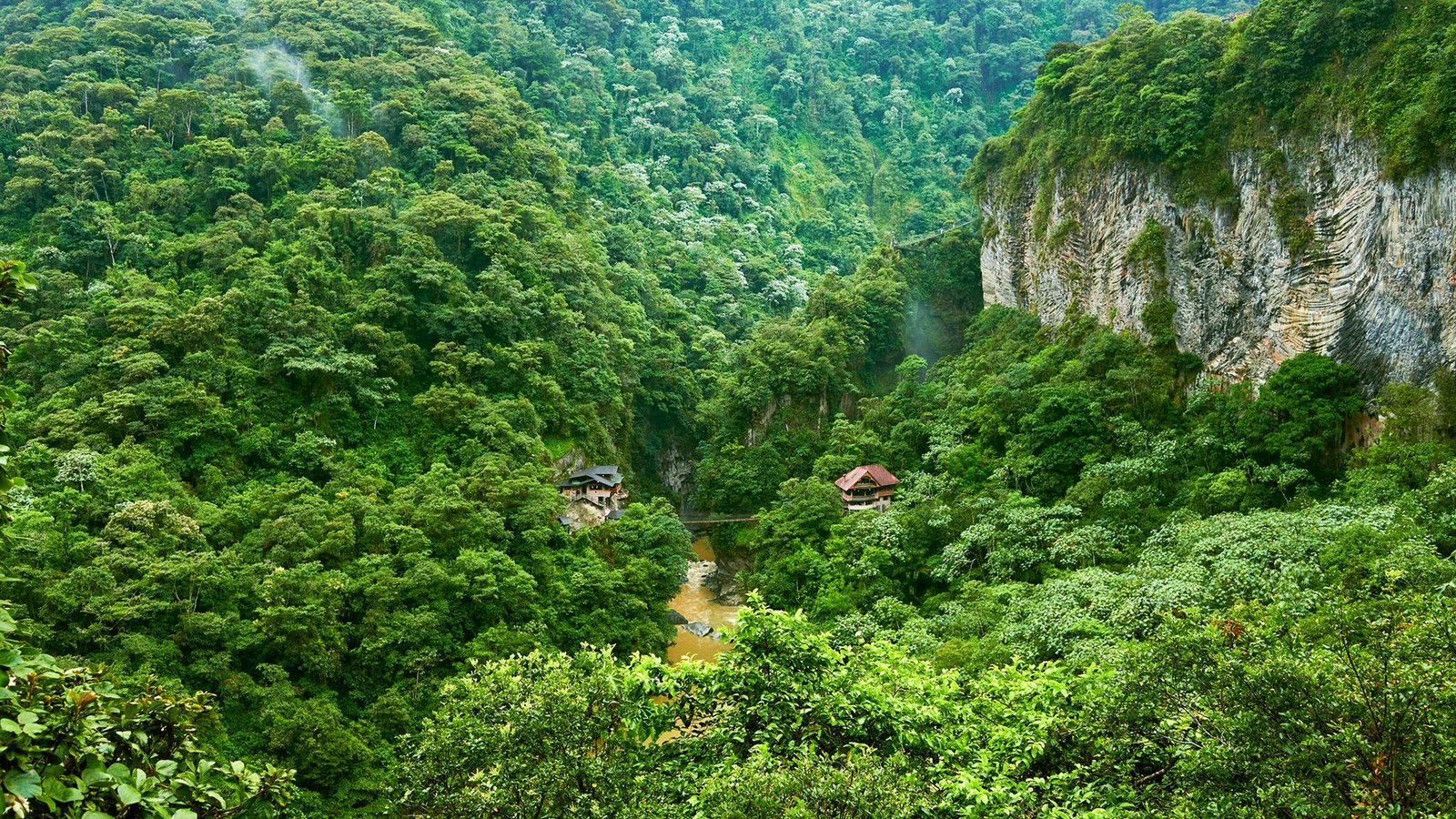
Tropical forests draw down and store large quantities of CO₂ from the atmosphere. The Amazon rainforest in South America, for example, stores approximately 123 billion tonnes of carbon — more than is stored in any other terrestrial ecosystem in the world. But these forests are facing a critical challenge.
Research from 2023, which was carried out by me and more than 100 colleagues, found that tropical forests in South America are vulnerable to climate extremes. We determined that during an El Niño event, the warm phase of a natural fluctuation in the Earth’s climate system, South American tropical forests may fail to act as a carbon sink.
This finding becomes even more alarming when we consider the increasing frequency and intensity of El Niño events. There have been twice as many “very strong” El Niños in the last 60 years as there were in the 60 years before that. And the US National Oceanic and Atmospheric Administration has recently confirmed that such an El Niño is currently underway.
Tropical forests absorb CO₂ through the process of photosynthesis and convert it into biomass. However, the balance between photosynthesis and respiration is delicate and depends on two factors: temperature and water availability.
In hotter and drier conditions, plants close the pores of their leaves to avoid water loss. But closing them effectively cuts off a plant’s fuel supply because it is through these pores they absorb CO₂. This starves plants of the carbon needed for photosynthesis and to grow.
During El Niño years, which are characterized by high temperature anomalies, prolonged climate stress leads to reduced forest growth and increased tree mortality. The effects of this are felt for decades as carbon is released back into the atmosphere when the dead trees decompose.
Our findings revealed that during the 2015-2016 El Niño, when temperatures on land were at least a degree higher on average than usual conditions, some of South America’s tropical forests effectively stopped absorbing carbon. This raises concerns about the possible impact of the current El Niño on the Amazon and global climate.
Get the world’s most fascinating discoveries delivered straight to your inbox.
A map of the Amazon River drainage basin in the middle of the Amazon rainforest.
In our research, we measured over half a million trees across six South American countries over a period of more than 30 years, using tape measures to track their growth. These trees belonged to over 4,000 different species. We used this data to calculate precise estimates of the amount of carbon stored as a forest’s aboveground biomass.
We found that the vulnerability of these forests to El Niño conditions was closely linked to their baseline climate. While we tend to assume that rainforests are all hot, wet and biodiverse ecosystems, seasonal drought is a reality for many tropical forests. Conditions in regions at the edge of the Amazon rainforest, for example, tend to be particularly hot and dry.
Our findings revealed that drier forests at the edge of the Amazon, where trees regularly endure periods of limited water availability, were especially susceptible to extreme El Niño conditions. On average, a 0.5°C increase in temperature caused these forests to lose 0.5% of their aboveground carbon.
Larger trees suffered the most. While tree mortality rates increased from 1.8% to 3% per year during the El Niño in South American tropical forests as a whole, mortality rates effectively doubled for medium (classified as over 20cm in diameter) and large trees.
The fact that larger trees with less dense wood died at much higher rates compared to small trees and those with high wood density points strongly to hydraulic failure, when intense atmospheric moisture demand snaps the tension in the tree’s internal water column rather than slow carbon starvation.
These results suggest that adaption to seasonal drought may not be sufficient to protect tropical forests from extreme events. Climate extremes are possibly already pushing forests at the edges of the Amazon beyond their capacity to adapt, causing catastrophic carbon losses.
A looming threat
Scientists have warned that 2026 may again be the warmest year on record. Heightening the alarm further is the severity of the current El Niño. Never before has an an El Niño begun when oceans are already so warm and air temperatures so high.
On top of this is the fact that, over the past three decades, the edges of the Amazon have experienced some of the highest temperatures and most rapid warming the tropics have ever seen. The structural integrity of a forest is compromised when a major climate anomaly occurs before it has recovered from recent, multi-year stress.
These compounding factors mean that we risk witnessing tree and carbon losses on scales not yet seen.
Tropical forests are invaluable assets in the fight against climate change. But South American tropical forests, a once-reliable carbon sink, are vulnerable to intensifying heat and drought. There is a risk these essential ecological allies stop acting as a carbon sink as extreme climate conditions become the norm.
Preserving tropical forests is thus essential. Their ability to continue acting as carbon sinks hinges on efforts to protect them and a collective commitment to limit global temperature rise. The Amazon’s future depends on this, and so does ours.
One of the fundamental pillars of modern cosmology may be beginning to wobble. A study published in Nature has found evidence that the universe may not behave the same way in every direction on the largest observable scales. “What we found is a network of enormous filaments and walls of galaxies that remain aligned and…
NASA’s year-long Mars mission simulation is hiring volunteers: How to apply NASA is set to embark on a year-long Mars and Moon simulation-based missions and for these missions, the space agency is actively looking for four volunteers. In the mission, the space agency will simulate challenges that astronauts could encounter during the Mars and lunar…
Physicists from the University of Jyväskylä and Aalto University in Finland have successfully created a two dimensional topological crystalline insulator, marking the first experimental realization of a quantum material that scientists had predicted for more than a decade. Until now, attempts to produce it had been held back by difficulties in developing the right materials….
Shopping Stuff that’s a little weird but so smart — starting at $5. Written by Veronika Kero Amazon We may receive a portion of sales if you purchase a product through a link in this article. Sometimes, the genius stuff that can solve a problem, take care of business, and streamline your day — may…
SMS is currently available in Australia, Belgium, Canada, France, Germany, Ireland, Italy, New Zealand, the Netherlands, Singapore, South Africa, Spain, Switzerland, the United Kingdom, and the United States. By entering your phone number and clicking the sign-up button, you agree to receive periodic text messages from MarketBeat at the phone number you submitted, including texts…
Researchers at Stanford University found that AI is also transforming scientific discovery by helping scientists to analyse complex data, generate hypotheses and formulate experiments faster than old methods. AI is entering multiple sectors, including biology, medicine, engineering, and astrophysics, to overcome limitations connected to time, resources, and data complexity. AI is also playing an increasingly…