US-built all-terrain robot smothers wildfires using liquid nitrogen
Yiannis Levendis, a professor at Northeastern University, has developed a robotic firefighting prototype that uses liquid nitrogen to rapidly extinguish wildfires without harming the environment.
Deploying autonomous or remote-controlled robots keeps human firefighters out of extreme danger, making the loss of a machine far preferable to risking lives.
It started with a stroke of scientific curiosity and a handful of shredded car tires.
Back in 2008, Levendis was experimenting in his lab, burning rubber crumbs to test alternatives to coal. On a whim, he grabbed a spoonful of liquid nitrogen and dumped it straight onto the flames.
Puff. The fire vanished. It was instant extinction.
And now that simple impulse has morphed into a potential game-changer for the world’s worsening wildfire crises: an all-terrain, tread-mounted robot engineered to march into blazing wildernesses and suffocate fires before they turn catastrophic.
Eco-friendly alternative
Wildfires are brutal. In 2025 alone, over 5.13 million acres of land were scorched across the United States — a burn footprint roughly the size of Massachusetts.
Fighting these infernos typically relies on dropping tens of thousands of gallons of water or bright-pink chemical retardants from the sky.
The problem is that water evaporates fast, and heavy chemical retardants often contain phosphorus or sodium ferrocyanide. When rain washes those chemicals into surrounding watersheds, they trigger toxic algae blooms that destroy aquatic ecosystems. Liquid nitrogen fixes this.
It turns out that fighting fire might just take a dose of deep freeze. When applied to a fire, cryogenic nitrogen rapidly expands into a gas, growing roughly 1,000 percent in volume almost instantly. This rapid expansion starves the fire of oxygen while simultaneously plunging the ambient temperature of pine needles, scrub, and dry brush down into the sub-zero zone.
Interestingly, it leaves absolutely no chemical footprint when the gas dissipates.
The delivery system
To turn cryogenic fire suppression into a practical field solution, Levendis needed a delivery mechanism that wouldn’t put human firefighters at risk.
This is where the robot comes in.
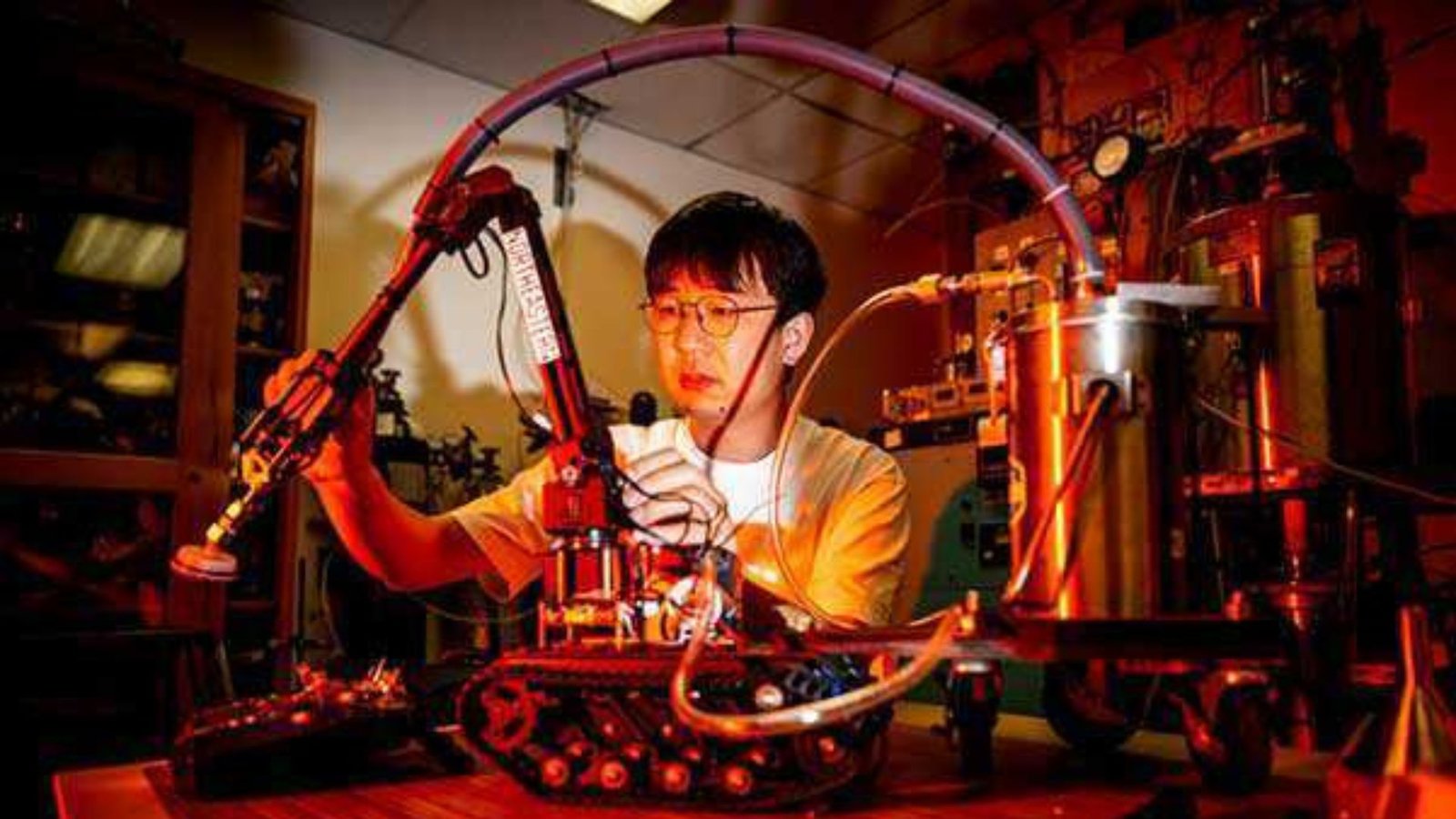
Built alongside engineering students Hayden Hishmeh and Aobo Liu with funding from the Gordon and Betty Moore Foundation, the current prototype resembles a heavy-duty trash can mounted on all-terrain caterpillar tracks, equipped with specialized cold-resistant tanks and hoses.
Unsuited for fighting massive infernos directly, the robot functions as a specialized reconnaissance unit, targeting localized hotspots with high precision.
Guided autonomously or via remote control, the robot crawls through dangerous terrain where humans can’t safely tread, dousing small hotspots and smoldering floor brush before they ignite full-blown canopy conflagrations.
“A perfect use for robots is to send them into dangerous spots. Even if we lose a robot, it’s just the cost of the machine that’s lost, not a person,” Tom Ryden, Executive Director at MassRobotics, told Northeastern Global News.
The prototype is currently undergoing rigorous testing on controlled forest fuel fires, simulating real conditions in the Western U.S. But the team isn’t stopping with small tread-bots. Levendis envisions converting full-scale firetrucks with heavy cryogenic tanks, creating a entire fleet of ultra-cold fire-suppression vehicles.