Vivo Y500 vs OnePlus N6 Comparison: Which Battery Phone Wins?
Vivo Y500 vs OnePlus N6: Two Budget Battery Phones, Two Very Different Bets
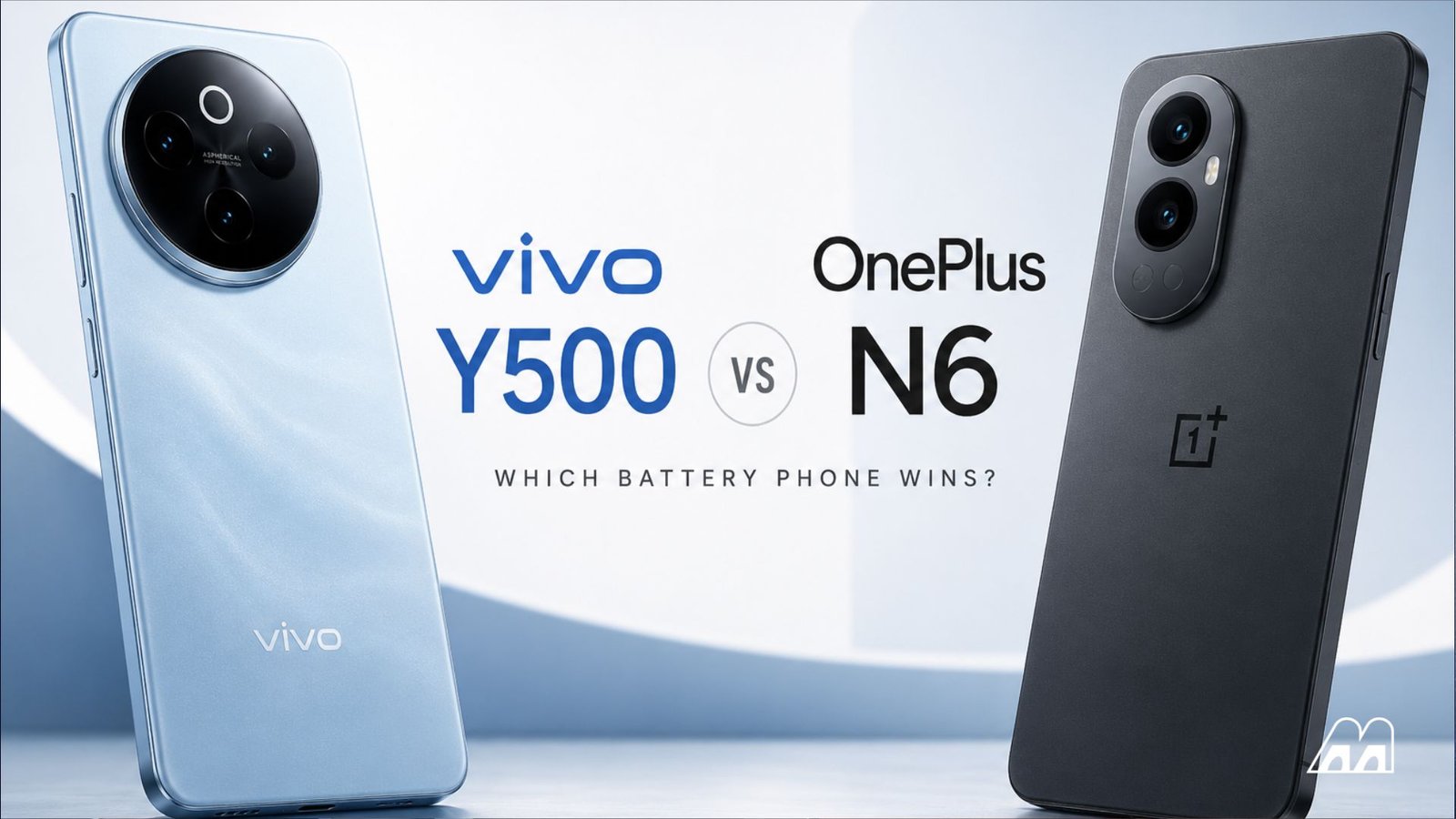
The Vivo Y500 and OnePlus N6 launched within days of each other in July 2026, both built around massive batteries that dwarf anything in the typical budget segment. The Vivo Y500 packs an 8,100mAh cell with a 1.5K AMOLED display and IP68/IP69 water resistance, priced at roughly $360 in Pakistan. The OnePlus N6 counters with an 8,000mAh battery and 5G connectivity at just $243 in India, but trades away display quality and durability to get there.
On paper, the battery difference between them is just 100mAh. In practice, these two phones represent fundamentally different philosophies about what budget buyers actually need. The Y500 spreads its value across screen, build and camera. The N6 bets almost everything on endurance and price.
Full Specs Comparison
| Spec | Vivo Y500 | OnePlus N6 |
| Display | 6.83″ AMOLED, 1260×2800 (1.5K), 120Hz, 5,000 nits | 6.8″ IPS LCD, 720×1570 (HD+), 120Hz, 1,200 nits |
| Processor | Unisoc T7300 (6nm, 4G) | MediaTek Dimensity 6360 (6nm, 5G) |
| RAM | 8GB LPDDR4X | 4GB or 6GB LPDDR4X |
| Storage | 128GB / 256GB UFS 2.2, no microSD | 128GB, microSD expansion |
| Battery | 8,100mAh, 44W charging | 8,000mAh, 45W SuperVOOC |
| Rear Camera | 50MP Sony IMX852 + 2MP | 50MP + 2MP |
| Front Camera | 32MP | 8MP |
| Durability | IP68/IP69, MIL-STD-810H | IP65, MIL-STD-810H |
| OS | Android 16, OriginOS 6 | Android 16, OxygenOS 16 |
| Weight | 215.72g, 8.40mm | 224g, 8.9mm |
| Price | PKR 99,999 (~$360) | ₹22,999 (~$243) |

Where the Vivo Y500 Wins
The display gap is the most visible difference between these phones. The Vivo Y500 uses a 6.83-inch AMOLED panel at 1.5K resolution (2800 x 1260 pixels) with a claimed 5,000-nit peak brightness and SGS sunlight readability certification. The OnePlus N6 runs an HD+ LCD at 720p with a peak of 1,200 nits. That translates to nearly 4x the brightness and roughly 3.5x the pixel count. In daily use, text will look sharper, colors will be more vivid, and the screen will remain legible in direct sunlight far more effectively on the Y500.
Durability is the second major advantage. The Y500 carries IP68 and IP69 ratings along with MIL-STD-810H military-grade shock certification. The IP69 rating means it can withstand high-pressure steam cleaning, a certification that goes well beyond casual rain or splashes. The OnePlus N6 is rated IP65, which covers basic splash resistance but nothing close to submersion. For buyers who work outdoors or in tough conditions, this gap is meaningful.
The camera hardware also favors Vivo. A 50MP Sony IMX852 main sensor with an f/1.8 aperture is paired with a 32MP selfie camera. The OnePlus N6 uses a 50MP main sensor without a named supplier and an 8MP front camera. For video calls, content creation, or any scenario where the front camera matters, the Y500 holds a clear edge.
Where the OnePlus N6 Wins
The $117 price gap is the N6’s biggest weapon. At roughly $243, it delivers an 8,000mAh battery with 45W charging, 5G connectivity, and expandable storage via microSD. The Y500 offers none of the last two features and charges slower at 44W, though the difference in charging speed is negligible.
5G support through the Dimensity 6360 is the N6’s most strategically important advantage. The Vivo Y500 runs a Unisoc T7300 that is limited to 4G LTE. In Pakistan and Nepal, where the Y500 has launched first, 4G remains the practical standard for most users. But in India, where Jio and Airtel continue expanding 5G coverage, the N6 is better positioned for the next two to three years of network evolution.
OnePlus also provides microSD expansion, which partially offsets the N6’s single 128GB storage option. The Y500 has no card slot, and its 128GB base model offers roughly 110 to 115GB after the operating system. For a phone designed to last years, that storage limitation is a consideration.
The OnePlus N6 also ships with a 5,300mm² vapor chamber cooling system and a 7-year battery health promise backed by a 1,600-cycle rating. Vivo includes a 3,000mm² vapor chamber in the Y500 but has not made a comparable longevity claim for the global model.
The Real Trade-off Behind the Price Gap
Both phones pack nearly identical battery capacity and target the same type of buyer: someone in South and Southeast Asia who charges infrequently, streams heavily, and treats battery life as a primary purchasing criterion. The $117 premium for the Vivo Y500 does not buy more battery. It buys a fundamentally better viewing experience, more robust waterproofing, and a stronger camera package.
This suggests a clear dividing line. The OnePlus N6 is built for buyers who view a smartphone primarily as a communication and battery tool, where the screen is good enough for WhatsApp, YouTube, and social media. The Vivo Y500 targets buyers who want those same battery credentials wrapped in hardware that also looks and feels like a step up from the entry level.
The gap also reflects different chipset strategies. Unisoc and MediaTek’s budget-tier Dimensity chips both target everyday tasks, but Vivo chose the T7300 with its AnTuTu score above 680,000 and redirected savings toward the display and durability stack. OnePlus chose the Dimensity 6360 for its integrated 5G modem and paired it with a simpler screen to hit a lower price floor. Neither phone is a performance device, but both are honest about what they prioritize.

What About the Redmi Note 17?
Neither phone will hold its battery crown for long. The Redmi Note 17 Pro Max is confirmed for July 2026 with a 10,000mAh battery, a 200MP camera, and 100W fast charging. That represents a 25% battery advantage over the Y500 and more than double the charging speed of both phones in this comparison.
The Redmi Note 17 series also targets the same South Asian and Southeast Asian markets. If Xiaomi prices it competitively, as the Note 15 series started at roughly $278, both the Y500 and N6 will face a credible challenger within weeks of their own launches. Vivo’s response may need to come through its broader Y-series. The Vivo X300e, which recently leaked with a 7,100mAh battery and Snapdragon 8 Gen 5 chipset, shows that Vivo is pushing large batteries across its entire portfolio, not just the budget tier.
Which One Should You Buy?
The decision between the Vivo Y500 vs OnePlus N6 comes down to three questions.
Do you need 5G? If you live in a market with expanding 5G coverage and plan to keep your phone for two to three years, the OnePlus N6’s Dimensity 6360 is the safer long-term bet. If 4G covers your needs for the foreseeable future, this factor is irrelevant.
Does screen quality matter to you? The Y500’s 1.5K AMOLED with 5,000-nit brightness is a different experience from the N6’s 720p LCD. If you watch a lot of video, game regularly, or simply prefer a sharper display, the upgrade is noticeable and worth the premium.
Is durability a priority? IP68/IP69 versus IP65 is a real gap. If you work in environments with water, dust, or physical risk, the Y500 offers meaningfully more protection.
For buyers where price is the dominant factor and battery endurance is the primary need, the OnePlus N6 delivers nearly identical battery performance at a cost that is roughly a third lower. For buyers willing to pay more for a complete mid-range package where the battery is just one piece of a stronger overall device, the Vivo Y500 justifies its premium.
FAQs
Is the Vivo Y500 available in India?
Not yet. The Vivo Y500 has launched in Pakistan, Saudi Arabia, and Kazakhstan as of July 2026. Vivo has not confirmed an India launch date, and availability in Southeast Asia also remains unannounced.
Does the Vivo Y500 support 5G?
The global Vivo Y500 does not support 5G. It uses the Unisoc T7300, which is limited to 4G LTE networks. The Chinese-market Vivo Y500 5G with a Dimensity 7300 chipset does support 5G but is not sold outside China.
How long does the OnePlus N6 battery last?
OnePlus claims up to three days of normal use. Early hands-on testing reported over 19 hours in a battery stress test. The phone also features bypass charging and a 1,600-cycle rating with a seven-year battery health promise.
Which phone has a better camera, the Vivo Y500 or OnePlus N6?
The Vivo Y500 has the edge on paper with a 50MP Sony IMX852 main sensor and a 32MP selfie camera, compared to the OnePlus N6’s unbranded 50MP main sensor and 8MP front camera. Real-world camera performance will depend on software processing, which has not been independently tested yet.