New robot can swim underwater before flying through the air like a bird | News Tech

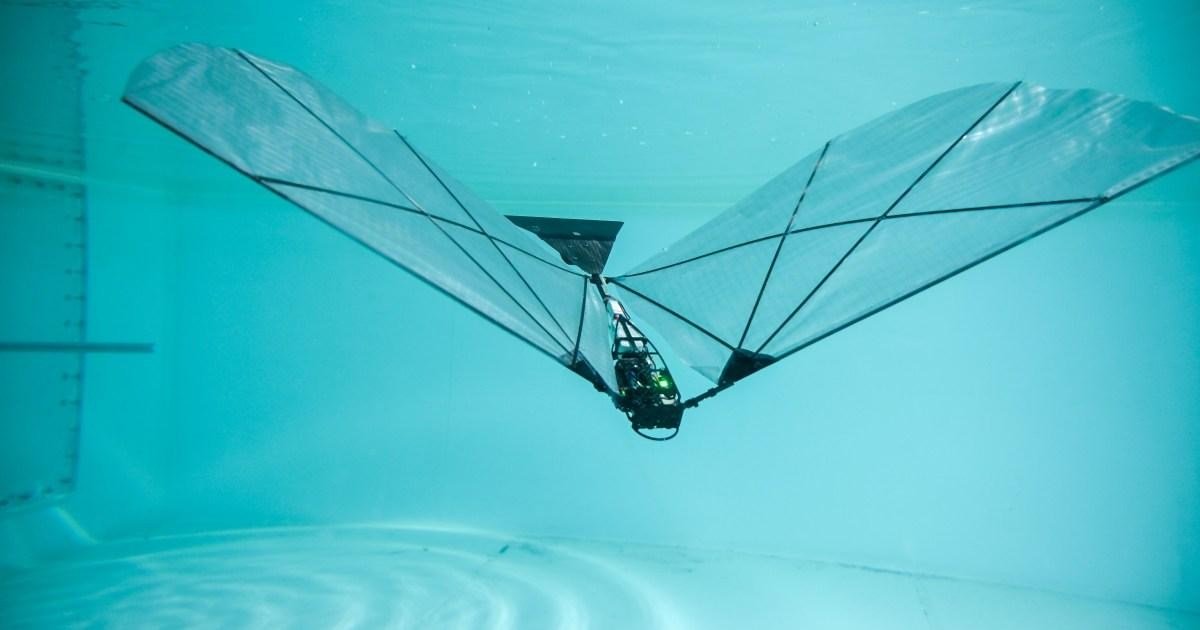
A new ultra-lightweight robot can swim underwater – before emerging to fly through the air like a bird.
The flapping-wing aerial-aquatic vehicle (FAAV), created by researchers at EPFL in Switzerland and the Massachusetts Institute of Technology (MIT), takes inspiration from diving birds including puffins, gulls, loons and petrels, which are able to both fly and swim.
The study, published in the journal Science, examined how a lightweight robot weighing less than 300g could replicate the movements of birds that dive beneath the water’s surface before returning to the air.
Researchers say the findings could improve understanding of how diving birds adapt their flight mechanics to move through two very different environments, while also informing the development of aerial-aquatic drones for scientific research.
The robot has a central fuselage, two flexible flapping wings and a steerable tail. Its wings are made from thin membranes coated with hydrophobic nanoparticles to repel water, while a waterproof electric motor drives the flapping motion.

During tests in a laboratory water tank and later in Lake Geneva, the team identified combinations of wing size, flapping frequency and tail angle that enabled the robot to swim underwater, break through the surface and continue flying.
The researchers found that wings measuring around 80cm across provided the best balance between flexibility in water and rigidity in flight.
The robot was able to swim at almost one metre per second while flapping its wings around five times a second, before flying at approximately six metres per second using a similar wingbeat frequency.

To transition from water to air, the robot had to pitch upwards at an angle of about 70 degrees to prevent its wingtips touching the surface.
Lead author Raphael Zufferey, a former EPFL researcher who is now an assistant professor of mechanical engineering at MIT, said the technology could eventually be used for environmental monitoring.
“Our dream vision is for oceanographers, marine biologists and coastal communities to launch this robot from a boat, or from shore, and it would fly close to the area of interest, such as an iceberg, a port facility or over a pod of whales,” he said.
“It would dive into the water to take a measurement or collect a sample, and fly back to deliver the data at a fraction of the cost of traditional methods. Then it could go back out to dive for more.”

Unlike many diving birds, the robot does not require feet to launch itself from the water.
“If you look at birds, most birds need to paddle their feet at the surface to take off. And the question was, do we need the same for robots? And it turns out we don’t,” Zufferey says. “No one’s been able to fly out of the water with wings.”
The research team says it is now working on improving the wing design so that the robot can also rotate its wings while flying. Future tests will examine how it performs in rough water and windy conditions before it is deployed in ocean research.
MORE: Dolly the sheep at 30: The clone that changed science (and celebrity petdom)
MORE: Blind people given fresh hope after scientific breakthrough
MORE: Boy, 11, dies of rabies 19 days after waking up with bat lying on his mouth
![Altera returns to growth as AI, robotics fuel demand], ETCIO](https://jobssz.com/wp-content/uploads/2026/07/altera-returns-to-growth-as-ai-robotics-fuel-demand-768x402.jpg)