The smartest AI models are being limited by the U.S. government, so here’s what I’m using instead
New AI models are dropping faster than most of us can even try them. Anthropic alone has been rolling out Opus 4.8, Sonnet 4.6, Haiku 4.5, and then Fable 5, and OpenAI’s GPT-5.6 Sol just went public after weeks of preview. Grok’s next version isn’t far behind either. The catch with almost all of them is they’re built by US companies, which means they now sit under US government review before they even reach us. Fable 5 got yanked globally back in June after a Commerce Department directive, and Sol’s release was gated by the same kind of process. So even when a model launches, its availability isn’t really guaranteed anymore.
That’s how I ended up spending more time in Mistral’s Vibe, which is French and runs under EU rules rather than US export controls. It’s been holding up better than I expected as a working alternative when the models I usually reach for might not always be a reliable option.
Want to stay in the loop with the latest in AI? The XDA AI Insider newsletter drops weekly with deep dives, tool recommendations, and hands-on coverage you won’t find anywhere else on the site. Subscribe by modifying your newsletter preferences!
US regulation is catching up to AI faster than anyone expected
And the pattern is repeating with every release

On June 12, 2026, Anthropic got an export control directive from the US Commerce Department, and by that evening, Fable 5 and Mythos 5 were disabled for every customer on the planet. The order technically only targeted foreign nationals, but Anthropic said it wasn’t technically feasible to filter users by nationality in real time on that kind of notice, so the only compliant move was pulling the models globally. This was three days after Fable 5’s public launch. The stated trigger was a jailbreak that reportedly let the model surface exploitable software flaws, and Anthropic pushed back, saying the same capability exists in other models.
This came off the back of a broader Trump administration push. A June 2, 2026 executive order set up a voluntary collaboration framework between AI companies and the government on frontier deployment, which is basically the mechanism that made the Anthropic directive possible in the first place. The Biden-era AI Diffusion Rule got rolled back earlier in the year too, and replaced with a “trusted partners” tiered access.
None of this is really a one-off anymore. GPT-5.6 Sol just went through its own government review before OpenAI could release it, which suggests this is the shape of things going forward rather than a temporary thing. Regulation around frontier AI probably needs to exist somewhere, I don’t really disagree with that. It’s more that the current version of it means the newest, best models are the least reliable ones to actually depend on, which is an ironic tradeoff.
This is where Mistral’s Vibe comes in
It plays by different rules
The tool I’ve been leaning into is Vibe, which was called Le Chat until Mistral rebranded it at the end of May 2026. Same URL and login as before so nothing really changed underneath, but it shifted from a standard chat box into a full-on agent workspace with dedicated “Work” and “Code” modes.
Mistral is a French company headquartered in Paris, and because it’s French, it’s not under US export control jurisdiction, and it’s also not subject to the US CLOUD Act. That second one is a bigger deal than it sounds. The CLOUD Act lets US authorities pull data from US-based companies even when that data is sitting on European servers, so a lot of the “EU hosted” claims from OpenAI or Google come with an asterisk. Mistral doesn’t have that problem because the parent company is outside US jurisdiction entirely.
Mistral is directly subject to GDPR and the EU AI Act, and all its API processing happens in EU data centers out of Paris. Vibe Pro, Team, Enterprise, and API data don’t get used to train models. Free tier conversations technically can, but you can opt out. There’s an older CNIL complaint from early 2025 about the free tier opt-out being harder to find than the Pro one, but Mistral did respond to it.
One more thing worth noting is that Mistral has always shipped open-weight models under Apache 2.0. Even in a hypothetical where the hosted service went away, the underlying tech is out there and can be self-hosted.
Mistral Vibe has more going on than the chat window suggests
And the free tier gets you more than you’d expect
The free tier is capped at around 25 messages a day on the better models, which sounds tight but hasn’t really been an issue for me because I don’t live in a chatbot all day. Pro is $15 a month, and there’s a $6 student option if you can verify an .edu address. I’ve been sticking with the free tier for now since it’s still early days (it took me months to commit to Claude Pro).
The chat side runs on Mistral’s Fast mode by default, which is a smaller model tuned for quick responses, and it holds up well for the everyday stuff. Quick lookups, summarizing something, casual back and forth, all of that. There’s a heavier reasoning option, too, when you need it, which handles more layered questions without making the wait feel ridiculous.
What I like about Vibe is its workspace features. The Memories feature is one of my favorites, and it even ships with preprompt cards on the memories page that helps you get the model to learn things about you if you don’t want to feed it manually. Instructions works like a system prompt at the account level, and then Projects lets you set instructions per space, so a project I made for design research has its own instructions that don’t bleed into everything else, for example. You can also throw docs and files into either a chat itself or into the instructions for wider reference.
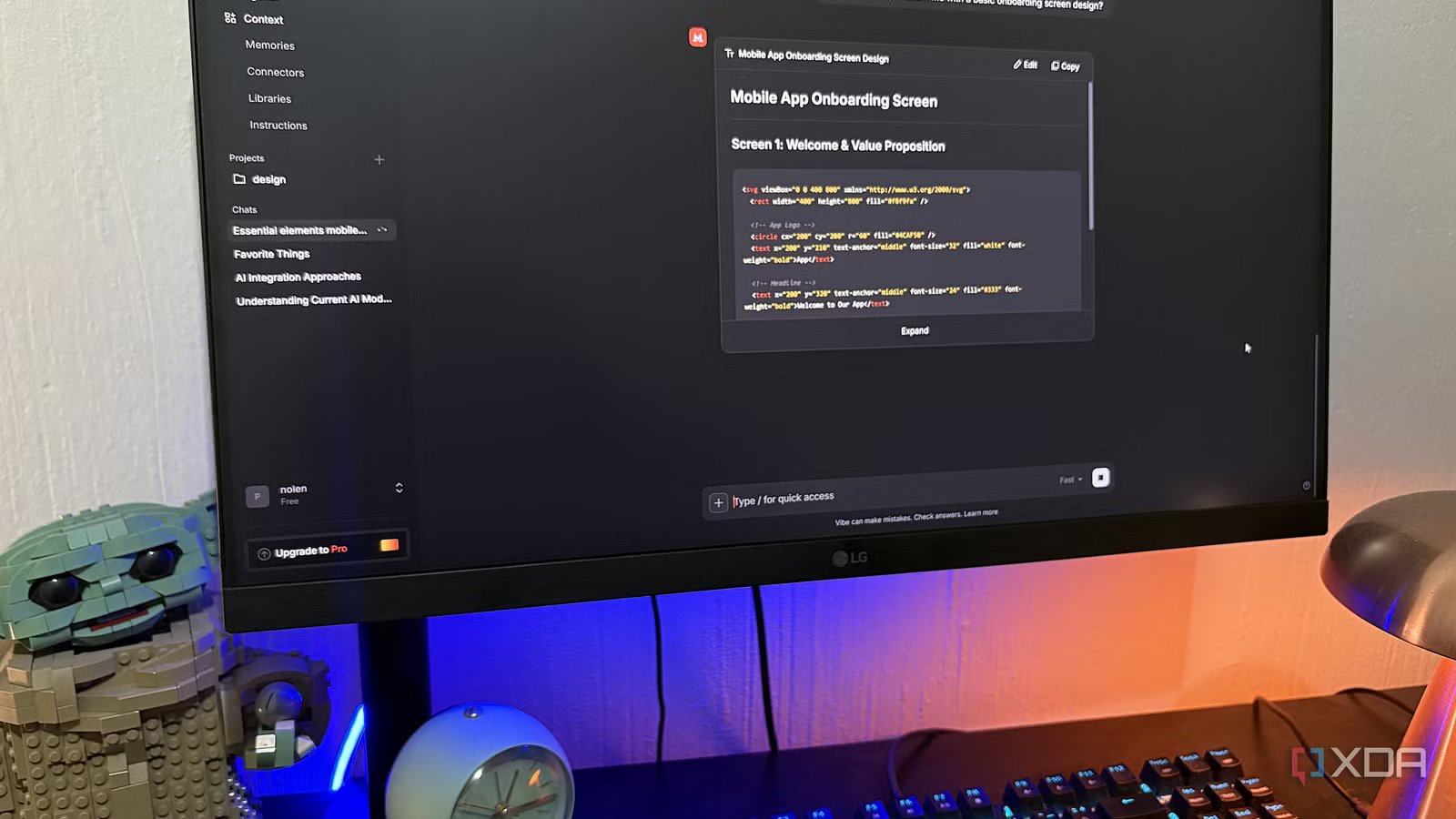
The Canvas feature is probably my favorite, naturally, since I like design and design-adjacent tools. It’s one of the many tools you can call while in a chat – you prompt it and it builds out an actual SVG prototype in a side panel, which reminds me of Claude Artifacts and Gemini Canvas but with its own take. I asked it to mock up a basic onboarding screen and it rendered a proper phone-shaped SVG with typography and CTA buttons in place. Beyond Canvas there’s also the Code Interpreter, Image Generation, and Web Search tools inside the chat panel.
There are also agents, and Agent mode comes with a few preloaded ones like Data Analyst, Personal Tutor, Global Summarizer, and Writing Assistant, or you can build your own with custom instructions. Handy for anything you find yourself doing over and over. Code mode is the other side of the platform, and it needs a GitHub connection. It runs sessions in isolated cloud sandboxes that survive a closed laptop, and it can open pull requests when it’s done with a task. There’s a VS Code extension and a CLI for it too.
It’s a nice-to-have, depending on what happens with US restrictions
The US restrictions on frontier AI don’t feel like they’re letting up any time soon, and honestly even if they did, Vibe would probably still be in my rotation because it turned out better than I expected when first going in. It’s also cheaper than the other big names if you do want to end up paying for more access. I think the value of having something outside the US regulatory pipeline goes beyond just availability though. It’s knowing that the tool you rely on isn’t one policy letter away from being switched off.